






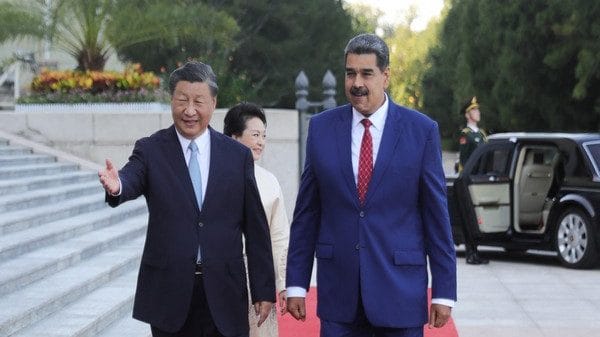



The new year had barely begun when the United States captured Venezuelan President Nicolás Maduro and his wife, an event that immediately drew global attention. In China, the operation quickly became a hotly debated topic, where commentators are widely interpreting it as a furthering of a “Trump 2.0” agenda and the revival of a “New Monroe/Donroe Doctrine”, reflecting Washington’s intent to assert strict control over the Western Hemisphere.
The Chinese narrative asserts that despite the geographic distance, the crisis carries direct implications for China’s investments, energy security, and regional influence in Latin America.
Chinese commentary has consistently framed the Western Hemisphere as the primary arena of US strategic influence. Niu Haibin, director of the Institute of Foreign Policy Studies and the Center for Latin American Studies at the Shanghai Institute of International Studies, argues that oil alone cannot explain the scale or symbolism of the US operation. Even as Maduro expressed openness to US investment in Venezuela’s oil sector, Washington opted for a military approach, signalling that the central goal was the reassertion of hegemonic control rather than securing energy access. Niu notes that US military dominance in the region, reinforced by repeated deployments since the early 2000s, reflects a long-standing mindset of treating Latin America as “private property.”
Tao Zhigang, professor of Strategy and Economics at Cheung Kong Graduate School of Business, emphasises that US concerns are ideological and geopolitical rather than economic. Washington amplifies narratives of Venezuela’s “drug problem” while remaining uneasy with socialist governments in its vicinity, as historically seen with Cuba. In Chinese analysis, the US’ ‘Western Hemisphere priority strategy’ also aims to limit China’s growing influence, making geopolitical friction an unavoidable feature of regional investment.
Power, resources, and signalling
Han Xiaopeng, a PhD scholar at the Zhou Enlai School of Government and Management at Nankai University, identifies three motives behind the US move: asserting regional dominance and warning countries such as Brazil, Colombia, and Mexico; securing control over Venezuela’s oil reserves while favouring American firms; and curbing China and Russia’s influence in Latin America. Li Yan, director of the Office of the President at the China Institutes of Contemporary International Relations, situates the “New Monroe/Donroe Doctrine” within Trump’s broader “America First” framework, linking it to US hegemonic anxiety driven by domestic populism and the rise of emerging powers.
China’s long-standing loans and investments, usually repaid through oil exports and settled in RMB, are now at risk, while US control threatens Beijing’s influence in Latin America and its Belt and Road ambitions. The move is also interpreted as a warning to regional countries against deepening cooperation with China. Analysts stress the need to safeguard investments, ensure loan repayments, and maintain normal business operations as a signal that harming China’s interests will not be tolerated.
Also read: What the world gets wrong about Venezuela’s Left–Right divide
Implications for China
Chinese commentary contrasts China’s self-image as a constructive, development-oriented partner with the US portrayal of a coercive hegemon. Observers note that China has supported Venezuela’s oil sector through equipment assistance, project development, and debt restructuring, easing key bottlenecks. Yet, despite these efforts, Venezuela’s oil industry has struggled to recover, a difficulty attributed to US sanctions.
Energy security is central: around 85 per cent of Venezuelan oil exports go to China, which make up roughly 4 per cent of Beijing’s total oil imports. Commentators warn that US control could undermine China’s long-term strategy of diversifying energy sources. Beyond energy, US attempts to weaken China–Latin America economic ties face structural limits: the US lacks the manufacturing capacity to replace China’s demand for strategic minerals. Chinese firms emphasise sustainable development and local processing, enabling Latin American countries to capture greater value along the supply chain, strengthening long-term cooperation.
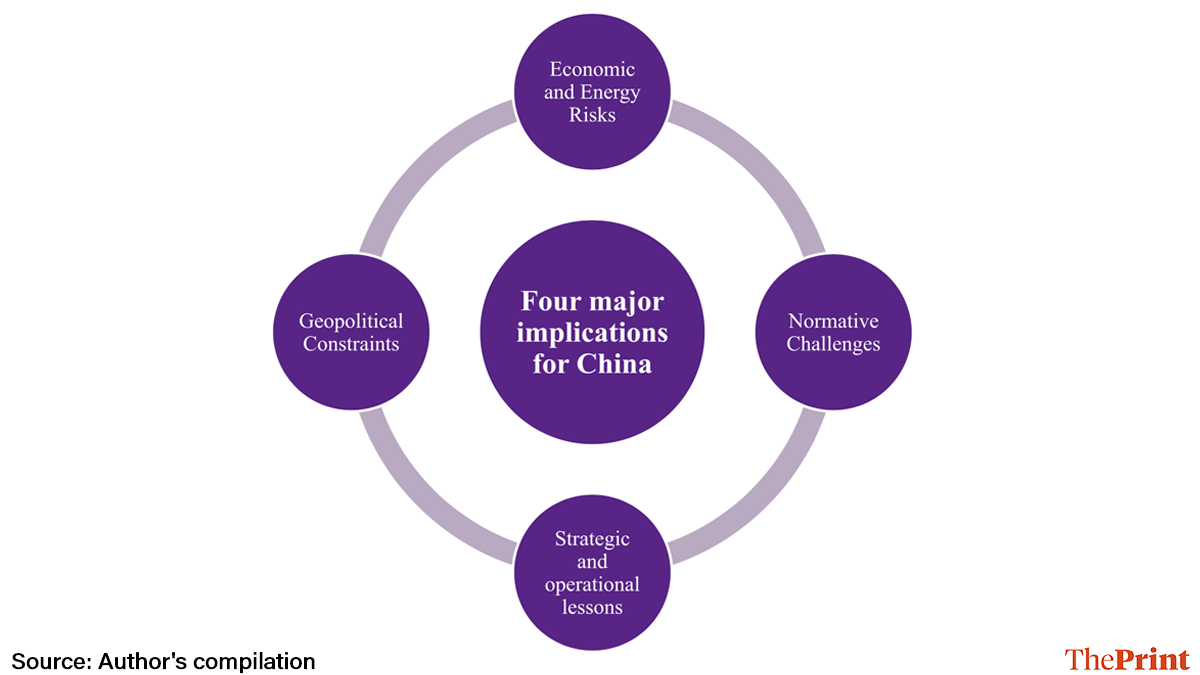
Bridging social commentary and academic analysis, a coherent Chinese narrative emerges: the US raid on Venezuela presents intertwined economic, geopolitical, diplomatic, and strategic challenges, calling for protective measures, adaptive policies, and forward-looking strategies to safeguard China’s interests.
Economically, Chinese investments, loans, and oil imports face disruption, while the RMB-settled oil trade, a cornerstone of China’s energy diversification in Latin America, could be undermined. Geopolitically, US dominance limits China’s influence, complicates Belt and Road initiatives, and raises the risk of regional pushback. Diplomatically, unilateral sanctions and long-arm jurisdiction weaken multilateral norms and challenge China’s overseas operations. Strategically, the crisis underscores that moral restraint alone is insufficient, highlighting the need for credible deterrence, stronger military capabilities, and resilient corporate strategies in sensitive sectors such as oil, telecommunications, and strategic minerals.
Chinese observers are also assessing whether the US show of military power in Venezuela is intended as a deterrence signal to the People’s Liberation Army, given that Venezuela uses Chinese weapons. A Baijiahao commentator noted that China’s defence systems remain stable and reliable, and that US operations rely heavily on long-established intelligence networks, highlighting that advanced US equipment is not omnipotent.
Also read: A 2-hour op, precise extradition—what Maduro’s capture tells us about modern US military
Options for China
Chinese commentators note that the crisis will impact China across multiple dimensions: personnel security, geopolitical posture, diplomatic principles, energy security, and economic interests. Tao Zhigang argues that China should prioritise engagement with countries farther from US influence and more economically and politically autonomous, focusing on sustainable development, job creation, and supply-chain upgradation, rather than using Latin America as a transit base for exports to the US.
Chinese social media highlights further strategic considerations. One Zhihu post observed that China’s “engineering + equipment export + credit support” model is vulnerable in critical moments, with the Maduro incident exposing structural challenges to its overseas strategy. Another noted that the new Venezuelan government may review contracts with Chinese firms, potentially limiting opportunities in strategic sectors such as oil and telecommunications. Stable reconstruction, however, could allow Chinese companies to remain competitive in engineering and technical projects, while future cooperation may shift to non-sensitive sectors like agriculture and mining.
Discussion also extends beyond Venezuela. Some posts linked the US raid to broader global challenges, questioning the resilience of international law and highlighting Chinese perceptions that US hegemonic behaviour threatens the rules-based order, presenting both challenges and opportunities for China’s strategic positioning.
Some Chinese commentary invoked Taiwan, considering whether Beijing could adopt a comparable approach. The US military’s operation in Venezuela is seen as evidence that American hegemony may be overstretched, creating what some describe as an opportune window for China to “address cross-strait issues” while limiting US intervention. Many Chinese commentators, however, emphasise that unlike Venezuela, Taiwan is regarded as a domestic matter.
A Baijiahao commentator cautioned that equating “capturing Maduro” with potential actions in Taiwan or framing the Taiwan and Ukraine issues similarly is misleading. Nevertheless, the commentator suggested lessons drawn from Venezuela: the episode should be viewed in Taiwan as exposing the limitations of the “American-style democratic umbrella” and that the US’ likely future strategy may focus less on direct defence and more on hollowing out Taiwan’s capabilities while exporting outdated weaponry.
In Chinese discourse, the Venezuelan crisis is less about Venezuela itself and more about a lens to examine China’s vulnerabilities, protect its investments and energy interests, counter US influence, and consolidate its strategic role in Latin America and the broader multipolar world.
Sana Hashmi is a fellow at the Taiwan-Asia Exchange Foundation. She tweets @sanahashmi1. Views are personal.