






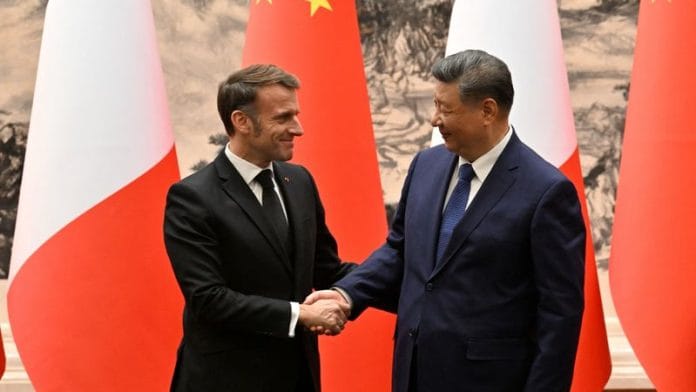



Chinese assessments portray 2025 as a relatively successful year for China’s diplomacy. High-level European engagement, renewed discussion of a G2 by United States President Donald Trump, and easing tensions with India are framed as evidence that China has capitalised on geopolitical uncertainty and Western disarray. This discourse offers insight into how Beijing both judges its diplomatic gains and signals continuity, confidence, and growing international appeal at a time of global flux.
One commentator on Baijiahao characterised 2025 as a year defined by five historic moments in Chinese diplomacy: the stabilisation and forward movement of China-US relations; the arrival of what is described as “China’s moment” in global governance; China’s unswerving defence of national sovereignty; the elevation of the concept of a community with a shared future for mankind; and the claim that China is now more popular globally than the West.
This interpretation is echoed in academic discourse. Gao Fei, Vice President of China Foreign Affairs University, along with another scholar He Gang, argue that China’s diplomacy in 2025 focused on stabilising a turbulent world, safeguarding core national interests, reshaping global governance structures, and advancing a vision of shared development and common prosperity.
Together, these narratives positioned China as both a defender of international order and a reform-oriented actor intent on recalibrating existing institutions.
Asia-Pacific and major-country diplomacy
Chinese discourse also underscores 2025 as a year dominated by “Asia-Pacific” diplomacy and engagement with major powers. For Beijing, Washington remains the central variable in its foreign policy calculus, alongside the broader regional environment that China continues to describe as the Asia-Pacific, rejecting the strategic framing embedded in the Indo-Pacific concept.
Xu Liping, a researcher at the Institute of Asia-Pacific and Global Strategy at the Chinese Academy of Social Sciences, reiterated that neighbouring countries remain the priority direction of China’s overall diplomatic strategy. According to Xu, deepening political mutual trust and integrating interests with neighbouring states are essential for maintaining regional peace and stability, while also injecting momentum into global development.
Wu Xinbo, dean of the Institute of International Studies at Fudan University, described 2025 as a year with multiple highlights in “major-country diplomacy with Chinese characteristics”. He emphasised that China consistently promoted development cooperation, peace, and win-win outcomes, reinforcing its preferred image as a non-disruptive rising power rather than a revisionist challenger.
At the same time, Chinese analysts pushed back against Western interpretations of closer China-US engagement. Zhao Long, Deputy Director and Researcher at the Shanghai Institutes of International Studies, argued that the idea of a “G2” or shared hegemony fundamentally contradicts China’s value orientation and strategic expectations. Within Chinese discourse, China does not seek joint leadership with the US but rather recognition as an autonomous and a stronger pole within an increasingly multipolar international order.
The year also witnessed heightened discussion around the so-called 80th anniversary of “the victory in the World Anti-Fascist War”. Within China, this historical moment reinforced nationalist narratives, particularly in relation to Japan. Anti-Japan sentiment intensified following the coming to power of Sanae Takaichi and her remarks linking a Taiwan contingency to Japan’s own existential security. These developments were widely framed as further justification for China’s firm stance on sovereignty and historical memory.
Taking advantage of US uncertainty
A recurring theme in Chinese assessments is the perception that China has been able to capitalise on uncertainty generated by US’ foreign policy. Zhao Long noted that Trump’s return to office coincided with visible fractures in US–Europe relations, while China-EU ties showed tentative signs of warming. In this context, China is portrayed in Chinese discourse as a comparatively predictable and reliable partner.
Diao Daming, Professor at Renmin University’s School of International Studies, argued that Trump’s second term and his more unrestrained “America First” approach present both risks and opportunities for China. He contended that Beijing should adopt a more proactive and coordinating international role, not only stabilising its own strategic trajectory but also guiding the international community along what Chinese discourse describes as the correct historical path of development.
Beyond major power relations, bilateral engagement across all regions and leadership in the Global South were also highlighted as a stabilising feature of China’s diplomacy in 2025. This reinforces the narrative that China’s external strategy is layered and diversified, rather than overly dependent on any single relationship or axis.
Also read: 2025 was good for Turkey’s defence industry. Indian analysts don’t see the threat
Outlook for 2026
Looking ahead, Chinese analysts largely anticipate continuity rather than disruption, at least for China. Lu Zhe, Chief Economist at Soochow Securities, contended that Trump’s foreign policy will continue to prioritise transactional and interest-based diplomacy. Trump is expected to push for conflict resolution in key hotspots such as Russia-Ukraine and the Middle East through limited direct intervention. At the same time, his emphasis on “peace through strength” implies continued reliance on economic and military pressure, including tougher sanctions, which could heighten geopolitical frictions and weigh on global risk appetite.
Yan Xuetong, Honorary Dean at Tsinghua University’s Institute of International Relations, argued that shifts in the international order are driven primarily by major power policy choices rather than structural forces, a trend he expects to continue in 2026. He anticipates a less turbulent year than 2025 as Trump’s presidency has now brought greater predictability with other powers adapting to US policy behaviour. At the same time, Yan foresees weaker global governance, deeper deglobalisation, and ongoing politicisation of economic issues, though with more manageable effects due to better preparation.
Yan also predicts a narrowing power gap between China and the US and a more favourable external environment for China, with improved relations with most neighbours except Japan. US containment is expected to persist, with strategic competition increasingly concentrated in digital technology and continued efforts to avoid direct military escalation.
Overall, Chinese foreign policy discourse suggests that Beijing is unlikely to alter course in 2026. Instead, China is expected to pursue a dual-track approach: maintaining firmness on sovereignty and security issues while deepening engagement with multilateral institutions and the Global South, primarily by taking advantage of the perceived US vacuum in several regions. Rather than signalling a shift in direction, Chinese commentary points to further institutionalisation of existing initiatives and a continued emphasis on major-country diplomacy.
Sana Hashmi is a fellow at the Taiwan-Asia Exchange Foundation. She tweets @sanahashmi1. Views are personal.
(Edited by Aamaan Alam Khan)
China is also benefiting from the missteps of the Trump administration. Dialogue from Shahenshah : Aap taash khel rahe ho, aur saamne wala Joker phaink deta hai.