






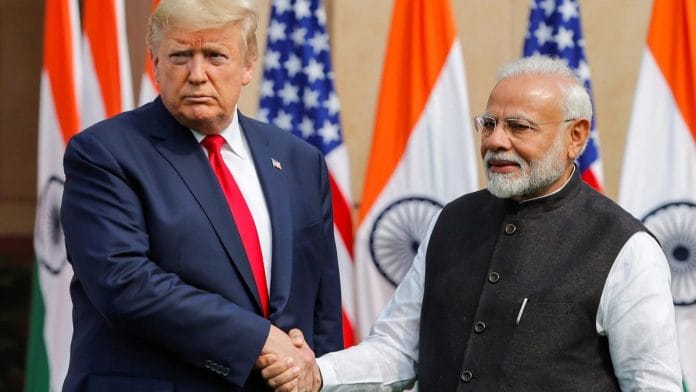



Close on the heels of the “Mother of all deals”, the India-EU FTA agreement, US President Donald Trump announced, through Truth Social, that the US had reached a “trade deal” with India. He informed the world that the deal would reduce the reciprocal tariffs on India from 25 per cent to 18 per cent. Trump’s change of heart is not out of love and affection for India, its people or the PM. It appears to be purely business—a decision guided by political and economic survival instinct.
What is surprising is that Trump said that this decision was made as per Indian Prime Minister Narendra Modi’s “request” and was born out of his “friendship and respect” for Modi. According to Trump, India agreed to stop buying Russian oil and buy “much more” from the United States and “potentially” buy oil from Venezuela. Another claim that Trump has made in his post is that India had agreed to eliminate all existing tariff and non-tariff barriers and buy American goods worth more than $500 billion across several sectors, including energy, technology, and coal. New Delhi is yet to agree with all these claims, but in principle, the trade deal is done, as the commerce minister confirmed that the two countries would sign a deal “shortly”.
But the finer details of a structured trade deal are yet to be ironed out, and one can only hope that Trump does not change his mind when the work is in progress. Unlike trade deals with other countries, the India-US trade deal appears to be a tripartite negotiation between the Indian and US negotiators and Trump. While India sees the trade deal as another avenue of commercial negotiation for greater business engagement with the world’s largest economy, Trump views it as an instrument of geopolitical realignment, strategic positioning of America in the changing conflict situation and a statecraft weaponisation mechanism.
There are several reasons for Trump to announce a trade deal with India almost as suddenly as he announced tariffs and sanctions. The India-EU FTA, Canada’s tough stance at Davos invoking ‘Middle Powers’ to unite against the unfavourable situation created by Trump and his ‘Greenland demand’, and internal turmoil in China following the purge in the PLA are only some of the reasons. US trade policy has fundamentally changed under Trump, who no longer talks the language of free trade. His obsession today seems to be China-Russia’s energy and defence partnership and the EU’s inability to stand with America on geopolitical issues. American industry and economy need insurance against these pinpricks and a risk-resilient supply chain, besides trusted partners in critical sectors.
For India, these American compulsions create a rare alignment of interests. A trade deal should explicitly position India as a China-plus-one manufacturing base for US firms in areas such as electronics and semiconductor assembly, testing, and packaging, pharmaceuticals and medical devices, defence components and dual-use technologies, clean energy hardware, and EV supply chains.
The challenge for India in negotiating a trade deal with America, with Trump intervening at every stage of changing geopolitical dynamics, is that Washington is able to shift goal posts often and drive a hard bargain, leaving India tied up in tariff issues.
Also read: Nuances, complexities & sore points of India-US trade deal sealed by Trump & Modi
The deal beyond trade
India and the US are already large trading partners, with bilateral trade crossing $190 billion. Yet the relationship remains superficial, transactional, and vulnerable to the political mood swings of one person in Washington. A hastily negotiated trade agreement focused only on selective tariff cuts, dispute settlement, or symbolic market access may award short-term progress, but it will do very little to re-position India’s structural trade architecture to integrate with the global economy.
Several commentators have been looking at the India-US trade deal mainly from the tariff prism, which limits India’s approach merely to trade. As the world’s largest economy and consumer market, which fuelled China’s manufacturing sector, the US economy has the potential to put Indian manufacturing back on the rails and generate employment. Increased business with the US, coupled with more trade with the European Union, will facilitate the integration of India’s manufacturing sector with global production networks, supply and value chain mechanisms.
While the US wants India to increase its buying from the US to the tune of about $500 billion, it will be crucial for Indian negotiators to make the US commit to market access, long-term procurement guarantees from US buyers and introduce concessions in financial regulations. The US cannot look at India merely as a procurement station, like China, without guaranteeing investments and technology transfer in core manufacturing sectors, including IT and defence co-development production and access to advanced and dual-use technologies.
The present punishing visa rules, restrictive employment regime and discriminatory immigration system are not the circumstances that will facilitate bilateral trade. A return to normal travel, employment and business environment between the two democracies and free economies is a precondition to a robust trade outcome.
One of the objectives of the trade deal should be to facilitate entrepreneurship and job creation by increasing focus on sectors where India has both a comparative advantage and a need for policy intervention. Sectors like textiles, apparel, leather goods and footwear, gems and jewellery, auto components and light engineering require at least partial restoration of preferential access, similar to the old Generalised System of Preferences (GSP), so as to yield employment gains far exceeding most of the present domestic incentive schemes.
For India, the ultimate objective of a successful India–US trade deal lies not in just ‘earning a few dollars more’ or boosting year-over-year (YoY) export statistics. It lies in placing India firmly in the global economic architecture along with the world’s most powerful strategic and security coalition and economic conglomerates, even as globalisation is fragmenting and multipolarity is gaining importance in an emerging new world order.
Seshadri Chari is the former editor of ‘Organiser’. He tweets @seshadrichari. Views are personal.
(Edited by Theres Sudeep)
Also, socialist India which is allergic to free trade can back of the deal anytime.