






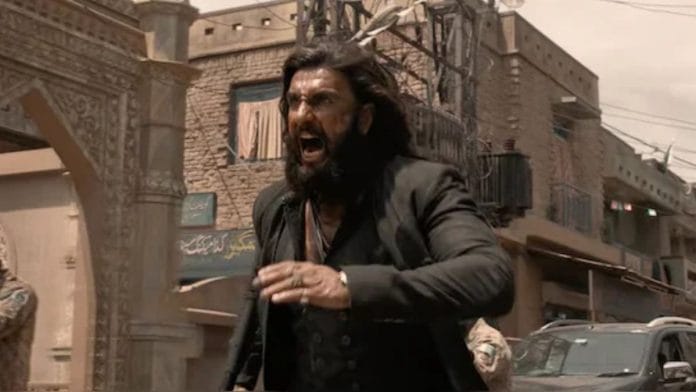



An early scene in Dhurandhar: The Revenge presages a kind of revisionism present throughout the film.
The Intelligence Bureau chief Ajay Sanyal, played by R Madhavan, attempts to enlist a broken Jaskirat Singh Rangi, a death-row convict who has been handpicked and spirited out of jail. Jaskirat only wants the release of an anonymous death, but Sanyal counters that sentiment with a rousing Sikh prayer. “Sura so pehchaniye, jo lade deen ke het / Purja purja kat mare, kabhoo na chhade khet,” Sanyal exhorts. Loosely translated, the lines mean that a true spiritual warrior is one who fights for the rights of the oppressed and does not abandon the battlefield, even when his body is demolished part by part.
It’s a beautiful, stirring call to courage that several TV shows and films have deployed, but perhaps its best use is in the National Award-winning Tamas (1988). Govind Nihalani’s devastating film, also set in Pakistan but during India’s Partition, lies on the opposite end of the ideological spectrum from Dhurandhar. If a congregation chants “jo lade deen ke het” right before plunging to their deaths in Tamas, Dhurandhar uses it to justify the murderous rampage it’s about to embark on.
And just like that, a prayer, shorn of its original context and meaning to hold your ground in times of adversity, is conscripted in the service of propaganda.
Dhurandhar repeats this exercise with its soundtrack, setting a wide-ranging playlist of bangers from the ’80s and ’90s as no-context background music for high-speed chases, suicide missions, and newer, more depraved ways of stripping bodies for parts. But it does it most sloppily to rehabilitate one of the most painful eras in India’s economic life: Demonetisation.
In Dhurandhar: The Revenge, the 2016 demonetisation is rebranded Operation Green Leaf. In the film’s telling, Pakistani intelligence and underworld operatives—including a fictionalised Dawood Ibrahim—have funnelled Rs 60,000 crore in counterfeit notes into India, specifically to buy the Uttar Pradesh elections. The Prime Minister’s televised address from 8 November 2016 is lifted wholesale and inserted into the film. This masterstroke, the film proposes, was merely the public face of a covert military strike.
It is an audacious retcon. But it only works if you don’t remember what actually happened.
Also read: Dhurandhar 2 album is very Punjabi. There are no item songs
Extraordinary manipulation
Dhurandhar 2 is untroubled by what followed demonetisation. Facts are for pesky liberals—and documentaries. The minor suffering of ordinary Indians is a small price to pay when a war is being fought around them, above them, and entirely without their knowledge: The nation is collateral in its own rescue. Dhurandhar 2 asks: What greater honour is there?
This extraordinary manipulation works like a charm when you depict the Kandahar hijack or the 26/11 attacks. Both these incidents are seared into public memory, but for the majority of Indians, there is no personal connection with these cataclysmic events. The same is not true for demonetisation.
Like millions of Indians, I watched that speech in the office of the online magazine I used to edit. (To this day, anytime there is an announcement of an 8 pm address by the PM, I begin palpitating.) Within minutes, our office emptied out—everyone from the management to the office helpers hotfooted it to the nearest ATM. On the walk back home through Bandra—one of Mumbai’s more expensive postcodes and a neighbourhood that is constitutionally incapable of being quiet—panic and paranoia were writ large on every face in an ATM queue. If this were Bandra, you could only imagine what was happening everywhere else.
But you didn’t have to imagine for long. The days that followed produced stories and images that refuse to leave. The elderly man crying helplessly at the bank. The daily wage workers tricked by their employers with advance wages in denotified currency. The farmers who couldn’t buy seed for the rabi crop. The single mother who burnt the notes she couldn’t exchange in time. The blind beggar who had saved Rs 65,000 over 20 years in notes that were rendered worthless.
The Centre for Monitoring Indian Economy estimated the cost to the economy at Rs 1.28 lakh crore in the first 50 days alone. But can that figure account for the scale of human suffering?
Every year, 8 November comes and goes without ceremony. From a government that counts—remarkably—even India’s tortuous path through Covid among its achievements, there are no anniversary addresses, no choreographed celebration of a masterstroke. Three years ago, Congress spokesperson Supriya Shrinate said as much during a TV debate: “If the BJP did think of this as a victory and a masterstroke, then they would have mentioned demonetisation when they celebrate their anniversary of being in power. But not once has demonetisation been mentioned, much like ‘achhe din’.”
That’s partly because the numbers make silence the only dignified option. The RBI’s own annual report said that 99.3 per cent of the demonetised currency returned to the banking system. Black money hoarders, whoever they might have been, survived. I imagine they all now have a foot in Goa, diversifying into real estate.
Also read: Dhurandhar shows Bollywood has a new box office mix—controversy, nationalism & spectacle
Jute bags of cash
There is an image so embedded in the Indian imagination that it has become shorthand for corruption itself: Jute sacks full of black money, stuffed under the bed or into the mattress. Bolstered by Bollywood, this image appears in raid coverage, in political speeches and anti-corruption campaigns. It is so powerful, so legible, that the consensus for demonetisation was built on it. In his 8 November address, the Prime Minister had asked: “Which honest citizen would not be pained by reports of crores worth of currency notes stashed under the beds of government officers? Or by reports of cash found in gunny bags?”
The problem is that this picture is incomplete. Black money in India is not primarily held in cash. It lives in land, in second houses, in gold, in overseas shell companies, in the instruments of political finance that would flourish in demonetisation’s wake.
Arun Kumar, whose 2018 book Demonetization and the Black Economy is a rigorous, forensic account of the policy, notes that the unorganised sector—which accounts for 45 per cent of the Indian GDP, employs the bulk of our workforce, and runs almost entirely on cash—nearly collapsed.
Yet, this is an image that refuses to vacate the public consciousness for good reason. In March 2025, eight years after demonetisation was meant to break the back of black money hoarders, firefighters responding to a blaze at the Delhi residence of High Court Judge Justice Yashwant Varma reportedly spotted jute sacks full of cash in the outhouse. Justice Varma would go on to label them “stationery and court papers”, but also a conspiracy hatched against him.
Also read: Dhurandhar is modern day Mahabharata. Dharma, debt, destruction
A bait and switch
Dhurandhar 2’s plot rests on the specific claim that Pakistani counterfeit notes were flooding India’s financial system. It is worth knowing that counterfeit currency accounted for approximately 0.025 per cent of total circulation in 2016. The entire fictional emergency of the film is constructed around an amount that could be a rounding error. In a more self-aware film, this might have been a punchline.
Alongside counterfeit currency, the shifting goalposts of demonetisation also included the spectre of terror financing, which the film references. To which we can only say, the attacks on India since then are a matter of record, whether they occurred in Amarnath (2017), or Pulwama (2019) or Pahalgam (2025) or Delhi (2025).
What the policy did generate, with some efficiency, was new avenues for black money. Arun Kumar documents how the rich deployed the poor as money mules, running old notes through Jan Dhan accounts opened for the purpose. Shell companies and hawala networks moved and legitimised funds.
If there is any justice in this, it is small: The sequel has alienated the very viewers the first film so carefully reeled in. The first part cannily hooked them by deeply embedding its characters and storyline in Lyari. Its super-slick action and textured world-building yielded an entertainer that even liberal viewers allowed themselves to be seduced by. But the sequel has pulled the rug.
Together, Liberal and Right-wing viewers have arrived at the same realisation – that the world they were so willingly inside was simply a vehicle for laundering government policy all along. So you find everyone talking about how the acting is extraordinary, the music so well-sampled, and the action sequences breathtaking. Because that’s about the only thing you can say about a film that has pulled off a bait-and-switch.
The audacity, at least, is eye-opening. For nine years, the government’s silence on demonetisation was its smartest move. Dhurandhar 2 has one-shotted that silence by reminding an entire country of exactly what was done to them. The nation is, once again, collateral in its own rescue.
Karanjeet Kaur is a journalist, former editor of Arré, and a partner at TWO Design. She tweets @Kaju_Katri. Views are personal.
(Edited by Theres Sudeep)