









In September 2024, a copywriter at The House of Abhinandan Lodha probably parsed through potential headlines, arrived at Delhi, Rulers of India, Now Conquer Goa, and said to themselves: “Yes! This will kill.”
Whatever your feelings about the line might be, you have to respect the unfettered directness of its vision. The real estate industry typically trades in softer notes, like “curated living” or “your own piece of paradise”. But the writer who dreamt up “conquer” must have grown weary of euphemisms. Here was a chance to say exactly what the pitch demanded, unfettered by niceties.
The people of Goa, though, were considerably less appreciative. The state’s Home Department issued the company a formal notice that labelled the ad “highly objectionable and obnoxious”, and said that it had hurt the sentiments of Goan people. They also ordered it withdrawn immediately. The company complied, made the right regretful noises, and then went back to business as usual.
Still, the ad offered a cross-section of a sentiment that has existed in Goa for a while now. Dilliwalas — and by extension, Mumbaikars, Bengalureans (?), and distinguished professional elites and businessfolk from across the country — have planted their flags in the state. There is a fairly reliable grammar to the Dilliwala or Bombaywalla house in Goa. It is not difficult to read, once you know what you are looking at.
The dead giveaway are the names of such villa complexes, or gated enclaves that are now fondly called “villaments” — the square footage of an apartment, with the accoutrements of a standalone bungalow. These names are aspirational across the country, but in Goa, they acquire a special pallor that appeals to the well-travelled. Every other neighbourhood, which might have had a modest “God’s Gift Apartments” now features a “Verde” or “Hacienda” or a “Casa Del Something”. The professional elite might make a beeline for the “Global One”s, but the dynasts will still flock to a “Tudor House”. Even standalone bungalows now bear suitably cosmopolitan names like “Umbra”.
‘Portuguese aesthetic’
Before you see these houses owned by Delhi or Bombay folks, you might hear them. Residents of Moira and Nachinola, for instance, have been driven up the wall by the constant, low hum of what everyone suspects are 24/7 generators that are necessary to power life at the pace of a city in a village.
There is the high compound wall, often painted baby blue, pastel green, or a Pantone Colour of the Year from the last decade. This serious, load-bearing declaration of intent will likely be topped with iron spikes, electric fencing, and bouquets of CCTVs around the perimeter. Beyond it, you can see very little, which is kind of the point. A professional landscaper will have ensured that what little is visible — the fronds of a manicured palm, the reflection of an infinity pool — looks effortless. It is anything but.
These are firmly at odds with the low, laterite walls of the neighbouring houses, and are meant to have the opposite effect. The balcao, a feature once meant to invite conversation, if it exists, is inside the compound facing the pool and defeating its purpose.
And then there is the car — maybe, a full fleet. They will be large, German, and almost certainly registered in Puducherry, where vehicle tax rates subsidise the aspirations of people who live nowhere near the Union Territory.
But it’s not really a house if it hasn’t featured in at least one of the several lifestyle and design magazines or YouTube channels. What might we see in the glimpses we are allowed to catch? “Tactile grain” unpolished cement floors? Neutral, monochromatic walls? A reclaimed wood dining table? And somewhere, a profusion of terracotta pots? It will be breathlessly misidentified as a “Portuguese house”.
Ayaz Basrai, co-founder of The Busride Design Studio and a close observer of what is happening to Goa’s built landscape, is somewhat tart on the subject. There is no such thing as Portuguese architecture in Goa, he points out. The label is largely an invention by brokers. “I grew up in Bandra, in a squat three-storey pink building called ‘Mon Bijou’, so I totally understand the misplaced low-hanging fruit of the ‘Portuguese’ aesthetic,” Basrai told me.
“It’s a low budget way of feeling you’re on vacation in Europe, on a domestic ticket price. Goa has always had a general atmosphere of assimilating the intangibles of a ‘happy place’ for the entire Indian subcontinent.”
But nothing like the Portuguese home has ever existed. “They’re Goan Homes. Equally magical, equally responsive, equally Goan.”
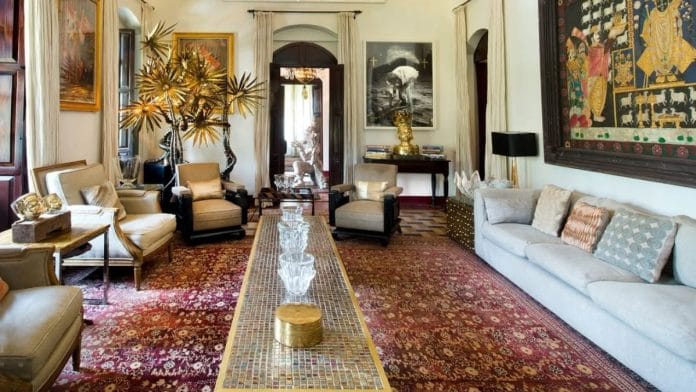
Every once in a while, the quiet luxury restraint favoured by the “outsider” owners of modern Goan homes, is punctuated by grand maximalism, and will get the full lifestyle media treatment. The Moira home of fashion designers Abu Jani and Sandeep Khosla has been covered, at this point, with the kind of reverence typically reserved for places of worship. It is, by any measure, an extraordinary house. I’ve read so many descriptions of the spiritual iconography and the bespoke dining table inlaid with recycled DVDs that I feel like I know it like my own house.
That home feels like the crown of what a successful escape from the city must look like. Fernando Velho, an architect and professor at CEPT University, Ahmedabad who has watched this transformation unfold over decades, references a term for this reimagination of Goa — a “pleasure periphery”, far away from the “metropolitan mindset”.
“In the 1990s and early 2000s, the state created the perfect conditions in Goa, to absorb surplus capital from the cities,” he told me. “You start to see the rise of casinos, the tourism economy, the promotion of an elite Catholic lifestyle. This image is constructed through books and festivals like IFFI and the Fontainhas Festival. Goa was pitched as a Europeanised lifestyle in a second home.” It absolutely peaked during Covid when houses in the villages of Saligao, Aldona, and Moira got bought. A rumour went that in the early 2000s, so many land parcels were sold that a reputed national bank in these villages had to bring in a senior manager to handle the inflow of cash.
No coverage of such houses lingers on the village itself, which serves only as atmosphere. You won’t read about the land struggles currently unfolding in Goa in a design and lifestyle magazine.
Also read: Goa’s Moira now houses a Rs 105 crore villa. New settlers are still trying to fit in
Paranoia
In the last weeks of February, thousands of Goans have taken to the streets. They have participated in sleep-in protests and hunger strikes at the Town and Country Planning office, marched through Panaji, walking all the way to the residence of TCP Minister Vishwajit Rane to demand the repeal of Section 39A of the TCP Act. Introduced in 2024, the section allows the Chief Town Planner to rezone individual land parcels — converting orchards, hill slopes, and ecologically sensitive no-development zones into “settlement” land where construction is permitted. This benefits large housing projects, builder lobbies, and hotels.
The contentious section has been scrutinised and criticised for months, but things began to reach a fever pitch earlier this year. Now that the resentment has spilled into the streets, the Chief Minister suggested that demonstrating outside a minister’s home was inappropriate. The protestors responded to that by holding a mock funeral for Rane.
But the metropolitan migration — of classes and capital — continues, undeterred by its own consequences. Velho points out that these modernist constructions are not built in any vernacular style, form, or typology, but they mimic certain elements which are “pasted upon” these villas. “Within the walls of a neo-colonial Goan Catholic villa, you find an open kitchen, a living area that opens into a pool, a balcao that is never used,” he said. “That’s a reflection of the type of person who is now buying in Goa, who wants to distinguish themselves from the masses.”
Yet, wherever you go, there you are.
The elites might have tried escaping the city, but have ended up materially recreating it. So many Goan neighbourhoods are now indistinguishable from GK-II or Bandra.
In a completely different context, novelist Amitav Ghosh spoke of Goa’s cosmopolitanism in 2011. “The cosmopolitanism of New York, for instance, is often a kind of provincialism, for it assumes that its existence is proved by the mere fact of having a variety of cuisines at its disposal. Similarly, it is perfectly possible to travel very widely and yet remain completely provincial: European colonial officials made a practice of this in the 19th and 20th centuries; World Bank functionaries excel at it today.” To this list, one might add the modern Goa homeowner who transplants a part of the city and all its paranoias onto a different landscape.
Basrai said that insularity “is more psychological than it is architectural”. “When someone arrives without ever engaging with the local language, village customs, or community rituals, a certain paranoia sets in,” he said. “And paranoia has a very clear material vocabulary like high walls, opaque gates, guard rooms, and random stone cladding. It’s anyone’s guess how comfortable one truly feels in a Grade-A high security prison — even if you designed it yourself.”
That’s the entire difference between living in a place and consuming it. Outside the villa, the village continues. It intends, despite everything, to go on.
This article is part of the Goa Life series, which explores the new and the old of Goan culture.
Karanjeet Kaur is a journalist, former editor of Arré, and a partner at TWO Design. She tweets @Kaju_Katri. Views are personal.
(Edited by Aamaan Alam Khan)
LOL!
Even the Portugese in Portugal have moved on and don’t have ‘Portugese’ houses any more.
Break the shackles of colonial mindset, Karanjeet.