






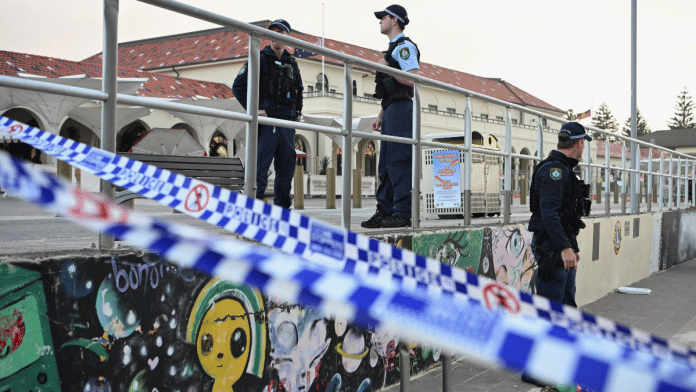



The pre-Christmas and New Year terror attack at Australia’s Bondi beach was reportedly pre-planned and may have had international links, with an ulterior motive to cause greater harm. The attackers, 50-year-old Sajid Akram originally from Hyderabad and his 24-year-old son, fired randomly at a Jewish group celebrating the Hanukkah festival, killing 15. While the father was killed by local police, his son has emerged from a coma and has been charged with 59 offences, including murder, terrorism, and possession of IEDs and flags of a banned terror outfit.
The attack shows that the threat of radical Islamic terrorism emanating from the now-downsized ISIS and other affiliated outfits remains a major threat to the West and for democracies such as India in Asia.
The fact that the attackers were able to gather such a large quantity of IEDs, reach a vantage spot on the beach, and go on a killing spree for more than half an hour reveals serious lapses in the security apparatus. It’s more troubling given that the highly crowded Bondi Beach and Bondi Junction areas in Sydney have witnessed mass killings before. In April 2024, a 40-year-old man stabbed six people to death and injured a dozen others at the Westfield Bondi Junction shopping centre. Two days later, in another stabbing incident, a 15-year-old wounded Assyrian Bishop Mar Mari Emmanuel and a priest, an attack that was classified as terrorism.
There have been reports of increasing attacks on Jewish targets, along with heightened threats, amid what Australian Jewish leaders describe as a surge in antisemitic incidents. Just weeks before last year’s Hanukkah celebrations, a synagogue in Melbourne was firebombed. That incident followed the vandalism of another synagogue in the same city, arson attacks in a Jewish neighbourhood, and an attack on a kosher deli in Sydney, among other incidents. In March 2024, a van was found in a nearby suburb packed with explosives, along with a list of Jewish targets.
Incidents of arson and vandalism continued into 2025. In August, Australia expelled Iran’s ambassador after Tehran was accused of plotting additional attacks. About two weeks ago, the Executive Council of Australian Jewry reported that antisemitic incidents in the country were nearly five times higher than the annual averages recorded before the 7 October 2023 attacks launched by Hamas fighters on Israel.
Against the backdrop of these incidents and recurring attacks on soft targets across the West and Asia, Australian security authorities should have been more alert and spruced up their counter-terrorism mechanisms. The ISIS flag and IEDs found in the vehicle of the terrorist duo signify links to the outfit and possibly to sleeper cells in Australia. Australian security agencies not only need to put their own house in order but also share intelligence with New Delhi and other friendly countries to build a stronger counter-terrorism front.
Also read: Dr Umar Nabi has shattered a popular misconception about terrorism
Lessons for India
Terror attacks anywhere in the world need to be closely monitored by Indian agencies, with lessons drawn to strengthen preventive measures rather than relying on damage control after the fact. The Bondi Beach attack holds several lessons for India, which has long been a victim of terrorism. India’s counter-terror focus must expand beyond organised modules to include individual radicalisation, mental health-linked violence, and seemingly spontaneous attacks in public spaces such as malls, railway stations, temples, beaches, and festivals.
Bondi Beach is an open, iconic public space known for frequently hosting cultural and religious events. India has many similar locations that host such gatherings throughout the year. These spaces are highly vulnerable and easy targets, allowing terrorist modules to attract maximum global publicity — one of the main objectives of terror outfits, which seek legitimacy and attention through violence.
It is high time India developed a national security doctrine that lays down standard operating procedures, including smart AI-based surveillance systems, profiling of suspicious individuals and groups, quick–response mechanisms, and other counter-terrorism measures that are strong enough to act as deterrents without creating panic, suspicion, or fear among citizens.
The Bondi Beach terror attack, like many such attacks in the past, indicates that future terrorism may be highly localised, conceal international linkages, be driven by radicalised religious ideology, feed on polarised political environments, and target vulnerable public spaces to cause maximum casualties. There is no single-window solution to this threat. What is needed is a combination of smart counter-terrorism strategies, effective public education, citizen involvement, responsible political cooperation, and broad social consensus.
Seshadri Chari is the former editor of ‘Organiser’. He tweets @seshadrichari. Views are personal.
One cannot target individual radicalistion in this climate of “political correctedness”. Law enforcement hounds people who show the mirror long before such events happen. Politicians let it happen. Still people do not have the guts to call out rampant extremism in a particular community. Everybody is intelligent enough to understand that bad apples exist in every community but when too many exist undet the guise of one radical ideology , people need to call it out, governments need to have the guts to spell it out and law enforcement the honesty to deal with a spade as spade. All the esoteric concepts of freedom of practising faith when such places become breeding grounds for extremism under the patronage of false religious heads should be dealt sternly . Until the forget about getting rid of this problem. In fact, it will only increase till we keep beating around the bush.