



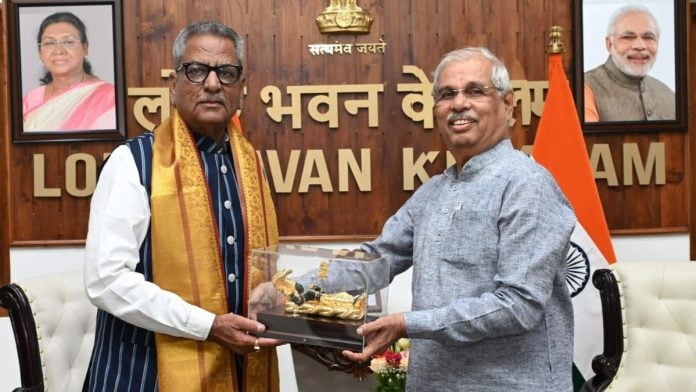
In truth, this is a controversy that deserves to last only as long as the news cycle that produced it. But involving as it does the governor of a state, an influential Congress leader regarded as Rahul Gandhi’s ‘Man Friday’, and the politically charged subject of food, it fetches a spot on this column’s menu.
KC Venugopal, Alappuzha Congress MP and AICC general secretary, has hauled Kerala Governor Om Prakash Mathur over the coals for enforcing a strict vegetarian policy in the Lok Bhavan kitchen. The governor was accused of infringing on individual freedoms by restricting the food habits of Keralites.
This was in keeping with “the unconstitutional interests of the Sangh Parivar” and “the first step toward implementing the saffron agenda…in Keralam,” Venugopal said, stirring the pot even more vigorously. Kerala’s Home Minister Ramesh Chennithala and CPI (M) state secretary MV Govindan chimed in with similar criticism, adding fuel to the fire.
Venugopal pointed out that people of Keralam have diverse food habits. The vast majority of the population consumes fish and meat in this largely non-vegetarian state. Estimates of the percentage of strict vegetarians vary, but even those on the higher side place them in the single digits.
Earlier BJP-appointed governors to Keralam — P Sathasivam, Arif Mohammed Khan and RV Arlekar — ran non-vegetarian kitchens in Lok Bhavan. So, Mathur’s vegetarian-only directive was a departure of sorts.
However, Mathur limited his orders to his personal kitchen, and Lok Bhavan made it clear that staff remained free to cook or consume non-vegetarian food within the premises. Given this, what could the rationale have possibly been for Venugopal and others to simmer with anger and demand that the Lok Bhavan kitchen be opened up for non-vegetarian cooking?
Limits of food liberalism
If one exists, it must rest on the idea that preference should be privileged over aversion. The argument is that the desire of the Lok Bhavan non-vegetarian Keralite staff to consume fish and meat must have priority over Mathur’s discomfort of having it cooked in the kitchen.
In a country like India, where food preferences and aversion inevitably collide in public spaces, the former (a positive inclination) must outweigh the latter (negative disposition).
Framed like this, the argument has a compelling and right-minded liberal ring. The problem, of course, is that it is deployed very selectively and, very often, by those who have strong food aversions over their very own.
Lok Bhavan and vegetarians may be an easy target for the Venugopals and the Chennithalas, but they are unlikely to push the food diversity and preference argument beyond a point. If pork is absent from institutional food menus in Kerala – for instance, public schools and government offices – it is because aversion or repugnance (among a sizeable Muslim population) is privileged over choice or preference.
Many non-vegetarians in India reflexively assume they are champions of food diversity, free from the kind of revulsion and prejudice that many ‘pure’ vegetarians have about the eating practices of others. But the non-vegetarian, at least the everyday or mainstream desi kind, is far from being an advertisement for thoroughgoing food libertarianism.
It isn’t merely that many recoil from beef and pork, depending on their religious denomination. Most have a deep aversion to the foods consumed in some parts of India. For example, dog meat is rooted in the historical lifestyles of certain tribal communities in Nagaland and Mizoram. And then there is smoked rat meat, a delicacy in some parts of Arunachal Pradesh, and silkworms, which are consumed in a large swathe of the north-east.
There is a popular Korean restaurant in Chennai, probably the best eating place of its kind in the country, which is famous for its barbeques and other authentic fare. I have asked more than one gastronomically adventurous friend, who has savoured such exotic fare as their Jok bal (pig’s feet), Nakji-bokkeum (stir-fried octopus) and Ddongjip (chicken gizzard), whether they would continue patronising the place if it served dog meat.
I haven’t received a “yes, of course I would” reply from anyone yet. Someone did ask, though: “Would they cook the dog meat in the same vessels?”, very much like the kind of question your typical desi vegetarian would ask.
Also read: What’s behind RSS chief Mohan Bhagwat’s embrace of ex-VP Jagdeep Dhankhar
Food, not a moral test
Disclosure: I am not a member of the Sangh Parivar. I am also an occasional non-vegetarian (having variously been a failed vegan and someone who has fallen off the vegetarian wagon more than once).
At the same time, I think we should recognise that everyone has dietary lines they will not cross and that there is really no material difference between a vegetarian who flinches at the thought of meat and a non-vegetarian who recoils from the flesh of dog or monkey.
Given this symmetry, there is a case for respecting food aversions, whenever some accommodation is possible, in the spaces we share. We do this at the personal level as a courtesy to others all the time – no pork when Muslim guests are invited home, no non-vegetarian for Mathur-minded visitors and so on.
I grant it is very difficult to strike a perfect, let alone a widely acceptable, balance. But we do have some idea of when aversion is taken too far. Housing complexes that bar people from cooking non-vegetarian food in their own kitchens are examples of aversion hardening into intolerance.
However, food diversity cannot be only about celebrating the different cuisines we eat. It must also be about respecting and protecting the right of people to eat differently.
Our food habits are so grounded in custom that almost every culture finds some food consumed by another distasteful, even nauseating. This is just an empirical truth. The important thing is to see that this distaste does not morph into a moral judgment about people who eat what may turn your stomach. What is in the pot or on your plate is never a measure of your worth.
As for Venugopal’s attack on Mathur, it can, and has, been countered with the obvious but unremarkable response: that in his house, his rules prevail. But to leave it at that would be to neglect some of the larger, hidden issues that attend India’s culinary culture wars.
Mukund Padmanabhan is a professor of Philosophy at Krea University and the former editor of The Hindu. He is the author of The Great Flap of 1942, a history of India and World War II.
Views are personal.
(Edited by Saptak Datta)