






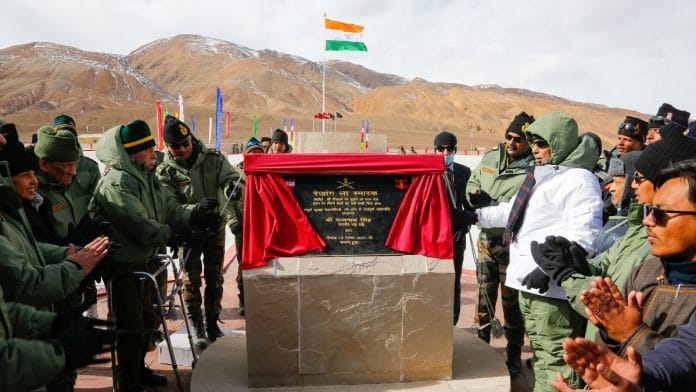



In September 1988, I stood at Tsaka La—a small pass connecting the Ladakh Range to the Kailash Range, and the Chushul Valley to the Indus Valley—looking toward Rezang La. This location is the famous for the last stand of Charlie Company, 13 Kumaon, against China’s People’s Liberation Army on 18 November 1962. I saw a jeepable track going upto Rechin La, a pass 3 km to the southeast of Rezang La.
I was the commander of the first Combat Group comprising one mechanised battalion and two armoured squadrons, inducted into Ladakh at the end of July 1988. I was carrying out reconnaissance to conceptualise the employment of mechanised forces in Eastern Ladakh. On an impulse, despite orders to the contrary, I drove up the winding track to Rechin La. The LAC runs along the crest of the Kailash Range and was not disputed by either side; both treated it as a de facto no man’s land.
From Rechin La, I could see a Chinese vehicle track going down to Spanggur Tso and joining the road to Rudok. The original International Boundary (IB) from that point is only 5 km to the east. It was an excellent approach for offensive operations with mechanised forces.
Following the Sumdorong Chu confrontation of 1986-1987, the Indian Army adopted a forward posture along the northern borders, reinforced by Exercise Chequerboard. The Army was rapidly transforming and was on par with the PLA. Eastern Ladakh was seen as an avenue for offensive operations led by mechanised forces, particularly in the Chushul and Indus Valley sectors.
My visit to Rezang La
Having already violated existing orders with respect to the Kailash Range, I decided to extend my reconnaissance to the Rezang La pass. Rezang La offered advantages similar to Rechin La, with a shorter approach once a track was constructed from the southwest. Twenty-six years after the battle, the tell-tale signs were still visible. I spent two hours studying the terrain where the battle had been fought.
It was easy to identify the three platoon positions. 7 Platoon was deployed on the higher ground north of the pass, and 8 Platoon to the south. 9 Platoon, along with Company Headquarters, was located 1-1.5 km southwest of 7 Platoon and approximately the same distance northwest of 8 Platoon.
What stood out was that the position ideally required two infantry companies to hold it. The huge gaps between the platoons and the open flanks made it vulnerable to infiltration, outflanking, isolation, and attack from the rear. The nearest friendly defences were 5 km to the south at Tsaka La, held by a company, less a platoon, of 5 JAT, and 8 km to the north at Magar Hill, held by two companies of 13 Kumaon.
Major Shaitan Singh, PVC, and his company fought the battle of Rezang La against all these odds. Of the 124 all ranks (including the administrative base personnel below the pass who were not part of the battle) one Officer, two Junior Commissioned Officers (JCOs) and 104 other ranks (OR) were killed in action. One JCO and four OR were wounded and taken as prisoners of war, one of whom later died in captivity.
Two OR of D Company at Magar Hill, part of a patrol trying to link up with Rezang La, were ambushed and killed in action and are considered as part of the Rezang La battle. The four prisoners of war were initially believed to have been killed in action. Hence, as per most accounts, 114 all ranks were killed in action. But actually, 110 were killed in action, including the soldier who died in captivity and the two from Delta Company.
Only four OR survived the battle and managed to return, apart from the four prisoners of war. A list of 17 survivors is with the researchers of the Rewari area. This includes four who survived and escaped, four prisoners of war who returned in 1963, and six other ranks who were probably in the administrative base or in transit at the time of the battle.
In February 1963, 97 bodies were recovered from Rezang La.
In the annals of Indian military history, no other battle equals the valour displayed at Rezang La. Sixty-three years later, it is pertinent to ask the question: Why was the company forced to fight the battle against overwhelming odds?
Defence of Chushul
Kailash Range in the Chushul sector is one area where the alignment of the 1959 Claim Line offers India a major strategic advantage. It dominates the area up to the original IB and provides a launch pad for an offensive toward Rudok, with an airfield available for logistics. It is also the key to the defence of Chushul.
During Phase 1 of the fighting, from 20 to 27 October 1962, China had reached its 1959 Claim Line in all sectors. However, its intent was not to allow India the advantage of holding the Kailash Range.
114 Infantry Brigade was moved to Chushul and given two additional battalions, one field artillery battery, and later two troops of AMX 13 Tanks for the defence of Chushul.
13 Kumaon was holding Magar Hill and Paw Hill with a company each; one company was at Rezang La. Battalion HQ and one company were located in the area of Track Junction, south of the airfield and earmarked as brigade reserve. One company minus one platoon of 5 Jat was holding Tsaka La.
1/8 Gorkha Rifles had one reinforced company at Gurung Hill, another to its north at Table Top-Camel’s Back, and one company defending the Spanggur Gap. Battalion HQ, with one weak company due to earlier losses, was located at the airfield.
1 Jat had two companies deployed at Thakung Heights, which also catered for any amphibious landings across Pangong Tso. Battalion HQ and two companies were deployed at Gompa Hill near Chushul village, probably also as the brigade reserve.
5 Jat was deployed at Lukung – Phobrang with one company less a platoon at Tsaka La under 13 Kumaon.
One battery of 13 Field Regiment, within 25 Pounder guns, was supporting the brigade. The battery was with a troop, each deployed south of Gurung Hill and Magar Hill.
Two troops of AMX-13 tanks had been flown in on 26 October and were located at the base of Gurung Hill to deny the Spanggur Gap approach to enemy tanks and support Gurung Hill.
Flawed enemy appreciation
The appreciation of the strength and intent of the PLA was seriously flawed. In Eastern Ladakh, the PLA had a total of three Infantry Regiments for the offensive, which stretched over 400 km from Daulat Beg Oldie (DBO) to Demchok. For Phase 2, after regrouping, it could muster only an Infantry Regiment less a battalion, excluding troops holding defensive posts, for the attack on Chushul, with the capability to capture, at best, two to three companies.
The PLA neither had the resources to progress operations into the Indus Valley nor the Nubra Valley. However, the Indian Military hierarchy was seeing ghosts and remained focused on the defence of Leh, 260 km behind along the existing road. Resources were equally distributed for the defence of Chushul, the Indus Valley sector, and Leh. Part of the brigade defending Leh, along with the artillery, could have been deployed to boost the defences at Chushul.
Flawed deployment
114 Infantry Brigade had sufficient troops for the defence of Chushul; however, its tactical deployment was flawed. The brigade made no attempt to secure or capture Black Top, the most dominating feature on the Kailash Range north of Spanggur Gap. In the initial stage, it was not held in strength by the PLA and could have easily been secured. As a result, the Chinese were able to dominate Gurung Hill and launch attacks from higher ground.
Similarly, south of the Spanggur Gap, Mukhpari, the second most dominating feature located between Rezang La and Magar Hill, was not held. There was an 8 km gap between the two posts. Rezang La was, thus, completely isolated.
The PLA was able to outflank it from both the north and south and attack it from the rear. It was tactically illogical to hold Rezang La to prevent the road to Leh from being cut off, as the route could still be cut off through the 8 km gap to the north or via the open flank to the south.
If Rezang La was to be held, Mukhpari, Rechin La and the pass to its south also needed to be occupied, each with at least a company. Either a greater risk could have been taken by deploying the brigade reserve of nearly three companies, or a more compact defensive sector could have been adopted, with Mukhpari held instead of Rezang La.
There was limited fire support — only one artillery battery was available. Due to a crest clearance problem, Rezang La had no artillery support. Higher commanders are to blame for this situation. India’s aircraft were landing at Chushul till 15 November and on 26 October, six tanks had been landed. If there was will, some additional artillery could have been moved by road or air. At a pinch, at least the battery at Leh could have been allotted.
Also read: US captured Nicolas Maduro in hours. Indian military should learn its precision and planning
Bravest of the braves
To a seasoned soldier like Major Shaitan Singh, the odds would have been obvious. He faced a choice: to deploy in an extended manner on the tactical terrain on both sides of the pass, or to focus on the most dominating feature north of the pass and hold a more compact defence. He chose the former to guard all approaches.
Due to a lack of resources, the PLA had a limited aim to evict the defenders from the dominating Kailash Range and make the airfield untenable. It chose to attack both flanks to capture Rezang La and Gurung Hill. Consequently, due to the terrain configuration, Magar Hill and Paw Hill would become untenable to defend as they would be isolated and artillery guns exposed.
The total force used to attack Rezang La was of one battalion plus an additional reinforced company. A PLA battalion has three companies of 150-160 personnel each. Thus, placing the attacking strength at 600-640 strong, giving an advantage of nearly 5:1 over the defenders.
The attack was supported by a 120 mm mortar regiment less a battery, one battery of 76.2 mm guns, and three 57 mm recoilless (RCL) guns for bunker bursting. It also included one engineer company, one flamethrower company, and one anti-aircraft company.
The attacking force was divided into two groups—north and south—each comprising two companies with supporting elements, under the Deputy Commander of 4 Infantry Division and Commander 10 Infantry Regiment, respectively. The plan was to isolate the defences through an outflanking movement from the north and south, and then attack all platoons simultaneously from north, south and west. Contact had also been made from the east.
The main attacking force only got into position at 09: 15 am on 18 November. However, small teams had infiltrated to launch probing attacks early in the morning. The main attack commenced at 09:15 am, and fierce fighting ensued for the next 13 hours. The guns only fell silent at 10 pm.
Major Shaitan Singh and his troops had anticipated that they would be isolated and fought to the last man. As per Chinese accounts, the PLA suffered 21 killed and 98 wounded.
There is no official account of the battle in the public domain. It is time for the Indian Army to formally commission an eminent military historian to write it. This will ensure that the supreme sacrifice of Major Shaitan Singh and all brave hearts of Charlie Company, 13 Kumaon, continues to inspire the soldiers and the nation as a whole for all time to come.
Lt Gen H S Panag PVSM, AVSM (R) served in the Indian Army for 40 years. He was GOC in C Northern Command and Central Command. Post retirement, he was Member of Armed Forces Tribunal. Views are personal.
(Edited by Ratan Priya)
It pains me to know that there is no official record of the Battle of Rezang La. The incompetent socialist state is scared of scrutiny; hence it wants no record of it. Long live Mother India, long live the defenders of the nation.