






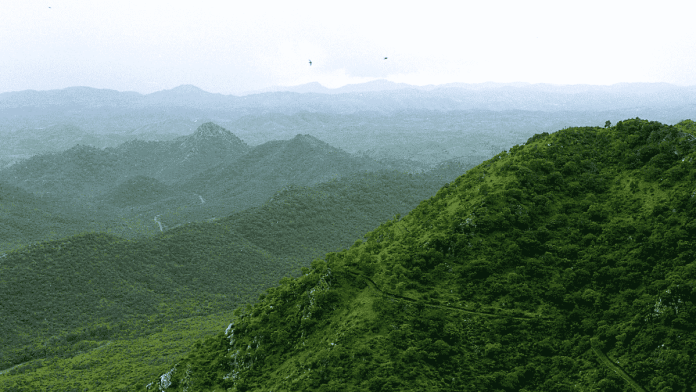



The latest round in the Aravalli mining battle is being fought on three fronts: in the courtroom, on the airwaves, and on the ground—on streets and along Aravalli pathways where local protests and marches are on the verge of hardening into a mass movement. A once “technical” dispute has become a public reckoning: about air, water, dust, corruption, and the right to a liveable region.
The Supreme Court has tried to impose definitional clarity and a planning framework on a landscape long mauled by illegal mining and administrative sleight of hand. Outside court, the Union government has reached for an older instrument of damage-control: a comforting statistic. “Only 0.19 per cent” of the Aravalli landscape will be affected, we are told—as if a decimal point can domesticate a quarry.
Why “definition” decides the fate of hills
Start with what the Supreme Court actually did. On 21 November—virtually a day before demitting office—a three-judge bench headed by then Chief Justice BR Gavai attempted to correct a foundational problem that has long haunted Aravalli governance: definitional chaos. For years, the meaning of “Aravalli hills” and “Aravalli range” has been kept elastic enough to be gamed.
Definitions are important. If you can shrink a hillock into a non-hill, or a ridge into an unprotected landform, you can shrink the protection zone without ever admitting what you did. The Bench accepted a committee-backed operational definition to end these shifting goalposts.
It then drew the operational line now central to official messaging: existing legal mines may continue under safeguards, but no fresh leases or renewals are to be granted until a Management Plan for Sustainable Mining (MPSM) is prepared. The MPSM is meant to map and zone the range—identifying where mining may be permitted and where it must be barred.
That is the architecture on paper. The live question is whether it will operate as protection—or as permission.
When the Court sidesteps its own amicus
The Supreme Court had appointed amicus curiae (friend of the court)—the eminent senior advocate K. Parameshwar—to assist the Court with an independent, precautionary judgment. On deciding definitions, Parameshwar urged a more conservative approach. The Court was free to disagree—and it did. When a court sidelines the caution of its own amicus on questions that determine what gets protected and what gets exposed, the public is entitled to scrutinise the reasoning.
In the Aravallis, how terms are defined is not a neutral matter. In a region where enforcement is historically porous and illegal mining stubbornly resilient, a “technical” redefinition can become a loophole. Lower hillocks and connecting formations—often ecologically crucial—risk being treated as dispensable.
Why is Centre’s defence so weak?
It is not surprising that state governments chase revenue and cheap construction material. What is striking is the central government’s weak resistance to dilution and its eagerness to pacify concerns with a decimal. Environmental protection around Delhi-NCR is a national public health imperative.
If the Centre wanted to be serious, it could have demanded non-negotiable safeguards: strict timelines, independent monitoring, public dashboards of compliance, and hard prohibitions within defined ecological buffers until zoning is completed and transparently reviewed. Instead, the government has offered reassurance by numbers, which can only confuse people.
As outrage rose in Rajasthan and Haryana, the Centre and the concerned state governments started saying the same thing: don’t worry, the impact is limited—only 0.19 per cent of the Aravallis is at stake. It is classic damage-control: answer public anger not with enforceable safeguards, timelines, supervision and accountability, but with a small-sounding number. Numbers don’t really reveal the reality of things.
Anchored to an Aravalli landscape of roughly 1.44 lakh square kilometres, 0.19 per cent translates to about 274 square kilometres—over 27,000 hectares, more than 67,000 acres—a vast operational canvas for blasting, excavation, crushers, haul roads, diesel and dust. Worse, it will not lie as one neat, monitorable block; it will be scattered in patches across ridges, slopes, valleys and district boundaries, multiplying roads, truck routes and cumulative damage across a landscape. The insult lies in the assumption that citizens will not do the math or visualise what tens of thousands of hectares look like. We should not underestimate the intelligence of our people: they may not speak in committee jargon, but they recognise what the eye sees and the lungs feel.
The MPSM: safeguard or gateway?
Which brings us to the centrepiece: the MPSM—presented as science stepping in to fix weak governance through mapping and zoning. If the plan can protect the hills, it can also legitimise harm. Zoning can “discover” new permitted areas, and once that category exists, it can become a target for lobbying and boundary changes.
Without proper oversight, the plan will tell the story that the most powerful interests prefer. If the public is expected to trust the MPSM, transparency cannot be optional: the maps, datasets, methods and assumptions must be public, contestable and independently reviewed. And none of this is happening in a neutral zone: the Aravallis sit beside the NCR construction machine, where stone and aggregates are political commodities. In that ecosystem—of cartels, illegal extraction networks, weak enforcement and quiet complicity—an opaque zoning exercise can be bent unless the data is radically transparent.
Also read: What are the Aravallis? The decades-long quest to define a 2-billion-year-old range
Start of a movement
A people’s movement is forming—especially in Rajasthan and Haryana—because the gap between official language and lived reality has become too stark to ignore. And this time, the story has an amplifier: national media headquartered in NCR has every incentive to cover what threatens NCR’s air, water, and heat stress. Once the Aravalli debate becomes a Delhi-NCR survival debate, it will not remain a niche environmental story. It will become political.
In the end, this is not merely an argument about mining. It is an argument about how reality is presented—and who benefits from that presentation. A small percentage can conceal a large wound. A scattered footprint can become a systemic tear. If governments choose to hide behind 0.19 per cent while opening up tens of thousands of hectares—fragmented across one of India’s oldest and most ecologically critical ranges—they should not be surprised when citizens reject the lullaby and demand the truth in plain, physical units: land, water, air, and loss.
Statistics may blur reality on paper. They do not blur the truth rising from the horizon when the hills are gone.
KBS Sidhu, IAS (retd.), former Special Chief Secretary, Punjab. Views are personal.
(Edited by Ratan Priya)