









You know Iran’s leaders are worried about the implications of last weekend’s US raid in Venezuela when the editor of the hardline Javan newspaper feels he has to write a polemic — headlined Iran Is Not Comparable – Don’t Waste Your Time — saying there aren’t any. But whether the Islamic Republic is ripe to fall from an external US or Israeli nudge is a much more complicated question.
These two deeply unpopular regimes have bonded over their hostility to the US ever since the 1980s, and most recently in their common need to circumvent energy sanctions. It’s possible that last weekend’s smash-and-grab extraction of President Nicolas Maduro from Caracas to New York may have jeopardized yet another link in Tehran’s rapidly shrinking web of alliances, together with a substantial financial investment.
I say “possible,” because it isn’t yet clear how the weekend’s successful US special forces operation will play out. Maduro’s former deputy, Delcy Rodriguez, made conciliatory remarks toward the US at her inauguration as president on Monday. She also, however, reserved her most demonstrative hugs and bows for the ambassadors from the regime’s major international allies, China, Iran and Russia, and is cracking down hard to crush any potential domestic opposition.
All of this matters to Iran, not because US Delta Forces are about to swing through the windows of Supreme Leader Ali Khamenei’s home — that would be much harder to pull off in Tehran than Caracas — but because the Islamic Republic he leads has rarely looked as weak.
Iran’s aging clerics are once again having to deal with a wave of mass street protests, and their security forces have so far killed at least 36 people and arrested about 2,000 in their suppression efforts. This prompted an early warning from Donald Trump that the US was “locked and loaded” to intervene, should the slaughter continue.
Khamenei has faced down much larger protest movements in the past, from the millions who turned out for the pro-democracy “Green Revolution” in 2009 to the Women Life Freedom movement of 2022-2023, and demonstrations over water shortages, prices and fuel shortages between. Yet this time feels different because the regime is on the defensive, both domestically and internationally. It was roundly beaten by Israel in an air war last year and proved unable to protect its core allies — including President Bashar Al-Assad in Syria, Hamas in Gaza and Hezbollah in Lebanon — from destruction. The humiliation involved has been extreme, for all Khamenei’s bombast. It’s also directly linked to protests over the dire state of the economy and a currency in freefall.
Among the complaints is that at the same time as neglecting the nation’s water supply, gorging on corruption and underfunding critical domestic services, Khamenei and his Islamic Revolutionary Guard Corps (IRGC) have spent hundreds of billions of dollars on a range of foreign adventures that — for the most part — have now gone up in smoke with no discernible benefit to Iran. This includes a uranium-enrichment program that lacked any commercial value, while costing tens of billions of dollars to build. It incurred even larger opportunity costs for the country, as a result of the sanctions and international economic isolation that its suspected goal of producing nuclear weapons drew.
Next in this story of strategic waste was the supply and subsidizing of allies in Khamenei’s so-called Axis of Resistance, which was designed both to attack and deter Israel. Assad’s Syria tops that list, with cost estimates for his support in the range of $30 billion. Hezbollah — and its vast arsenal of rockets and missiles — comes a close second.
There are no official figures for how much Iran has invested in Venezuela that it could now also lose. But with projects ranging from building oil refineries and tankers to automotive factories and housing, estimates suggest some $2 billion to $4 billion of credit may be outstanding. That isn’t big money for a sovereign nation of some 90 million people, but it would extend an unwelcome narrative of loss and failure for a government that just had to withdraw an essential tax increase under pressure from public fury over soaring inflation and living costs. Now it’s diverting still more money and attention from the civilian economy, as the IRGC races to rebuild air defenses and missile stocks destroyed by Israeli and US air strikes last year.
This brings us back to Trump’s “locked and loaded” threat. Iran and Venezuela have long been exhibits A and B for the contention that no matter how unpopular they are, authoritarian regimes fall only once domestic security services are unwilling to kill to keep them in power. That hasn’t yet changed for either. But if Khamenei takes Trump seriously, as he should, his options for repression could become limited if the protests continue for long or grow in size.
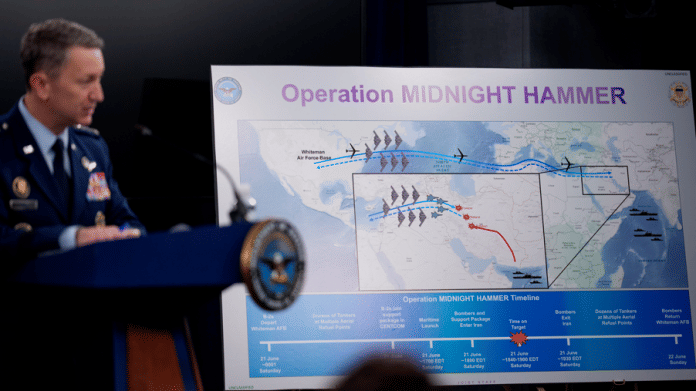
That makes both Trump’s threats to intervene over mass killings and Israeli warnings over Iran’s ballistic missile program good policies. But when it comes to actually repeating last year’s US and Israeli airstrikes, the calculations are less clear. The question isn’t whether Iran and the region would be better off without the Islamic Republic, but whether more airstrikes would advance or hinder that goal.
There are at least two reasons for restraint. The first is that the regime enjoyed a rally-around-the-flag effect for some time after June’s air strikes, because nobody enjoys being bombed by a foreign power or the civilian collateral damage that it almost inevitably involves. Iran’s Islamist leaders even adopted Persian nationalist symbols they previously denounced as pagan to encourage this surge of patriotism. There’s every reason to suspect that a repeat of last year’s strikes would have the same effect. Protesters might well go home for fear of being seen as abetting the enemy.
A second reason to pause is that it’s highly unlikely that even if a second US-Israel attack provoked a collapse of the regime, a stable pro-western democracy would follow. More probable is that power would shift to a less religiously fervent but equally hostile government run by the IRGC. Still worse, in what is a multi-ethnic empire posing as a nation state, would be a power vacuum that risked civil war. Think Syria, but in a nation with a population more than three times bigger.
Napoleon famously told his generals they should never interfere while an opponent was making a mistake. It was good advice then; it still holds true today.
This report is auto-generated from Bloomberg news service. ThePrint holds no responsibility for its content.