







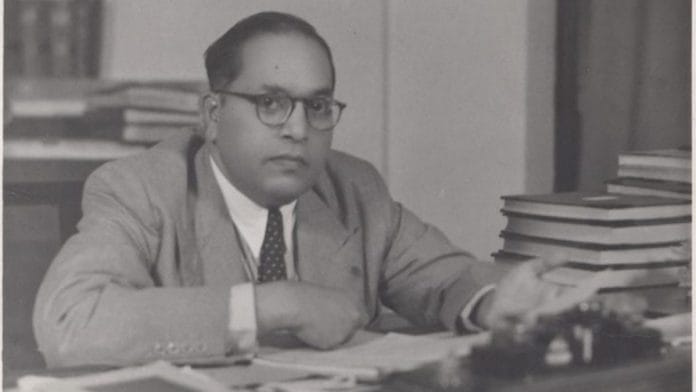



In the classic story titled Jenvha mi Jaat Chorli by Marathi writer Baburao Bagul, the central character — Kashinath, a Dalit protagonist — challenges the systemic caste structure by affirming his faith in the Constitution of India. Published in 1963 as part of Bagul’s award-winning collection of short stories of the same name, the story reaffirms Dalits’ faith in their beloved Babasaheb Ambedkar and in the Constitution of India, which he served as the chairperson of the drafting committee and is widely regarded as its chief architect.
However, history has been unkind to Ambedkar, whose thinking and actions went far beyond his banal fencing around reservation or Dalit issues alone. We take a look at some of the lesser-known aspects of Ambedkar’s thoughts, including his initiation of new discourses of manuski (humanity and compassion), his pursuit of civic rights through pragmatic law, and his foregrounding of the Indian principles of constitutional morality.
The manoos (person) behind Dalit literature
Ambedkar played a pivotal role in shaping Dalit literature, drawing inspiration from philosopher John Dewey’s ideas. He emphasised the role of education, social systems, and, primarily, the individual in confronting the systemic inertia that stabilises in favour of dominant classes.
This idea became the driving force behind the architecture of Dalit literature, which began with autobiographies, poetry, and short stories, primarily challenging Victorian modernity and traditional methods long regarded as literary standards. Dalit literature comes from the rejection of, and resistance to, the injustices of the caste system.
Consider this poem titled Empty Advice by poet Pralhad Chendwankar.
This country, which demands.
A pot of blood
For a swallow of water—
How can I call it mine?
Though it gives the world
The empty advice of peace.
Chendwankar’s poem reflects the Dalit struggle for dignity and human rights in India, particularly through the lens of the Constitution.
Marathi author Sharankumar Limbale notes in his book Dalit Sahityache Soundarya Shastra. that Ambedkar’s ideas helped awaken the Dalit community’s conscience.
This achievement focuses on reclaiming humanism and placing people at the centre. Because of this emphasis on manuski, one of Ambedkar’s beloved words, Dalit literature is unique. It promotes inclusivity and speaks for everyone, not just for Dalits.
Dalit literature prompts readers to reevaluate their assumptions and encourages them to delve deeper. It challenges them to move beyond traditional views and engage with the complexities of Dalit society.
Also read: Blaming Macaulay for India’s failures is just lazy politics we’ve perfected since 1947
Engendering the politics of labour
The distinctions between labour and work have been recognised since Aristotle, influenced by factors such as space, time, and personal experiences. Labour is often associated with physical effort and subservience, while philosophers such as Karl Marx and Hannah Arendt address this differentiation. In contrast, classical liberals, such as John Locke and Adam Smith, primarily focus on labour without acknowledging work as a distinct concept.
Ambedkar (1891-1956), aware of his identity as an untouchable, approached labour and work in the Indian context, incorporating discussions on gender, caste, class, and culture, informed by his education in Deweyan pragmatism and Fabian socialism. Drawing from various texts, including Rousseau’s Social Contract, Marx’s Communist Manifesto, Pope Leo XIII’s Rerum Novarum, and John Stuart Mill’s On Liberty, he developed a unique sense of labour.
Ambedkar’s perspective was evident when he contested the 1936 elections for the Bombay Legislative Council as a candidate of the Independent Labour Party (ILP), which he founded. In his party manifesto and campaign speeches, he presented a synthesis of labour, work, and action. His election symbol—a human figure, in contrast to other parties’ materialistic symbols—reflects his ideal of manuski and his view of labour as a form of qualified humanism.
Later, in his interventions as a Labour member in the Viceroy’s Executive Council, Ambedkar emerged as an organic intellectual, prioritising principles over rigid traditions and continually undergoing pragmatic transformation. The interplay of law, Labour, and societal morals, along with their tangible and intangible impacts, significantly influenced Ambedkar’s socio-political movement.
Ambedkar’s legal acumen
Ambedkar’s pivotal role in drafting the Constitution of India needs no discussion today, and rightly, he is called the father of the Indian Constitution. His writings deeply inspire the masses, especially the Bahujan strata of society, and he stands as a symbol of excellence for them to emulate.
Increasingly, he is gaining recognition for his work, which is drawing international attention for his championing of human rights and challenging patriarchal narratives of his times and inspiring an array of movements not only in India but across the world. His work provides a framework for social activism against injustices related to gender, race, and ethnicity.
Known as the “poor man’s barrister,” Ambedkar valued the Fourteenth Amendment to the US Constitution, which was ratified in 1868. This amendment granted equality to African Americans after the Civil War (1861-1865). It clarifies the phrase “due process of law” when read with the Fifth Amendment. While drafting the Constitution of India, particularly clause 9 of the Advisory Committee on Minorities and Fundamental Rights, this phrase was included: “… Nor shall any State deprive any person of life, liberty, and property without due process of law.”
Legal and constitutional expert BN Rau’s meeting with US Supreme Court Justice Felix Frankfurter raised concerns about the separation of powers among the executive, legislature, and judiciary. This separation could lead to the misuse of due process, as mentioned by him during this meeting, in the context of the Lochner vs New York (1905) case. This led to a tussle between the executive and judiciary, as seen in President Franklin D Roosevelt in 1937, whose statements sparked frictions between the two branches of the state.
Ambedkar, in his debates in the Constituent Assembly, presented himself as a strong advocate of judicial independence, harmonious working between the executive and judiciary, and caution against executive overreach. (These very principles later came to be held as the basic structure of the constitution). However, he recognised the importance of due process of law but wanted to implement it with adequate checks and balances for the people of India.
In September 1949, he defended clauses Article 22(3) to Article 22(7) in a lively debate, saying, “My friends and I have been trying in some way to restore the content of due process of law in its basics without using the term ‘due process.’” This portrays him as a legal visionary who had already predicted and sought to introduce the due process of law. Thus, Ambedkar, a visionary far ahead of his time, anticipated the substantive doctrine of due process of law, a basis for substantive democracy, accompanied by a strong system of checks and balances, making it justiciable and accountable.
Aditi Narayani is an assistant professor of sociology at Lakshmibai College, Delhi University. She tweets @AditiNarayani.
Nikhil Sanjay-Rekha Adsule, is a Senior Research Scholar at IIT-Delhi & John Dewey Emerging Scholar, USA. Views are personal.
(Edited by Saptak Datta)