






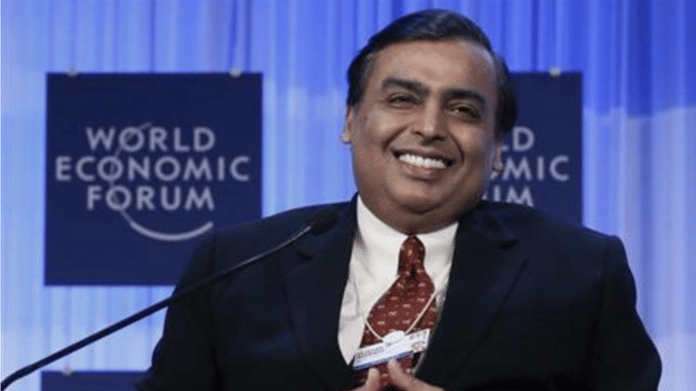



It took a war in Iran to reveal the full extent of billionaire Mukesh Ambani’s sway over the White House — and his centrality to mending the frayed US-India bilateral relationship.
Ten days after Iran effectively shut the Strait of Hormuz, plunging global energy markets into chaos, a relatively obscure corporate entity in Texas broke the silence. America First Refining, the vehicle poised to fire up the first major, world-scale oil refinery on American soil since 1976, announced it had received a “nine-figure investment from a global supermajor at a 10-figure valuation.” More importantly, it had secured a 20-year purchase agreement for the refinery’s output from that same mystery partner.
The shroud of anonymity didn’t last long. President Donald Trump took to Truth Social to unmask the benefactor, thanking Ambani’s Reliance Industries Ltd. for anchoring a “historic $300 billion deal,” the largest in US history.
Last year, when Washington and New Delhi were locked in a bitter spat over tariffs and nontariff barriers, I argued that India’s richest tycoon could play the ultimate peacemaker. My thesis was based on Ambani’s hunger for US ethane — an increasingly attractive feedstock for his sprawling petrochemicals empire. By importing more American molecules, he could help narrow the US trade deficit with India while giving Trump the Make America Great Again bragging rights he craves.
But even stronger evidence arrived last week. It appears that the 68-year-old businessman is getting directly involved in the infrastructure of the Permian Basin, America’s oil-producing heartland. The purchase commitment acts as a virtual 12,000-mile conveyor belt between the Port of Brownsville and his Indian gas crackers. In all likelihood, Texas will produce the shale ethane and propane streams; Reliance will turn them into polyethylene and polypropylene, compounds that clothe, house, and package the modern world.
For America First Refining, making gasoline and diesel exclusively from US sweet crude is a way to earn the margin that’s currently pocketed by refineries abroad. Co-Chief Executive Officer John Calce wants to start selling fuel from the refinery by 2029.
Although Reliance hasn’t publicly commented on the deal, the conglomerate’s plan appears rooted in geopolitics. With energy markets in turmoil, Ambani is dialing down his dependence on the Middle East.
For decades, the family’s fortune was tied to the Persian Gulf. Mukesh’s father, Dhirubhai began his career as a gas-station attendant in the Yemeni city of Aden — then a British crown colony — before returning home to start a trading operation in yarn. In the 1990s, Reliance set up the Jamnagar complex in Gujarat. It would eventually become the world’s single-largest refining hub, built to process the heavy, sour crude that flowed across the Arabian Sea.
But after the Ukraine conflict got underway in 2022, Ambani and other Indian refiners pivoted to buying discounted Russian oil. That put them in the crosshairs of the Trump administration, which blamed Indian billionaires for financing Vladimir Putin’s war machine. In August, the US imposed a punitive 25% duty on Indian imports, on top of a 25% reciprocal tariff. Although Washington has since put away the stick to pursue a trade deal with New Delhi, it reserves the right to wield it any time.
Yet, even here, Ambani found a way to win a reprieve from the war-induced shortages threatening daily life in India. According to Bloomberg News, “intensive engagement by the Reliance leadership” helped secure a 30-day waiver from Washington to buy Russian oil currently stranded at sea. Although that exemption has since become global, Ambani’s commitment to purchase from the Brownsville project makes India’s hall pass special. The tycoon has successfully transitioned from being a war profiteer in the eyes of the US Treasury to becoming a strategic partner.
The Texas plant is being touted as the “cleanest in the world.” Instead of using dirty fuel oil or methane to heat the refining towers, it will burn hydrogen, whose only byproduct is water vapor. This is bound to have piqued Ambani’s interest — if he can port the technology back home, he will be able to protect his petrochemicals revenue from future global carbon taxes in Europe.
The tech upgrade will also bring the family arc to its logical conclusion. Dhirubhai was the original “Polyester Prince.” Mukesh perfected the art of refining the crude. He used the cash flows to dominate India’s telecom, media, and retail landscapes. Now Anant, his youngest child and heir apparent for the energy business, will spend his career deciding where the all-important molecules must come from and how best to put them out in the world.
The message from the patriarch seems to be clear: No matter who’s at war with whom, the conveyor belt to Gujarat must never stop. It’s a masterclass in MAGA diplomacy that will also serve the broader US-India relationship. For Washington and New Delhi to move past the never-ending cycle of bickering over quotas and tariffs — while a mercurial president resides in the White House — they need the cold, hard reality of mutual dependency. Ambani has shown both sides exactly how to do it.
This report is auto-generated from Bloomberg news service. ThePrint holds no responsibility for its content.
Also Read : India-US trade deal to be signed after Trump administration decides new global ‘tariff architecture’