







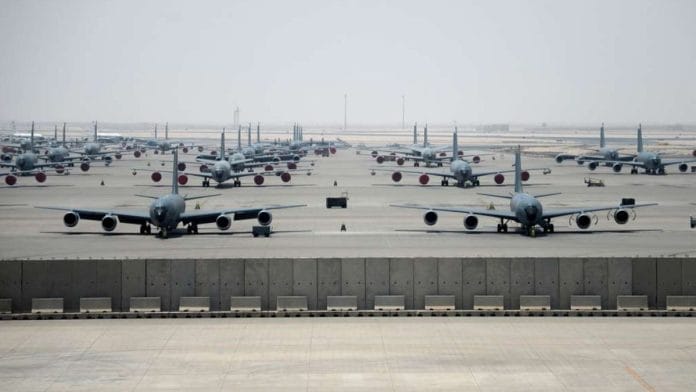



Airbase attacks have become commonplace in both major and minor, as well as symmetric and asymmetric, conflicts across the world. Though not a novel phenomenon, such attacks are a direct result of the decisive advantage air power holds, compelling warring actors to strike each other’s airfields and associated infrastructure.
“It is easier and more effective to destroy the enemy’s aerial power by destroying his nests and eggs on the ground than to hunt his flying birds in the air,” Italian Army General Giulio Douhet acutely observed in 1921.
The development of modern sophisticated weaponry—from missiles to the proliferation of unmanned aerial systems and loitering munitions to precision strike capabilities—has further facilitated such attacks.
Although attacking an airfield does not necessarily translate into air denial, which is the ability to prevent an adversary from operating in the air domain, it can impede an air force’s capacity to conduct both offensive and defensive operations. This is especially so if the attack is on a forward airbase. Such attacks can deny a force from achieving air parity, and consequently, from establishing air superiority.
A study by RAND Corporation identified four broad objectives behind airbase attacks: capture airfield, deny defender use of airfield, harass defenders, and destroy aircraft and equipment. Not every airbase attack strives for all of these goals; it typically depends on the level of threat perception linked to the airfields and accordingly, the degree of damage the attacker wants to wreak.
What recent conflicts lay bare
Three months into 2026, the world has already witnessed umpteen airfield attacks. On 3 January 2026, the United States launched ‘Operation Absolute Resolve’ to capture Venezuelan President Nicolás Maduro. Key to its success was the US forces infiltrating the country’s airspace by neutralising its air defences in different bases such as Catia La Mar and Port of La Guaira. In any case, Venezuelan air defence units, composed mainly of Russian-made S-300 and Buk-M2Es, were uncamouflaged and vulnerable, with some even being non-operational.
More recently, Iran’s retaliatory response following the assassination of Ayatollah Ali Khamenei by a US-Israeli strike consisted of attacks on US military bases across the Middle East. It targeted US airbases in Qatar, the United Arab Emirates, Kuwait, Jordan, and Iraq.
Closer to home, in May 2025, India struck 11 Pakistani airbases in the aftermath of the Pahalgam terror attack. Most notable among them was the Nur Khan airbase, located in Rawalpindi’s Chaklala Cantonment, not too far from Islamabad. Using the four objectives outlined by the RAND study, it can be said that India’s goal was neither to capture these airfields nor to deny the defender the use of airfields. Rather, it had the latter two aims: harassing defenders, and destroying aircraft and equipment by striking air defence units, logistical infrastructure, and runways to temporarily degrade operational capability. Pakistan, too, attempted to strike the Indian Air Force’s forward bases in Udhampur, Pathankot, Adampur, and Bhuj.
While airbase attacks are typical in conventional wars, such attacks are now being witnessed in conflicts that fall well below the threshold of a full-scale war, without full-scale military mobilisation. This was apparent in the latest conflict between Afghanistan and Pakistan, where the Afghan Taliban claimed to have struck Pakistan’s Nur Khan airbase, while satellite images show that Pakistan hit Afghanistan’s Bagram base.
Also read: Naxalism was on decline under Manmohan Singh. Modi govt moved in at the time of consolidation
India’s preparedness
It is against this backdrop that taking stock of India’s air defence architecture assumes greater importance. India’s air defence is a mix of long, medium, and short-range missiles; aircraft interceptors; electronic warfare systems; and the Integrated Air Command and Control Systems (IACCS). The long-range variant consists of the Russian-made S-400 Triumf surface-to-air missile (SAM) system, famously known as the ‘Sudarshan Chakra’, which was used effectively in Operation Sindoor to neutralise Pakistani drone and missiles. The Barak-8 missile system, co-developed by India and Israel, has both long-range and medium-range options.
The medium-range variants comprise the indigenously developed Akash SAM, also used successfully during Operation Sindoor. The short-range consist of Man Portable Air Defence System (MANPADS). India also managed to operationally integrate the L-70 guns into its integrated air defence system.
To ensure continuity in air operations and minimise damage to combat aircraft, India has diversified its air assets. Among other measures, this means investing in Emergency Landing Facilities (ELFs), which turn highways into runways in contingencies. In February 2026, India inaugurated the first ELF in the Northeast. The Moran Bypass highway in Assam’s Dibrugarh district has been converted into an emergency landing strip, on which aircraft such as C-130J, Rafale, and Su-30MKI were put on display. The first ELF to be constructed was on the National Highway-925A in Rajasthan’s Barmer in 2021, although mock landings had been conducted as far back as 2017 on the Lucknow-Agra Express Highway.
More ought to be done
India’s air defence architecture, based on the IACCS, proved its mettle in the last conflict. However, more can be done to fully integrate all three services and civil aviation radars to provide a composite air situation picture to decision-makers. The Air Battle Managers (ABM), who manage every node of the IACCS, exercise distributed control and decentralised execution to the weapon systems that would engage hostile threats.
This command and control architecture needs to be made resilient, jam-resistant, and integrated with AI tools to respond to incoming and evolving threats. From hard-kill options to soft kills, the entire system needs to be indigenous, with the ability to integrate sensors from the space domain, so as to protect against ballistic missile threats. This is in tandem with Prime Minister Narendra Modi’s goals of Atmanirbhar Bharat and Mission Sudarshan Chakra, which aims to build an indigenous, robust air defence system by 2035.
While no air defence system would be foolproof, India must ensure that its sovereign airspace is as impregnable as possible, in particular its airbases, which hold crucial assets for offensive and defensive air operations. This is especially considering the stark cost asymmetry at play. It is cheaper to strike an airbase than defend one. Offensive weapons are mushrooming rapidly at low costs, while defence systems, exorbitant to build and sustain, are racing to keep pace with evolving threats. But no matter how expensive air defence is, it arguably helps control the escalation ladder, because it limits the damage an adversary can cause.
In addition, if the air defence weapon systems are mobile, their survivability and effectiveness would only increase against enemy air attacks.
Air Vice Marshal Anil Golani (Retd) is the Director General of Centre for Aerospace Power and Strategic Studies (CAPSS). His X handle is @AnilGolani.
Bantirani Patro is a research associate at CAPSS. Her X handle is @bantirani_patro.
Views are personal.
(Edited by Prasanna Bachchhav)