









Pakistani jets have bombed several cities in Afghanistan over the past few days. The two countries have been exchanging fire across a contested border, even as several Pakistani leaders have insinuated an Indian hand — firmly denied by the Ministry of External Affairs.
These strikes are not a straightforward result of geopolitical rivalry: they are the convulsions of an old wound. The relationship between Afghanistan and the Indian subcontinent was built over five centuries by people who were entrepreneurial, mobile, literate, and commercially connected. Decades of war and border-making have hollowed out these networks. The Taliban is what remains.
Afghans in Medieval India
In the late 1300s, with the Delhi Sultanate fragmented into smaller but vigorous polities, medieval India’s military labour market was thriving. In an earlier edition of Thinking Medieval, we saw its eastern node: the Purab region of Uttar Pradesh and Bihar, from where peasant-soldiers migrated in search of seasonal employment.
The northwestern node of this market was linked to the Roh Plateau: a broad highland straddling present-day eastern Afghanistan and northwest Pakistan. Pashtuns from Roh, referred to in medieval sources as “Afghans”, entered India riding horses, which were not bred in the subcontinent. These horse traders were accompanied by bands of young men seeking military service, just like their contemporaries from Purab. Over time, literal horse-trading transitioned into political horse-trading, as Afghans turned from mercenaries into kingmakers.
In the 15th century, the Lodis — an Afghan clan that had migrated to Punjab — seized the throne of Delhi and established the city’s last pre-Mughal dynasty. However, their state was initially unstable. Bahlul Lodi, the dynasty’s founder, famously refused to sit on his throne before his Afghan nobles, as a continuation of the egalitarian tribal ethos. Afghan sultans needed to govern as first among equals: the great chieftains retained their own men and revenues.
This began to change in the early 1500s. Babur, the Turko-Mongol conqueror, crushed the Lodis at the Battle of Panipat in 1526, releasing even more Afghan strongmen into the military labour market. Deep in the Gangetic Plains in present-day Bihar, one strongman, descended from a family of horse traders, was perfectly positioned to take advantage. This was Sher Shah Suri, who would become the most successful Indian ruler of Afghan descent. Sher Shah was acutely aware of the squabbles and disloyalty that the egalitarian ethos had created.
By the 1530s, as noted by historian Dirk Kolff in Naukar, Rajput, Sepoy, Sher Shah had systematically brought Afghan chieftains under centralised pay and command — subordinating them, standardising salaries, and regulating troop numbers. He absorbed the Purbiya mercenary networks too, breaking the autonomy of warlords and folding their men into his armies. Finally, a standard silver rupiya currency and the Grand Trunk Road project cemented the Sur Empire’s control over North India’s military market, directly laying the basis for further centralisation under the Mughal Empire.
Also read: South India challenges the notions of medieval Islam—lessons from Deccan history
Afghans in the Mughal Sunset
Through the 1500s and 1600s, horse trading of various sorts continued to flourish under the Mughals. The highway and trade infrastructure encouraged ever-larger numbers of Afghans to move into the subcontinent, supplying horses as well as warriors. Some were employed by Aurangzeb in the late 17th century to put down revolts in the Gangetic plains; after his death, they began to carve out their own dominion in the Katehr Doab, soon to be known as Rohilkhand — the land of the Rohillas, from Afghanistan’s Roh Plateau.
As historian Iqbal Husain documents in The Rise & Decline of the Ruhela Chieftaincies in 18th Century India, the Rohilla chiefs built their power on two parallel foundations: military service to Mughal governors and the direct agricultural development of their territories. They cleared jungle, settled cultivators, and built towns. Balancing between the Marathas, various Nawabs, and the East India Company, Rohilkhand was flourishing by the mid-18th century, “cultivated like a garden, without one neglected spot in it”, as one observer put it.
But it was not to last. In 1774, the Nawab of Awadh, backed by East India Company troops, devastated and plundered Rohilkhand. Even British observers were shocked at the “shamefully bloody, mercenary, and lucrative subjugation of Rohilcund”, as Thomas Babington Macaulay noted in an essay targeting the corruption of the Company’s Governor-General, Warren Hastings. Never again would Indian Afghans rise to such prominence. Their political cycle in India — trader, mercenary, chieftain, king — had been violently interrupted by a new power with every reason to eliminate the competition.
Also read: Five myths about Afghanistan that India must overcome, along with its timidity
Two roads from the ruins
The dispossessed of Rohilkhand — soldiers, retainers, traders without a state to serve — did not simply disappear. Some drifted into the courts of Awadh and the Marathas. Others fed a new current of reformist Islam moving in the opposite direction.
Consider the career of Syed Ahmad Barelvi, born in Rae Bareli, close to Lucknow, in 1786. He trained in Delhi under Shah Abd al-Aziz, the pre-eminent Islamic scholar of the age. He then served in the cavalry of Amir Khan, a Pathan military entrepreneur who had worked for the Marathas against the British — until finally accepting British supremacy as the hereditary Nawab of Tonk.
Meanwhile, by the 1820s, Barelvi was marching northwest with thousands of followers, calling for jihad against the expanding Sikh Empire. The Sikh ruler Ranjit Singh had expelled the Durrani Afghans from Peshawar; some sources suggest that his governors had also banned the azan and seized mosques. Either way, Barelvi was convinced that India was falling into the hands of “infidels” and intended to establish an Islamic state in the Peshawar valley to eventually confront the British. However, his ragtag army was politically and militarily outmanoeuvred by Ranjit Singh, and he was killed at Balakot by Sikh forces in 1831.
A century later, in the same Peshawar valley where Barelvi had been killed, Khan Abdul Ghaffar Khan — a Pashtun from Charsadda — chose an entirely different road. He founded the Khudai Khidmatgar: a nonviolent movement of over 100,000 Pashtuns, allied with the Indian National Congress and committed to a free and undivided India. As anthropologist Mukulika Banerjee documents in The Pathan Unarmed, this was a reimagination of Pashtun culture, framing it through nonviolence and solidarity. Two roads from the same ruins. One pointed northwest, towards Afghanistan. The other pointed southeast, to India.
Also read: Who are Pashtuns? Afghan majority with countless tribes that Imran Khan got wrong
Thrown to the wolves
In June 1947, seven weeks before Partition, Ghaffar Khan and his allies declared the Bannu Resolution: a loya jirga demanding that Pashtuns be given a third option — an independent Pashtunistan — rather than the binary choice of India or Pakistan. The British refused. When Congress accepted Partition, Ghaffar Khan, the “Frontier Gandhi,” famously told them: “You have thrown us to the wolves.”
What followed — the Soviet occupation, the civil war, the first Taliban regime, the American invasion, the second Taliban regime — destroyed whatever remained of the political and social structures that had once allowed Afghan communities to move between the plateau and the plains. The horse-trading networks, the cross-border merchant relationships, the ties to Indian employers and employees: generations of near-continuous warfare have turned them into little more than ghosts. What survived, for young men with no other route to power or status, was religious militancy. The Taliban is what remains of Afghan political and military entrepreneurship when all other markets have been destroyed.
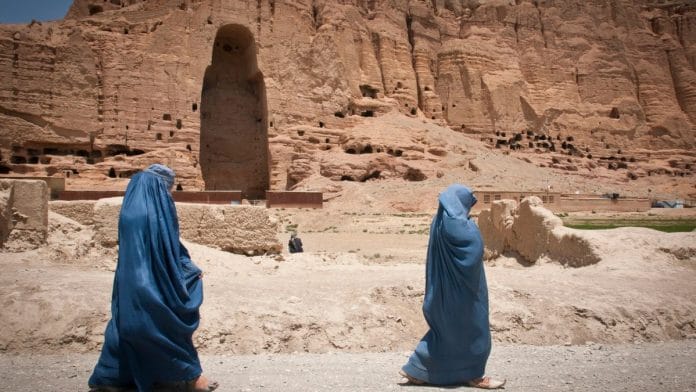
Last October, Taliban foreign minister Amir Khan Muttaqi held his Delhi press conference in front of a painting of the Bamiyan Buddhas — placed there by officials of the former Afghan republic, who had refused to display the Taliban flag. The man whose predecessors dynamited those statues in 2001 spoke beneath their image, though no comment was offered for the Taliban’s role in their destruction. Soon after, he went on to visit Deoband, the seminary that has shaped generations of Muslims in the subcontinent.
In doing so Mutaqqi was tracing ghostly footsteps — those of a relationship so entangled that no partition, however violent, has managed to fully sever it. No ruling regime in Kabul, Islamabad, or Delhi has yet found the courage to reckon with it honestly. For if Afghanistan is ever to transcend its framing as a regional security challenge, history tells us that the answer lies only in mobility, commerce, and the free movement of peoples and cultures.
Anirudh Kanisetti is a public historian. He is the author of ‘Lords of Earth and Sea: A History of the Chola Empire’ and the award-winning ‘Lords of the Deccan’. He hosts the Echoes of India and Yuddha podcasts. He tweets @AKanisetti and is on Instagram @anirbuddha.
This article is a part of the ‘Thinking Medieval‘ series that takes a deep dive into India’s medieval culture, politics, and history.
(Edited by Prashant Dixit)