








Fireworks rose from Srinagar, their warm light bouncing off the warren of canals that ran through the old city, emptying into the quiet expanse of the Dal Lake. Little gaggles of kids, standing on the fringes of the great procession which marched through Rajouri Kadal with the five terrorists freed from prison that night by the Government of India, stopped cars to ask for contributions to the carnival. Less than a week later, the regime of the Romanian Communist leader Nicolae Ceaușescu disintegrated: To Kashmiri secessionists, it seemed the Indian state was ready to be kicked over, too.
This week, the Central Bureau of Investigation (CBI) made the latest in a series of arrests intended to cage ogres and djinns set free on the night of 13 December 1989. That night—the older daughter of the former Union Home Minister and Jammu and Kashmir Chief Minister Mufti Muhammad Sayeed—had been driven home quietly, the five freed terrorists the price of her life.
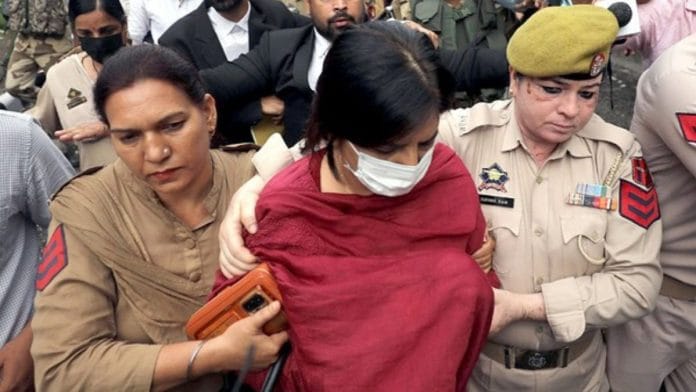
Fugitive Shafat Ahmed Shangloo, with a Rs 10-lakh bounty on his head, is the latest to be arrested. The CBI alleges he was among the men who facilitated the kidnapping
Except, this story—like so many other stories told since Rubaiya Sayeed’s fateful kidnapping—makes no sense. For a supposed fugitive, Shangloo lived in remarkably plain view, sharing his Facebook life with eminent scholars and journalists. He ran a small but successful business. Following his production before a Terrorist and Disruptive Activities (TADA) Court, the CBI was unusually denied his custody.
The kidnapping—followed by the killing of four Indian Air Force officers soon after, and the executions of Intelligence Bureau (IB) personnel—made the triumph of jihadism seem inevitable. And key Indian policy-makers decided they had no option but to try and transmute the terrorists into Kashmir’s future leaders.
Amateur peacemakers
Local police officials were telling then Chief Minister Farooq Abdullah, who flew back from London to handle the 1989 kidnapping crisis, that there would be no need to release Jammu Kashmir Liberation Front (JKLF) terrorists. Kashmiri religious leaders were exerting pressure for the young doctors’ release, Abdullah was told, and most ordinary people were repulsed by the kidnapping. Taken from the minibus she was riding on to get home from work, Rubiya had first been held in Sopore. Then, she was taken to the home of businessman Mohammed Yaqoob, a haven secured by police.
Even as Abdullah pushed to wait until the kidnappers cracked, a small army of mediators interjected themselves into the conversation: Srinagar cardiologist Dr Abdul Ahad Guru, Allahabad High Court Judge Moti Lal Bhat, and the journalist Zafar Meraj. Three members of the Union Cabinet, Arun Nehru, IK Gujral and Arif Mohammed Khan soon joined in.
Faced with intense pressure from the then Prime Minister VP Singh, the expert Manoj Joshi has written, Abdullah finally buckled to pressure for the release of Hamid Sheikh, who was recovering from a bullet wound in the hospital, Mohammed Altaf Butt, Sher Khan, Javed Ahmed Zargar and Mohammed Kalwal. Then, he drafted a fourteen-page letter to the Prime Minister, explaining exactly why he thought the decision was terrible.
The plain words of Kashmiri separatist leader Yasin Malik explain how he used this meltdown to position himself as a spokesperson for a movement, helped along by the intelligence agencies and security services.
Also read: Washington shooter’s story is about American barbarism, not ‘Third World’ backwardness
Talking to terrorists
For India’s intelligence establishment, the Rubaiya kidnapping marked an emerging political implosion. Terrorist coercion undermined India’s ability to govern. Large numbers of National Conference workers had been assassinated, forcing the party rank-and-file to flee to Jammu. The Lok Sabha elections of 1989 saw Muhammad Shafi Bhat elected from Srinagar uncontested, while Saifuddin Soz won Baramulla with just 1 per cent of the vote. Following these failed elections, there was a string of bombings and shootings, often pitting mobs against the army and police.
An affidavit filed by Yasin in a parallel terrorism funding case in the Delhi High Court makes clear he was rapidly recruited as a potential political asset. Following his arrest on 6 August 1990, he was brought to a Border Security Force (BSF) guest house in Mehrauli, on Delhi’s fringes. There, officials of the BSF, the Intelligence Bureau and the police tried repeatedly to pressure him to meet with then Prime Minister Chandra Shekhar.
Facing serious cardiac problems, he underwent an open heart surgery in 1992, with funds, two government sources have told ThePrint, that were originally earmarked for meeting the needs of indigent Kashmiri Pandit refugees in the city. Eminent civil society actors like Kuldeep Nair and Justice Rajinder Sacchar met with Yasin multiple times, his affidavit states, together with various high officials.
Three years of negotiations, which also involved diplomats from the United Kingdom and the United States, led Yasin to commit to non-violent democratic struggle—a decision likely influenced by the decimation of the JKLF by rival groups like the Hizb-ul-Mujahideen. The JKLF leader was granted simultaneous bail in all 32 cases pending against him, and the prosecution simply disappeared. He would go on to meet Home Ministers and Prime Ministers in India, and Generals and jihad commanders in Pakistan.
Also read: Dr Umar Nabi has shattered a popular misconception about terrorism
The endgame that hasn’t
From the memoirs of the former Research and Analysis Wing (RAW) chief, we know several similar efforts were underway. Arrested in 1989, People’s League leader Shabir Shah was cultivated to see if he might be willing to contest the Assembly elections scheduled for 1996. Long years of effort, though, ended in what Dulat has described as “a hell of a letdown”. Figures around Shah—like Firdaus Syed, Bilal Lodhi, Imran Rahi and Ghulam Mohiuddin—announced a peace initiative in 1996, but lacked either a political leader or a clear agenda of action.
Another peace effort in 2002, spearheaded by the Hizb-ul-Mujahideen dissident Abdul Majid Dar, ended in ferocious infighting.
There were separate efforts to persuade Hizb-ul-Mujahideen chief Muhammad Yusuf Dar—who uses the pseudonym Syed Salahuddin—to return home. In 2000, his son was granted medical college admission in Srinagar despite not having the grades, with the help of the IB.
For the most part, Dulat writes, India’s intelligence services sought to buy out the secessionists. This was true to pattern, he notes. The sacking of Farooq’s government in 1984 was secured by “money [which] went in an IB bag, and was distributed by a big businessman who used to be a Congress MP, Tirath Ram Amla.”
Even the hand-outs, however, did not persuade the Hizb-ul-Mujahideen chief to come home. The assassination of potential dialogue partners with the Indian Government, like Abdul Gani Lone, meanwhile, went on. Election after election.
And the cases against Yasin kept hanging, just in case—but it soon wouldn’t matter.
Then, in 2016, the uprising that swept the Indian state out of large parts of southern Kashmir made one thing clear: The secessionists who had emerged from 1989 on now spoke for no one, most certainly not the mobs of young people battling India on the streets. The reasons aren’t too hard to find. India’s efforts mistook handing over cash for a political engagement. There was no serious discussion on what political participation might look like, and how a new force might coexist with the older, still-formidable parties like the National Conference.
Ever since 2019, the Government has begun pushing prosecutions in old cases stalled for decades, signalling its seriousness about combating terrorism. The perpetrators of kidnappings ought indeed have been punished for their crimes, not dressed up and paraded as Kashmir’s future political leadership.
The challenge of rebuilding a political establishment battered by decades of war remains: For a political class to reclaim its authority and legitimacy is no small thing. The real lesson from the Yasin’s cases is that no amount of cash wipes the taint of blood from killers who have never repented the means they used, nor the ends they sought.
Praveen Swami is contributing editor at ThePrint. His X handle is @praveenswami. Views are personal.
(Edited by Saptak Datta)