






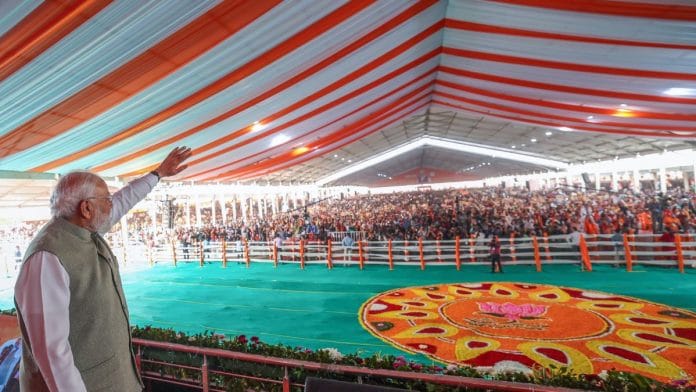



Prime Minister Narendra Modi likes to visit West Bengal only on the eve of elections. Modi arrives accompanied by a drumroll from the mainstream media, busily running visuals of “massive rallies” and feverish public welcomes; the BJP’s IT cell zealots ramp up Modi-centric hashtags as a security razzmatazz of running commandos and limousine convoys plays out. Modi, the political tourist, descends on Bengal with only one mission: To target the Bengal government and insult its people.
In the run-up to the 2021 Assembly polls, Modi, bellowing from stage, mocked India’s then only woman Chief Minister, Mamata Banerjee, with the phrase “Didi oh Didi”.
This time, ahead of the Assembly polls, at a rally in Malda, Modi yelled that “infiltrators” are being converted into voters in Bengal and that “divisive politics” is the norm of all eastern Indian states. At a rally in Singur last week, Modi again warned Bengal’s youth to beware of “infiltrators”, who the TMC is apparently “protecting.”
Mamata Banerjee is a three-time chief minister who has repeatedly won the approval of Bengal voters: She won 184 seats in 2011, did better in 2016 with 211 seats and even better in 2021 Assembly polls winning 215 seats.
To dismiss these wins as the result of “infiltrators” is a supreme insult to the mandate from the sophisticated Bengal voter who has always made informed choices based on an informed awareness of both governance needs and democratic and cultural convictions. The Bengal voter can give a ringing endorsement but equally quickly withdraw her support. The Left Front won a landslide three-fourths majority in 2006, collapsing completely just five short years later.
Also read: Modi thinks he can win Bengal just like Bihar. Five reasons why he’s wrong
Insulting Bengali identity
The intelligence of the Bengal voter must never be insulted or underestimated; yet this is precisely what Modi likes to do. An arrogant prejudice against Bengal marks Modi’s government, a smirking demonisation of an entire state as apparently a place of violent anarchy, a taunting mispronunciation of the word Bengali as “Bangaali,” the bizarre mauling of Bengal’s cultural markers like referring to the legendary football club Mohun Bagan as ‘Mohun Began’ or Bankim Chandra Chattopadhyaya as ‘Bankim da’ or the inability to somehow pronounce the word “Kolkata” without making it sound like “Kalcotta” or “Kolcotto” reveal a barely concealed condescension, a sneering ridicule, an aggressive rudeness toward Bengal’s identity. However quickly hurriedly it is covered up, or retracted, the BJP and Sangh Parivar’s Bangla Virodhi mindset repeatedly reveals itself.
Here are ten examples of the BJP’s Bangla Virodhi mindset.
1) For Modi and his trusted number two, Home Minister Amit Shah, Bengal appears to be a synonym for “infiltrators or ghuspetiya.” Infiltrators, infiltrators, infiltrators is the Modi Shah refrain.
There is no appreciation whatsoever of Bengal’s vibrant society, its vivacious student community, the breadth of its cultural life, its progressive women’s movement, publishing houses, theatre groups, intellectual forums, industry bodies, lively clubs and associations—all of which make up Bengal’s effervescent civic landscape.
By harping on infiltrators, the Modi regime is in fact repeatedly exposing its own national security failures. After all, guarding the borders is the sole responsibility of the union government and the Home Ministry. Why are “infiltrators” being allowed to come in in apparently huge numbers? Why has the Modi government failed to stop cross border terrorism from Kashmir to Delhi? Why is the Border Security Force, which works directly under the Home Ministry, failing in its duties?
The figures actually do not show a so-called “ghuspetiya” influx into Bengal. The infiltrator chorus is nothing but bogey to stereotype and target an entire state and its people.
If indeed Bengal was so lawless and so overrun with ghuspetiyas, would it be ranked as the second most visited destination for international tourists from western countries?
2) The BJP and Sangh Parivar show a constant contempt for the Bangla language. A Delhi Police circular last year referred to Bangla-speaking migrant workers from Bengal speaking, a language it called the “Bangladeshi” language. The BJP’s IT Cell head Amit Malaviya supported the Delhi Police and asserted that there is no language known as ‘Bengali.’
Migrant workers who speak Bangla have been arrested and even deported to Bangladesh in BJP ruled states. It’s as if speaking Bangla identifies one as an outsider forced to endure perpetual suspicion of being “Bangladeshi.” Speaking Bangla is seen as an anti-national outrage against the Sangh Parivar’s Hindi-Hindu-Hindustan construct of the nation.
3) During the Vande Mataram debate in Parliament, to mark 150 years of the national song, BJP speakers laid claim to Bankim Chandra Chattopadhyay’s verse, yet did not even take the trouble or the interest to learn how to refer to Bengal’s cultural figures. Modi referred to Bankim Chandra Chattopadhyay as “Bankim da,” union minister Gajendra Singh Shekhawat referred to Chattopadhyay as “Bankim Das Chatterjee,” and BJP MP Anurag Thakur twice referred to Vande Mataram as ‘Vande Bharat.’
4) The same Vande Mataram debate revealed a lack of awareness of India’s greatest modern poet and author of our national anthem, Rabindranath Tagore.
Historical inaccuracies were peddled that the Congress party excised certain paragraphs of the song, when it was on the advice of Tagore, in 1937, that the song was shortened, when it was sung at meetings during the Independence movement.
The BJP government has recently removed the honorific ‘Mahatma’ Gandhi from the MGNREGA Act and has renamed and redrafted this law on rural work. It was Tagore who had bestowed the honorific ‘Mahatma’ on Gandhi, a title the Modi regime chose to slight.
This is visible by its zeal to rename MGNREGA and replace it with the 2025 G-RAM G law. Can any top BJP leader today recite a paragraph of any Tagore poem? There is no evidence of it so far.
5) The Modi-led centre has repeatedly denied Bengal’s just dues and constitutionally guaranteed funds. Awas Yojana dues are stalled, MGNREGA dues are stalled. The Centre owes Bengal more than Rs 2 lakh crore, including Rs 52000 crore in MGNREGA dues.
In times of natural calamities, it is Chief Minister Mamata Banerjee who is seen on the ground—available to the public in the hour of need, personally supervising relief and welfare.
When a bridge collapsed in Kolkata in 2016, Modi callously called it an “act of god,” yet it was CM Banerjee who sat at the accident site day after day ensuring that relief and reconstruction work proceeded apace.
6) The BJP and Sangh Parivar repeatedly play politics with crimes against women that have occurred in Bengal.
The BJP attempted to drum up an entirely false narrative of “mass rapes”, in Sandeshkhali, the Durgapur hostel case was politicised, but the BJP was forced to back down when certain facts emerged about the case. The NCRB has ranked Kolkata as the safest city in the country for four years in a row. In 2023, it had the third lowest rate of crime against women, only behind Coimbatore and Chennai.
7) The BJP’s Bengal face Suvendu Adhikari is a prime beneficiary of the BJP’s “washing machine” politics. Accused in corruption and bribery cases when he was in the TMC, Adhikari who joined the BJP in 2021 suddenly appears to be washed clean and is projected by the BJP as the harbinger of “Hindu” cause in Bengal.
This again reveals a cold-eyed condescension and patronising view of the Bengal voter. Does the BJP seriously imagine that Bengal’s public does not know about Adhikari’s about turns and his less than savoury track record?
8) When a state makes strides in development and opens itself for business, the so-called Viksit Bharat-touting BJP should applaud such efforts. Bengal held the Bengal Business Summit in February 2025, Kolkata is emerging as an IT hub, the Tata leadership has been welcomed into Bengal, and spanking new townships in New Town show the resolve and determination of the state government to shake off the torpor of the Left Front years and leap into a new era of entrepreneurship, tourism and open-ness. Bengal tops India in women-headed MSMEs. Yet this effort by Bengal is never recognised in the constant campaign of vilification and name-calling carried out by the BJP and its allied media.
9) The BJP’s Bengal Virodhi mindset is seen in its open as well as underground machinations to divide Hindus and Muslims in Bengal.
Bengal’s inheritance is uniquely syncretic and plural; a new Jagannath temple has been inaugurated, Eid and Christmas are celebrated openly, the Kolkata Durga Puja has been awarded with a UNESCO Intangible Cultural Heritage of Humanity title. As Mamata Banerjee puts it, “Dhormo jaar jaar, utshob shobar,”—we all have our personal faiths, yet we celebrate festivals together. Bengal’s age-old friendship and amity between communities still endures despite the BJP’s polarisation campaigns.
Injecting the poison of religious hatred in a social fabric rooted in diversity and coexistence is to do a terrible wrong to Bengal. Especially because the state witnessed the great ‘Bengal Renaissance’ of the late 18th to early 20th centuries, a cultural churn that disseminated pluralism, openness and reformist values across the state.
10) The last and most telling example of the BJP-Sangh Parivar’s Bengal Virodhi mindset is the grotesquely patriarchal and misogynist language used by its leaders against Mamata Banerjee as well as against Bengal’s women public figures.
A woman grassroots leader who fought her way to the political summit through sheer struggle, a three-time CM, multiple-term union minister and seven-time MP, Mamata Banerjee is an unprecedented political phenomenon not just in India but across south Asia, where women leaders from Benazir Bhutto to Indira Gandhi to Sirimavo Bandaranaike to Sheikh Hasina achieved political saliency by inheriting leadership mantles from male ancestors.
Mamata Banerjee has had no male mentors. In fact, she has faced obstacles and marginalisation from entrenched male-dominated networks, before striking out entirely on her own and building a successful political party and movement. A woman-headed political start up in the viciously unjust world of Indian politics, is nothing short of an astonishing achievement.
The Bengal Virodhi mindset of the BJP blinds it to Bengal’s identity and achievements. But in 2026 voters will make sure the BJP’s eyes are opened to the truths of a fast developing, safe, harmonious and culturally vibrant state.
Sagarika Ghose is a Rajya Sabha MP, All India Trinamool Congress. She tweets @sagarikaghose. Views are personal.
(Edited by Theres Sudeep)