



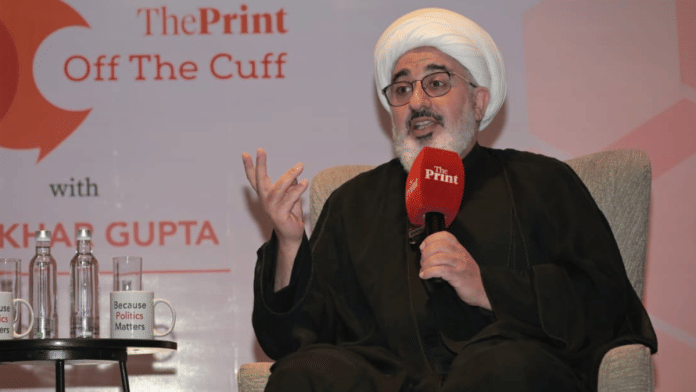
Gurugram: Iran’s Islamic Revolutionary Guard Corps (IRGC) warned not only Indian-flagged vessels, but also Chinese ships, against transiting the Strait of Hormuz following its swift opening and closing a couple of weeks ago, Dr Abdul Majid Hakeem Ilahi, the Representative of Iran’s Supreme Leader to India, said Monday.
Commenting on the incident where two Indian-flagged vessels were fired upon by the IRGC on 18 April, Ilahi made it clear that Tehran warned them due to concerns about the “security” of the global waterway, caused by US naval ships in the vicinity.
The Representative of Iran’s Supreme Leader highlighted that it became “dangerous” after Tehran realised that the US wanted to “pass some warships” through the Strait of Hormuz, leading to its closure. This occurred hours after the Iranian government had stated the global waterway was “completely open”.
“…while the Strait of Hormuz was closed, Iran allowed some Indian ships to pass the Strait of Hormuz. When they came to this ceasefire, Iran and the Minister of Foreign Affairs of Iran announced that the Strait of Hormuz is open for everyone,” Ilahi said, while speaking at ThePrint’s “Off The Cuff” at the Quorum Club in Gurugram.
“But, at the same time, Iran was surrounded by warships of the United States. So, Iran realised that they want to pass some warships through the Strait of Hormuz, and coming near to Iran, and it will be more dangerous. Iran announced that the Strait of Hormuz, because of the security, is now closed…So, Iran warned these ships: now stop. It’s [not] just India. Even China also, the ship was from China, also the same.”
On 17 April, Iranian Foreign Minister Seyed Abbas Araghchi declared the waterway “completely open” following the announcement of a ceasefire between Israel and Lebanon. Within hours, however, US President Donald Trump made it clear that the US naval blockade on Iran would not be lifted despite the opening of the strait, prompting the IRGC to effectively shut it down once again.
On 18 April, the incident against the Indian-flagged carriers occurred, following which India summoned the Iranian Ambassador to India, Mohammad Fathali, and lodged a strong protest.
Ilahi underlined that the Strait of Hormuz was “open” before 28 February, and that it was only as a result of the war initiated by the US and Israel that Tehran took action in the global waterway. Around a fifth of global energy supplies transit through the Strait of Hormuz. The effective closure of the strait for the better part of the last two months has shaken international markets.
“Iran provided security for all ships and they were passing through the Strait of Hormuz. Iran never asked anything, any new law conditions posing on the Strait of Hormuz. But after this war, which they initiated, this place, the Strait of Hormuz, became the main subject or major field of the problem and crisis,” said Ilahi.
The fate of the Strait has also had a larger impact on the ending of the war. Iran has maintained that it will not lift its military control over the waterway until the US naval blockade against its ports is removed.
Trump has maintained that the blockade will remain in effect until Tehran agrees to a deal. The second round of direct negotiations between Iran and the US, scheduled to be held in the Pakistani capital of Islamabad over the weekend, did not occur. Iran has maintained that there will be no direct negotiations as long as the US naval blockade is in place.
Araghchi travelled to Islamabad last Friday and shared his position with the Pakistani leadership. The US negotiating team was set to travel to Pakistan Saturday, however, Trump pulled out of the talks given that the Iranian side would not be present. The war has impacted India negatively, as almost 80 per cent of New Delhi’s imported liquefied petroleum gas (LPG) comes from countries surrounding the Strait of Hormuz. Around 40 per cent of India’s liquefied natural gas (LNG) also emanates from countries within the Strait.
(Edited by Niyati Kothiyal)
Also Read: ‘Don’t know if Supreme Leader lost his leg but he’s healthy’—Mojtaba Khamenei’s India representative