





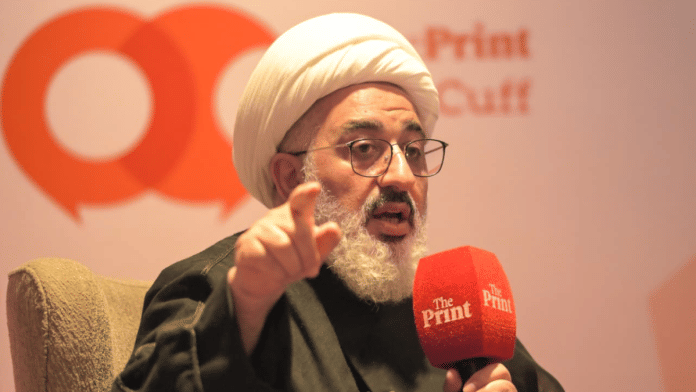


Gurgaon: Relations between Arab countries and Iran will “improve” after the US–Iran war “because they realise that no one can protect them or bring them peace”, said Dr Abdul Majid Hakeem Ilahi, the Iranian Supreme Leader’s representative in India, Monday.
Speaking at ThePrint’s “Off the Cuff” event in Gurgaon Monday, Illahi described the UAE as Iran’s “closest neighbour” and said it shares “a very good friendship” with Tehran. His tone, however, shifted sharply when he referred to Abu Dhabi’s strategic alignment with Washington.
“They offered their land to the United States of America, supported them and other countries, and they attacked us, however, we didn’t attack this country. We don’t want to attack; we only defend ourselves,” he said.
Pressed on whether the UAE’s growing ties with Israel complicated matters, he struck a pragmatic note. “Having a relationship with any other country is their matter, their issue, and their business. We don’t want to interfere in their policy.”
However, he drew a clear line: “You are not allowed to provide opportunity and basis for our enemy to attack us. This is the major problem.”
Turning to Iran’s broader relationship with Arab neighbours, Illahi framed tensions as the result of external pressure rather than intrinsic rivalry.
“We had a very good relationship with our neighbours, really. We are the same tribe, the same people, the same culture, and we didn’t have any problem with them,” he said.
He then added: “These Arab countries, our neighbours, unfortunately, offered their land (to the US) and they started building bases against Iran. According to the report of some American senators, Iran was surrounded by 45 bases.”
Referring to remarks he attributed to US President Donald Trump, Illahi said Gulf leaders had been persuaded to rely on US protection. “If I don’t protect you, you won’t sustain for a week,” he quoted Trump, suggesting such statements reinforced dependency.
Last week, Iran called for compensation from five Arab nations—Saudi Arabia, the UAE, Bahrain, Qatar, and Jordan—accusing them of aiding US-Israeli strikes on its territory.
After the US-Israel joint strikes on Iran on February 28, Tehran retaliated by launching attacks targeting Israel, Iraq, Jordan, and Gulf states hosting US military bases. A two-week ceasefire was announced last week, following widespread casualties, with thousands reported dead or injured across the region.
In a letter sent to UN Secretary-General António Guterres and UN Security Council President Jamal Fares Alrowaiei, Iran’s UN envoy Amir Saeid Iravani alleged that these countries violated their international obligations by supporting the attacks. He argued they should therefore be held accountable and compensate Iran for the damage caused during the conflict.
Meanwhile, Iran has launched more than 4,300 missiles and drones at the six Gulf Cooperation Council (GCC) countries, accounting for the majority of its retaliation in the West Asia war.
The UAE has been the hardest hit, facing at least 1,815 drones and 372 missiles, along with over 100 recorded strike events in February.
Still, the representative ended on a note of cautious optimism. “Sometimes it wasn’t good, but we tried to have a very good, strong relationship,” he said of ties with neighbouring states. “I’m sure now, after the war, our relationship will be better and stronger than before. Because they realised that no one can protect them, no one can bring peace for them.”
(Edited by Shashank Kishan)