





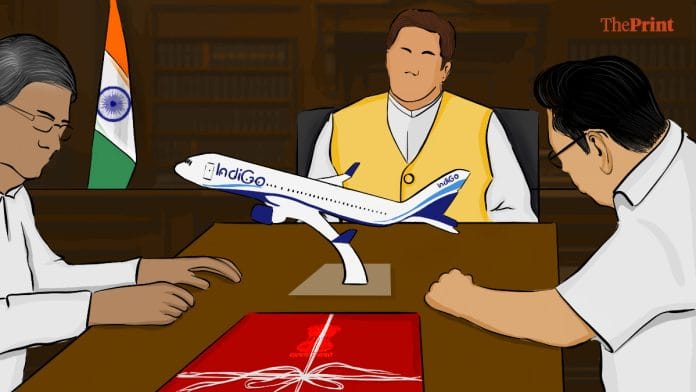



There can be three immediate reactions when you see the unravelling of IndiGo, arguably the greatest global brand built in post-reform India. All three come with some frustration.
The first, the IndiGo founders and the management must be nuts, unthinking, or arrogant, as some have argued, to have let it go into such a rapid meltdown.
The second, that whoever thinks of taking on the Government of India, and that too the Modi government, particularly when Vladimir Putin was in town is smoking something illegal. Remember those that allegedly triggered Shaheen Bagh protests while Donald Trump visited New Delhi in 2020 are still in jail without trial. And this, as the Holiday weeks are beginning.
And third, for those who’ve argued for decades for the government to get out of our lives, especially in areas served better by the private sector, how reckless did you have to be to do exactly the reverse? That holier-than-cow mai-baap sarkar is back to clean up the mess created by an arrogant, anti-customer private sector leader. This is a national tragedy.
You can quite believe that for all these years, as private aviation grew, took the Jet and Kingfisher meltdowns in its stride, and Air India was privatised, many in the ancient regime chafed at the loss of power. No planes to buy, no largesse of hirings, contracts, even purchases of consumables.
The Government of India, or what in my more frustrating moments I have described as Sarkar-e-Hind, given its self-image, had been rendered irrelevant in at least one area. Here the private sector built a globally envied success. Even in telecom, at least some vestiges of old power stay with the government: spectrum sales, one active PSU in BSNL, and a 49 percent equity in Vodafone-Idea. In civil aviation, it has nothing barring that insignificant helicopter charter. Most of the significant airports are privately owned and many others will soon be.
Now, the sarkar is back and how. The minister is strutting from one TV channel to another, promising to clean up the mess IndiGo created, threatening to indirectly take over the management of a listed company still valued at around Rs 2 lakh crore (two trillion) or $24 billion, despite a nearly 15 percent collapse in the wake of the crisis. This happens only in India: a private company messes up. But the guy explaining and taking questions is not its CEO but a minister.
The minister threatened to have the CEO fired, and had him summoned by the sector regulator for a highly publicised humiliation. He first withdrew in panic the regulations on pilots’ duty hours that his own ministry and regulator failed to enforce over nearly two years and then ordered a cut in flights till February, 2026. He’s now thinking aloud. A duopoly is bad, so his preference is to have five airlines instead with a hundred aircraft each.
Is he going to give IndiGo or Indian aviation, since the airline is two-thirds of it, its ‘Baby Bells’ moment. That harks back to the US anti-trust process breaking up AT&T’s monopoly into Regional Bell Operating Companies (RBOCs). The minister should have his staff Google that. Indian aviation looks big, but it has enormous headroom for growth. Just IndiGo has another 1,400 jets on order, Air India approximately 570 and another couple of hundred between Akasa Air and SpiceJet. How can we talk of wishing for five airlines with 100 planes each when India can absorb five with 500 planes each?
This incredible Indian success story was made possible because the establishment for once accepted what Prime Minister Narendra Modi has said often: the government has no business to be in business. Just as Indian aviation is growing at a global scale, the minister in charge is talking of cutting it into pieces. This when both his Prime Minister and his party Supremo, Chandrababu Naidu, are believers in scale.
We might be losing our way, however, in venting much over the poor minister. He was given what seemed to be an easy if glamorous ministry with very little to do except cutting ribbons. Then a crisis found him.
So, we leave him to his prime time and return to the real issue—the return of the government into the very heart of one of India’s most spectacular success stories. How else can we describe the placing of officers in key positions in the IndiGo corporate headquarters, overseeing decisions. This is accountability-free micromanagement. They come from the same regulator, the Directorate General of Civil Aviation (DGCA), which first introduced rules for crew rest-and-recovery so conservative even the Europeans would baulk. They did so without getting the stakeholders’ buy-in. Unless the idea was the old one: any impossible regulations bring discretion and exceptions in their wake. That’s how the sarkar has built ATMs for itself through generations.
The success of private aviation made the case for minimum government. Civil aviation became the most expendable ministry. It should’ve been abolished without needing some Javier Milei as Mr Mckinsey.
Also Read: A tribute to Tejas. India’s delay culture is the real enemy in the skies
There’s much to blame IndiGo for, but its greatest crime is to have made the government appear as a saviour in the face of furious public opinion. The same government that ran Air India and Indian airlines as monopolies, ran them into the ground, and lived through multiple aircraft-purchase scandals. Some of these still endure. Now it’s back in your headquarters. Good luck.
Just how did IndiGo let things collapse, and then hid in a bunker hoping it would dissipate. Which century are they living in? In the past, you could buy ‘goodwill’ with most media through advertising, favours, largesse, Diwali gift hampers and having breathless commercial hagiographies written about yourselves.
But in the era of social media, where every abandoned passenger has a voice and each stranded bag an identity, don’t blame misfortune. This is colossal incompetence and insensitivity. So bad, heads would have rolled even in the old PSU-era Indian Airlines and Air India. Civil aviation ministers have lost their jobs over much less.
IndiGo leadership should’ve been out and speaking in contrition laced with reassurance at the first sign of trouble. But why bother if the customer has nowhere else to go? And the ministry? Of course, we have that base covered. They forgot that dealing with the government is like playing in a casino. However brilliant you may be, however deep your pockets, the House always wins.
PostScript: One of those storied pilots’ strikes in the PSU era led to Madhavrao Scindia resigning as the civil aviation minister on 9 January, 1993. To keep some air-connectivity going, he had wet-leased aircraft. One of these, a Russian/Central Asian aircraft, landed on top of another taxiing at New Delhi in deep winter fog. Scindia took moral responsibility. A couple of days later, as I made a stop at Sitaram Kesri’s home as I sometimes did, for a tutorial on Indian politics, he said that Scindia was very young, bright, popular and ambitious. Good candidate for Prime Minister, but will never make it.
I asked why.
He said Scindia took moral responsibility for an accident and resigned. He should’ve followed it up with press conferences and interviews to cash in on his sacrificial martyrdom.
“I checked,” he said, “and he had gone incommunicado, on a silent vacation in the hills.” This showed, he said, that Scindia lacked the instinct for the top job. It’s a different matter that history could never put Kesri’s hypothesis to test as fate intervened and Scindia died in a private plane crash on 30 September, 2001.
Also Read: India’s ‘big’ state is making a comeback with laptop import curb. It’s yesterday once more
One of the best articles i have ever read.Kudos to you sir.Wish we had more journalist like a you.I am a big fan of yours.Hope we keep on getting such quality journalism for many many more years to come
the guy explaining and taking questions is not its CEO but a minister…because the DGCA failed to discharge it’s duties!
From what is now coming into the public domain, IndiGo was not a good, healthy, vibrant workplace. For pilots, cabin crew. Ground staff have borne the brunt of passenger fury. Airlines is a service industry, not an oil refinery cum petrochemical complex in Jamnagar. Human interface matters. Employees cannot give of their best to passengers if they are themselves poorly motivated. As IndiGo rebuilds itself, the top management should think about this.
Honest, anguished query. Why have India’s leading business houses not built a single spectacular global brand.
Deve Gowda’s immortal quip about Sitaram Kesri : Old man in a hurry.