








Two National Interest columns over the past year have had a convenient, ‘Thank You Trump’ headline, because it was his hectoring and humiliations that shook a chilled-out India, prompting it to focus on its economy, invest in defence, dump ideological trade aversion and embrace FTAs. The situation now is more complicated.
If I said ‘Thank You Trump’, I’d need to add Netanyahu and definitely somebody from Iran. But who to thank in Iran? Those one could have, from Ayatollah Khamenei to Ali Larijani, are gone. We don’t know where and how Mojtaba Khamenei is. And frankly, you’d think twice before putting anybody on that pedestal. Because in this season of assassinations, who is to guess what happens to whom tomorrow?
But why would we, in India, be thanking the three belligerents—two against one—for starting this war? A war is a bad thing anywhere, especially when it’s so close to our region and strangles our energy jugular. There are also between 9 and 10 million Indian workers in the Gulf, large mutual investments, and three decades of strategic partnership-building. Shouldn’t we be cursing those involved in the war, especially those that launched it on 28 February, rather than thanking them?
The picture is more complex than that. One way of seeing it is through the partisan debate at home. Those with the BJP/Modi government would have us believe that this war is resurgent India’s coming-of-age. That the government has played its cards with genius, strengthened its friendships among the Arabs while keeping the equilibrium with Iran and secretly cheering its dismantling by our formal strategic partners America and Israel. By the way, India now has seven formal strategic partnerships in the Middle East: the UAE, Saudi Arabia, Egypt, Qatar, Oman, Kuwait and indeed Israel. All of them are combatants on the same side now, so India’s choices are simple. And can Iran afford to dump India? That’s why every tanker crossing the Strait of Hormuz is hailed as a masterstroke.
The critics would say India has lost its strategic autonomy with its failure to condemn the attacks on Iran, or at least the war in general. That, in this case, Prime Minister Narendra Modi has not even invoked his familiar ‘this is not the era of war’ doctrine; that India has become so dependent on the US and Israel that it has given up its neutrality. How can India be so ungrateful to ‘old and loyal friend’ Iran? India failed to push back against Trump on Op Sindoor claims and tariff humiliations. And the exaggerated commitment to Israel is blamed on the BJP’s anti-Muslim politics.
That last one, however, is complex. While the BJP is not known to be an admirer of Muslims, the fact is, most of the Muslim world is in the camp opposed to Iran. Who are the Gulf Arabs if not Muslims? And in that 18 March joint statement in Riyadh condemning Iranian attacks on the GCC (Gulf Cooperation Council) members, Turkey and Azerbaijan, Pakistan also joined in. That adds up to about five times the Muslim population in Iran. So if you want to see Modi government’s position here in the communal, Jew versus Muslim terms, the answer is a BAH. In all capitals.
Also Read: Trump brings the Age of Humiliation for friends. Modi needs stoicism abroad, humility at home
Fans of the government say look how beautifully India is positioned in this turmoil while Pakistan flails, torn between its security commitment to Saudi Arabia and pretensions of support to ‘brotherly’ Iran. See those tankers crossing the Hormuz, an Iranian naval ship in safe harbour at Kochi, and those prolific phone calls between Modi and Gulf heads of state—also the one with Iranian President Masoud Pezeshkian. This, when India and Israel have just signed a significant defence agreement, and hello, Trump hasn’t said a rude thing about us for a month. That’s India rising in its true ‘virat vishwaguru’ avatar.
We can, however, distil it down further and arrive at two simpler, rival formulations. One side thinks that, given all of the factors listed above, India under Modi is punching way above its weight. The other thinks Modi has undermined India’s traditional strengths, burnished by its Gandhian and Nehruvian moral authority. See how seriously we were taken in the past. It’s all gone, along with strategic autonomy. India is therefore punching way below its weight.
Both are wrong. And delusional. Through its independent history, then (Congress era) and now (under Modi), India has punched according to its weight. It has, however, always had an exaggerated sense of its own power and authority—more moral, philosophical and ideological in the past; more strategic, economic and spiritual now.
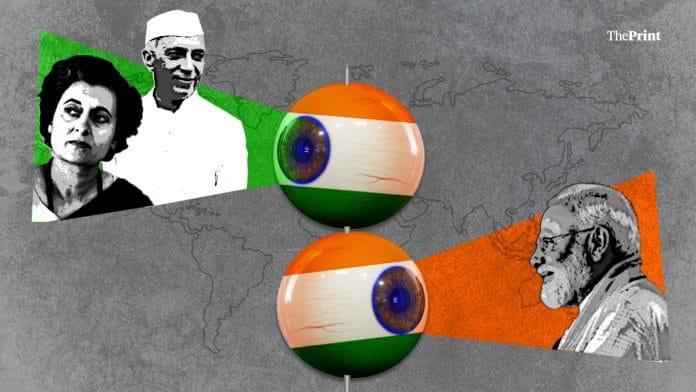
In each era, this sense of exaggerated global authority was built around a leader. Nehru and Indira then, Modi now. The BJP and RSS routinely get bad press for their idea of India being vishwaguru (teacher to the world).
The same notion prevailed in the Nehru-Indira era. Sermonising the world has been our national pastime. We did so with a per capita income of $92 in 1962 or about $3,000 now. They might use different descriptions but being a vishwaguru is a truly bipartisan, let’s say, secular fantasy in India.
Also Read: No country is ever fully sovereign. Cold War era taught India its real meaning
Self-image is an essential ingredient in a nation’s weight, but many others count too. In the past, we were economically weak, militarily threatened, strategically aligned with the Soviet Union (with compromised strategic autonomy) and for a long time needed food aid. If we kept quiet over the Soviet action in Hungary (1956), Czechoslovakia (1968), Cambodia (1978), and Afghanistan (1979) it showed how little strategic autonomy we had. And yet we were able to stand up to Richard Nixon and Henry Kissinger in 1971. That demonstrated the strategic clout we had built through our Soviet alliance and the Green Revolution. Net net, we were punching according to our weight.
Today, on our way to being the world’s fourth largest economy albeit at a per capita GDP of just around $3,000, way below the middle-income status, we can build a most consequential partnership with the US while maintaining a robust relationship with Russia and stability with China. Europe, Britain, Canada, and many other middle powers see value in upgrading ties with India. Israel is a key strategic partner and the Arabs close friends. India is one of the ‘I’s in I2U2 (India, Israel, UAE, USA) and at the same time maintains at least civil relations with Iran.
These are the classical limitations of a middle power with dependencies across the world. On the US, Russia, Israel and France for defence; for energy on Russia and the Gulf; for cheaper engineering and electronics on China; for fertilisers and pulses on a lot of the world; and for employment on the Gulf and the US. These dependencies should sober down heady notions of India’s new power. This is why India cannot call out Russia on Ukraine, the US-Israel combo on Iran, and even Iran on its patronising militant/terrorist groups in so many countries. That’s also why India has to live with a difficult modus vivendi with China on the LAC.
India, like every nation, makes its choices given its power and needs of the day. Within that definition, India is making its choices and punching well within its weight. Of course if this crisis drives us harder towards defence production, energy exploration and fertiliser reform, we will yet again say: Thank You Trump, Netanyahu and somebody on the Iranian side who’d go unnamed.
Also Read: The new Great Game—Trump’s playing for time, China for leverage & India for wiggle room
Few commentators have lectured India more confidently about unsentimental foreign policy realism than Shekhar Gupta, which makes it all the more remarkable that this piece reads like a man mourning a world that left without saying goodbye. He just wrote the most elaborate self-refutation in recent Indian commentary, and somehow didn’t notice.
His grand conclusion — that India is “punching according to its weight” — is literally the Modi government’s foreign policy argument, just stripped of the triumphalism. He handed them the trophy while pretending to be the umpire.
The Nehru-Indira nostalgia is even more self-defeating. Gupta lists India’s reliance on Soviet support, acceptance of food aid, and silence during the crises in Hungary, Czechoslovakia and Afghanistan — and calls it strategic autonomy. That wasn’t autonomy. That was subservience dressed up in Nehruvian prose, and you can almost feel him wincing as he types it.
Then comes Iran, where he ties himself in the most spectacular knot. He wants to say India should have been warmer to Tehran, but the entire Arab-Muslim world — including Pakistan — had already condemned Iran before he finished the sentence. So he writes “BAH, in all capitals” and hopes nobody notices the BAH was aimed squarely at himself.
The vishwaguru he’s swinging at is a strawman — nobody serious is lecturing the world anymore. India isn’t lecturing the world, it’s cutting deals with it, and Gupta knows that too. That’s precisely what makes the piece so excruciatingly painful to read.
India as a middle power, part of a large cohort, acting responsibly on the global stage, preserving its core national interests while contributing to an international system that is still guided more by rules rather than the law of the jungle. Close to USA but not a formal military ally or a camp follower. That seems to be a template more in consonance with our present attainments and capabilities than the larger than life aura that was being created.
He could have stopped at the headline. The essence was already clear. The rest of the article reads like typical SG-style verbosity, adding little of real substance. Point taken though.