


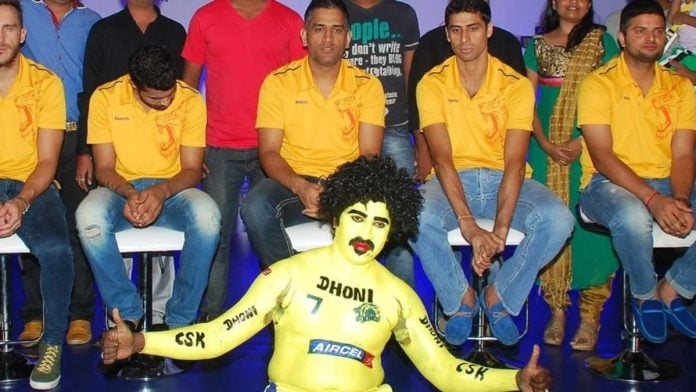
New Delhi: A Chennai Super Kings (CSK) fan known for painting himself yellow, sporting the name of IPL team’s former captain Mahendra Singh Dhoni and the iconic No. 7 on his body, has secured interim protection of his personality rights as the Madras High Court restrained quick commerce platform Blinkit from commercially exploiting his visual identity without permission.
Justice P.B. Balaji, in an order Monday, said that the constitutional protection available to individuals cannot be restricted to celebrities, such as actors and sportspersons. The court observed that even though petitioner Saravanan Hari may not have the stature of Amitabh Bachchan, Rajinikanth, Sachin Tendulkar or Dhoni, he has carved a niche for himself through his distinctive appearance at CSK’s matches.
“Without the consent and prior permission of the applicant, the first defendant cannot exploit the individual personality rights that have been acquired, whatever little it may be, for commercial gain,” the court said.
The order came on a suit filed by Hari against Blink Commerce Private Limited (the firm that runs Blinkit); Bennett, Coleman & Company Limited (publisher of The Times of India); and unidentified persons. Hari alleged that an illustration resembling him was used in a Blinkit advertisement published in the Chennai edition of The Sunday Times on 23 March, 2025.
The court found a prima facie resemblance between the illustration and Hari’s distinctive appearance, observing that the advertisement could mislead the public into believing that he had participated in or endorsed Blinkit’s commercial campaign.
The ruling is significant as it takes the personality rights debate beyond established celebrities, and raises questions about the commercial use of an ordinary individual’s recognisable identity.
Also Read: Preity Zinta vs Google, Meta, X: Why Bombay High Court’s nod to her AI deepfake suit matters
How fan’s appearance became subject of legal dispute
Hari has been following CSK across cricket matches in India and abroad. His distinctive appearance, involving yellow body paint, Dhoni’s name and a rendition of the No. 7 jersey, has made him a familiar face among cricket fans.
He alleged in his plaint that the illustration in the Blinkit ad reproduced the combination of features associated with his public persona. The ad—carrying a slogan that read “The men in yellow always deliver”, and cricket-themed illustrations—promoted a match-ticket voucher offer. A cartoon of a yellow-painted fan, with a moustache, curly hair and the words “THALA 7” on his torso, appeared in the bottom right corner.
Hari said that the use of the illustration gave the impression that he had associated himself with Blinkit. People who knew him contacted him after seeing the ad to ask if he had endorsed the company’s products and services, he added.
He had also approached the company and the newspaper publisher through legal notices, alleging unauthorised use of his image and personality for commercial gain.
Blinkit denied the allegation, maintaining in its reply that the characters in the ad were fictional and entirely distinct from Hari. The TOI publisher, meanwhile, contended that it had merely published the advertisement, and was not responsible for its contents.
Justice Balaji was, however, not persuaded by Blinkit’s defence. He noted that Hari’s distinctive pose had appeared in newspaper articles and television coverage, particularly during cricket matches. The illustration in the ad bore a clear resemblance to the plaintiff and reproduced the same pose, the court said.
“There is every likelihood that the public will be misled to believe that it is the applicant, who has been part of the advertisement,” the judge observed.
The court, however, left the publisher’s liability to be examined during the trial.
‘Protection cannot be limited to celebrities’
Personality rights are generally meant to protect an individual’s identity—including their name, image, voice and other distinctive characteristics—against unauthorised commercial exploitation.
Such disputes have predominantly involved celebrities and sportspersons, whose identities carry considerable commercial value, and are frequently used in advertisements and endorsements.
In this case, the court was dealing with a person, who is not a celebrity in the conventional sense, but has developed a recognisable public identity through his appearances at cricket matches.
Taking note of newspaper articles and interviews referring specifically to Hari, the judge said the Constitution protects the rights of every individual, and that such protection need not be confined to actors and sportspersons.
The court’s observation that Hari’s personality rights had acquired “whatever little” commercial value they might possess is significant. It indicates that the absence of celebrity status, by itself, cannot be a ground to deny an individual protection against unauthorised commercial use of an identifiable persona.
While granting the interim injunction against Blinkit, the judge did not make a final determination on the alleged infringement. The matter will be examined further after the defendants respond to the suit.
The court has also directed Blinkit and the newspaper publisher to preserve materials linked to the ad, including original artwork, samples, correspondence with the design team and external vendors, along with email communications. It said destruction of these materials could affect Hari’s ability to establish his claim for damages and commercial exploitation.
The matter has been listed for the next hearing on 14 December.
Aditya Edara is alum of ThePrint School of Journalism, and an intern with ThePrint.
(Edited by Mannat Chugh)