





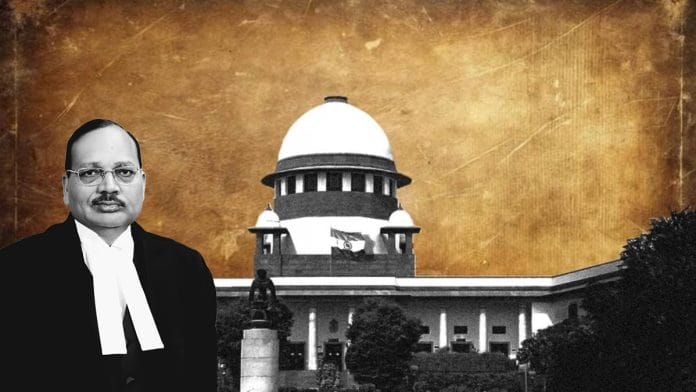



New Delhi: Chief Justice of India Surya Kant Wednesday slammed a reference to “corruption in the judiciary” in a new Class 8 National Council of Educational Research and Training (NCERT) textbook, saying he would not allow anyone to defame the institution.
Taking suo motu cognisance of the issue, he said: “I will not allow anyone on Earth to taint the integrity of the institution and defame the institution. At any cost, I will not permit it. Whosoever high it may be, the law will take its course. I know how to deal with it,” he said.
Justice Joymalya Bagchi, also on the bench, said that “constitutional integrity to the basic structure is missing in the structure of the book.”
The issue was mentioned before the CJI by senior advocates Kapil Sibal and Abhishek Manu Singhvi, who expressed concern that Class 8 students were being taught that the judiciary is corrupt.
Sibal told the court that members of the institution were “deeply disturbed” and described the contents as “entirely scandalous”, adding that they had copies of the book.
The controversy emerged after the new NCERT Social Science textbook was released on Monday with a chapter titled ‘The role of the judiciary in our society’.
The chapter lists “corruption at various levels of the judiciary” and “massive backlog… on account of multiple reasons, such as a lack of an adequate number of judges, complicated legal procedures, and poor infrastructure” as challenges.
When the matter was mentioned before the CJI Wednesday, he said that he was already aware of the issue and had received numerous calls and messages regarding it, including from high court judges who were “perturbed”.
“I can assure all of you. I am fully aware of it,” the CJI said.
When urged to take suo-motu action, he responded, “Wait for a day for it to be listed and for the registry. This is definitely concerning the entire institution. The bar and the bench are perturbed.”
He added that he had already started the proceedings on the matter.
Also Read: Deleting history from NCERT textbooks is lying to children. It’s also betraying parents
(Edited by Sugita Katyal)
It is common knowledge that judiciary is corrupt. Judges are as human, too. They should stop pretending otherwise.