





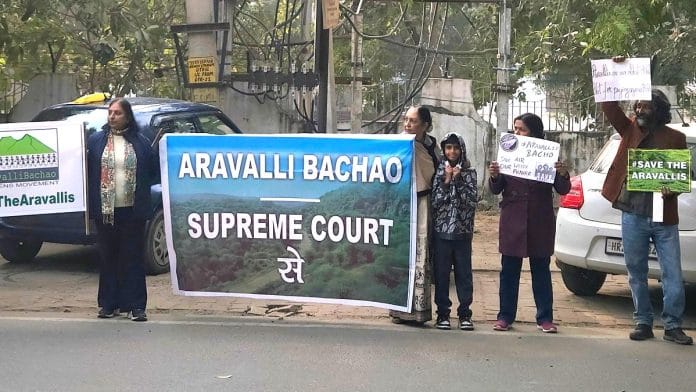



New Delhi: A former Indian Forest Service (IFS) officer has expressed concerns over the 20 November Supreme Court order on the Aravalli matter, which says that the sustainable mining plan would be applicable only on ranges having an elevation of 100 metres or more, as defined by the Central government-appointed expert committee.
A sustainable mining plan that does not apply to the entire Aravalli ecosystem would be a “colossal waste of public resources” apart from affecting the integrity of the range, R.P. Balwan has submitted in an application filed before the top court.
Balwan has described this definition of Aravallis as unscientific. and urged the court to clarify its order to say that the sustainable mining plan would be applicable to the entire Aravalli ranges, including the valleys.
To restrict the plan’s application to ranges, as defined by the committee, will “fragment and destabilize” the entire Aravalli range, leading to “disastrous consequences” for not only the Aravallis, but also major parts of the Indo Gangetic Plains (IGP), including the entire National Capital Region (NCR), already facing unprecedented levels of pollution, besides being at risk from desertification, he said.
Requesting the court to give an “urgent clarification” on its order, Balwan has asserted in his application that “Aravallis need to be understood as one contiguous eco-system – with hill formations of various heights and valleys enclosed in between.”
Since the committee’s definition of Aravallis, formally accepted by the SC in its 20 November judgement, would exclude 90 per cent of the range from legal protection, a sustainable mining plan that does not apply to the entire ecosystem would be a “colossal waste of public resources,” apart from affecting the integrity of the range, he has said.
Balwan has suggested the court accept the definition given by the Forest Survey of India (FSI), as it comprehensively covers the Aravalli Hill ranges.
As per the FSI’s definition, the area that encloses a range having a slope under three degrees, has a foothill buffer of 100 metres and is located at a 500-metre distance from another hill is defined as a hill.
If the committee’s definition is accepted, then any land form below 100 metres of height would be excluded from the legal protection the court has provided through its order. This entire area, Balwan has mentioned in his application, would then be open to mining, which has been the primary cause of devastation in the Aravallis over the decades.
Balwan’s application was listed on 17 December before a bench led by Chief Justice Surya Kant. It was taken up as an intervention application (IA) in a pending matter that deals with upcoming development projects in forest areas. Though Balwan’s counsel had requested the bench to hold an urgent hearing in the matter, the court listed it on 7 January.
ThePrint contacted Rajasthan additional advocate general Shiv Mangal Sharma to seek his views on Balwan’s application. Sharma said the former forest officer’s application, in the present form, was not maintainable. He was also of the view that the application had been filed without a proper understanding of the Supreme Court judgment and the Committee’s report.
Mining in the Delhi-NCR region, he said, is completely prohibited and would continue to remain in force. Moreover, he said, mining lease, as per the SC order, cannot be granted as a matter of course, but would be permissible only in extremely limited, special or strategic circumstances.
“Therefore, the notion that mining will be freely permitted in the Aravallis after the Supreme Court’s order is entirely unfounded,” he said.
(Edited by Ajeet Tiwari)
Also Read: Rajasthan: Over 27,000 illegal mining-related cases in Aravallis since 2020, but FIRs for only 11%
Mining is just one aspect. There appear to be plans to create massive road infra by cutting or removing parts of Aravali in Gurgaon/Manesar area. That also needs to be addressed.