





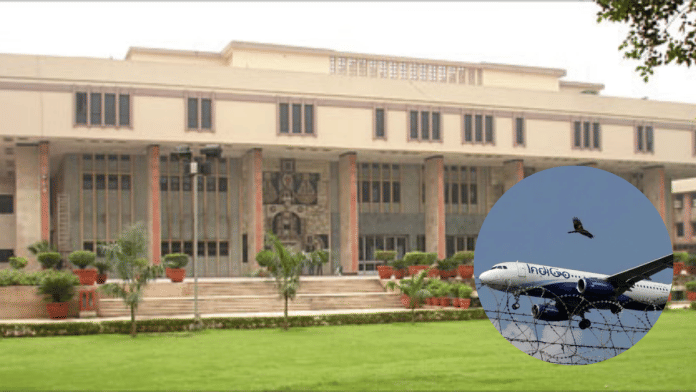



New Delhi: The Delhi High Court pulled up the Centre Wednesday over its delayed response to IndiGo’s flight disruptions, asking why it only stepped in after the situation at airports had deteriorated.
“You allowed the situation to precipitate and only then did you take action. Why did you allow all this to happen?” a bench of Chief Justice D.K. Upadhyaya and Tushar Rao Gedela asked.
The court also ordered the airline to take effective steps to initiate compensation to passengers stranded and affected by flight disruptions and cancellations. The Ministry of Civil Aviation and the Directorate General of Civil Aviation (DGCA) are to ensure compliance.
The court said the compensation was not just for cancellation but also for other sufferings of passengers, especially children and senior citizens.
Additional Solicitor General Chetan Sharma, representing the Central government, told the court that the “government has done more than it could”, pointing to the appointment of an inquiry committee and restorative measures. He also asked that there should not be a “knee-jerk reaction” to the situation.
The government on Tuesday ordered IndiGo to reduce its operations by 5 percent, later increasing the cut to 10 percent, following the cancellation of thousands of flights because of a shortage of pilots after it failed to plan adequately for new rules limiting how many hours they work.
The crisis, which began on 2 December, has now stretched into its ninth day as of Wednesday.
The court also asked IndiGo to comply “strictly” with a 6 August 2010 DGCA circular detailing the facilities to be provided to passengers by airlines due to denied boarding, cancellation of flights and delays in flights. It also asked the ministry to ensure it was enforced.
The court’s order came after the judges heard the Centre’s submissions on a public interest litigation petition filed by two advocates, Utkarsh Sharma and Akhil Rana, seeking government support and refunds for affected passengers.
The court took strong note of the manner in which the petition was drafted with “vague prayers”, saying the petition was “not up to the satisfaction of the Court” and lacked “adequate research”, but it took up the matter due to severe public interest in the matter.
The court asked the Centre to ensure that the situation returns to normal at the earliest “without any compromise to the safety of the passengers”.
The court also told all airlines to “employ an adequate number of pilots” in line with the Flight Duty Time Limitations (FDTL).
“If a pilot is supposed to do 2 landings in a night and he is doing 6, he is compromising on people’s safety,” it said.
The Chief Justice also noted that IndiGo could not recruit an adequate number of pilots in line with FTDL norms.
Chief Justice Upadhyaya expressed concern about not just the passengers being stranded but also the country’s economy being severely affected by the flight disruptions.
He raised a question about the “agony” of the passengers and the manner in which the airline’s “hostile staff” conducted the entire situation.
Also Read: IndiGo was irresponsible — but so was a regulatory system that failed to act on time
What is the inquiry report?
The DGCA informed the court that it formed a four-member committee to review IndiGo’s response on 5 December, three days after the situation turned for the worse.
The court noted that the DGCA found “prima facie deficiencies in internal oversight and compliance plans”.
The committee called for massive regulation to identify the main cause behind fluctuating roster systems and to establish issues in FTDL compliance.
A 6 December show-cause notice by the DGCA was placed on record, asking IndiGo to explain why action should not be initiated for alleged violations.
In reply to this notice, the airline has apologised “profusely”, the court was informed.
The committee will submit its status report to the court in a sealed cover on 20 December. IndiGo will also have a fair chance to give a reply to the situation.
The court refrained from making any further observations until then.
Also Read: IndiGo blamed most of its flight cancellations on FDTL changes. What are these safety rules?
What did IndiGo say?
Representing IndiGo, Advocate Sandeep Sethi told the court that “multiple other factors” led to the current situation, including “technical glitches and bad weather conditions in the East and North East”.
He informed the court that the airline had already refunded Rs 1,100 crore on account of the cancellations and requested the court not to go by media reports as “this situation has come up for the first time in 19 years of their functioning”.
According to him, they have been the most “reliable” airline in all of South Asia.
Sethi did not make a full submission to the court as the inquiry report is pending, but assured that it was doing its best to bring the situation back to normal.
Price surges in other airlines
The court was told that the Ministry of Civil Aviation had issued a letter on 6 December 2025 mandatorily capping fares to check an unreasonable hike in fares by other airlines.
But the court observed that these steps were taken only after four to five days and not immediately. It also asked how airlines could hike a Rs 3,000 ticket to Rs 30,000 or Rs 40,000, “taking advantage of the situation”.
One-time exemption to IndiGo
In 2024, the DGCA introduced new rules on duty and rest, which were to be implemented in a phased manner by the direction of the court.
The court on Wednesday noted the provision of giving rest to pilots was to be implemented from November 2024, but IndiGo had not carried it out.
“In case any airline failed to adhere, what is the provision available to you in case of failure by these airlines? Are you helpless? What action could you take against them for failure to adhere?” the court asked.
The court’s observations stemmed from a separate matter before a single judge on FDTL implementation.
The court was informed that the DGCA had regular meetings regarding the implementation of FDTL norms, and while small airlines repeatedly made their representations before the court to ensure their compliance with the rules, IndiGo and Air India took time.
Furthermore, IndiGo was granted an exemption from complying with the rules in the stipulated time, by 1 November.
Anjana Gosain, representing the DCGA, said it was not giving the exemptions happily. “If we had not granted these exemptions, it would have had a cascading effect,” she said.
The next hearing is on 22 January 2026.
(Edited by Sugita Katyal)
Also Read: Indigo crisis is a management failure. Don’t blame the pilots