





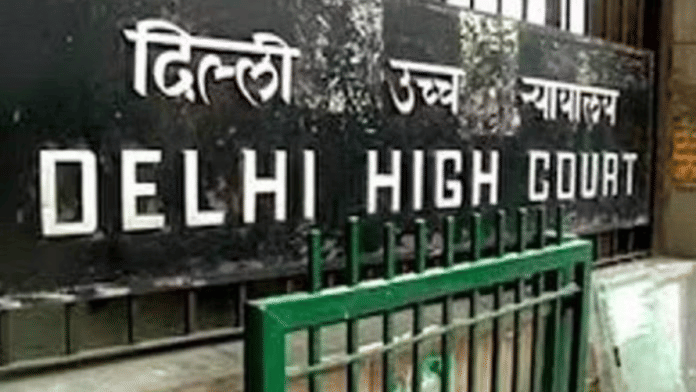



New Delhi: The Delhi High Court this week intervened to restrain the circulation of online content linking convicted-offender Jeffrey Epstein to daughter of Union Minister Hardeep Singh Puri, holding that she had made a “prima-facie” case for grant of an injunction restraining publication and directing takedown of content.
In an interim order, Justice Mini Pushkarna noted that the balance of convenience was in favour of Himayani Puri and that irreparable injury shall be caused if such posts are not restrained.
The HC directed that specific posts, videos and articles identified in the suit be taken down till the next date of hearing in August. It further restrained defendants from “publishing, re-publishing, circulating or disseminating” the content “in any manner, whether directly or indirectly”.
It further clarified that the order would extend not only to existing URLs but also to “subsequently discovered” identical or similar content. The HC also directed platforms to step in and remove the material if the original publishers fail to comply within 24 hours.
This is not the first defamation dispute involving the Union minister’s family. In 2024, Hardeep Singh Puri’s wife Lakshmi Puri had moved the Delhi HC against Trinamool Congress spokesperson Saket Gokhale over certain tweets made in 2021 alleging irregularities in property-related transactions.
In that instance, the court had then found the tweets to be “false” and “maliciously made”, holding that they caused reputational harm. The HC had then ordered Gokhale to issue an unconditional apology, take down the posts, and pay Rs 50 lakh in damages to Lakshmi Puri.
“It is accordingly held that the offending tweets are per-se defamatory; that the plaintiff has suffered undeserved legal injury to her reputation, which warrants redressal,” the court had held in that case.
In the present case, the civil suit was filed by Puri following the circulation of online documents linked to Epstein in February 2026.
Puri contended that multiple posts across platforms sought to link her and her family to Epstein through allegations of financial impropriety, professional misconduct and illicit transactions. She said that these were a “systematic, coordinated, deliberate, and malicious campaign” of defamation.
These posts had claimed that Puri was associated with a “convicted criminal”, to allegations of receiving about Rs 8,400 crore “purportedly” from Epstein, to insinuations of regulatory violations and unethical business practices.
Puri denied all such allegations and told the court that she has never interacted or communicated with Epstein. She argued that the allegations are chronologically impossible, including claims tied to Realm Partners LLC that had ceased fund-raising activities years prior to the alleged transactions and had formally shut operations thereafter.
She said that she was being maliciously targeted in a “concerted and motivated manner” solely because her father was a serving Union minister and former diplomat.
The New York resident also told the court that her professional reputation is her most “valuable asset” and that continued circulation of such content would cause “serious and irreparable harm” to her.
Based on these grounds, Puri had sought global removal of the content, relying on an earlier Delhi HC decision in the 2019 Baba Ramdev defamation case.
However, counsel for the platforms said that the issue of a global takedown is currently pending before a division bench of the HC and should not be ordered at this stage.
One of the issues in the Ramdev case is whether Indian courts can order global takedowns of defamatory content, or whether relief must be limited to geo-blocking within India.
This position is currently under challenge and technology platforms, including major intermediaries, have argued that global takedown orders raise concerns of international comity and risk exporting Indian legal standards to the global internet.
With the scope of take-down orders still pending, the HC in this case has not ordered a global removal but taken a narrower route by providing a relief “within the jurisdiction of India/Indian domain”.
The HC said that content uploaded from India IP addresses must be disabled, while content uploaded from outside India must be blocked and disabled within India to ensure that users in India are unable to access such content.
Akshat Jain is a final-year student at the National Law University, Delhi and is a contributor with ThePrint
(Edited by Tony Rai)
Also Read: ‘Met Epstein 3-4 times as part of delegation’—Hardeep Puri after Rahul rakes up issue in Parliament