





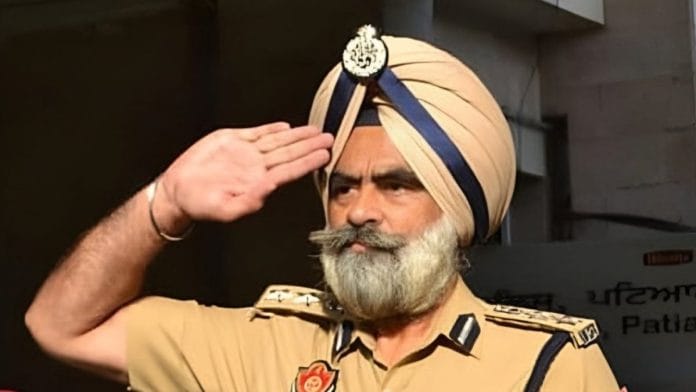



New Delhi: The place of crime—not the posting of an official alleged to be involved in the crime—decides the jurisdiction of a CBI investigation, a Chandigarh special court has ruled. With this, the court, two days ago, dismissed the bail application filed before it by suspended Punjab Police DIG Harcharan Singh Bhullar.
In October 2024, the Central Bureau of Investigation (CBI) took Bhullar into custody from his office in Mohali in connection with a bribery case involving a scrap dealer. The CBI first arrested national-level hockey player Kirshanu Sarda, allegedly red-handed, while he was accepting a bribe in Chandigarh. Sharda acted as a middleman between Bhullar and the scrap dealer, according to the CBI.
DIG Bhullar’s counsels, S.P.S. Bhullar and H.S. Dhanoa, are now arguing that the CBI was not sanctioned to arrest the DIG from his office in Mohali. The advocates contend that the CBI lacked the Punjab government’s approval, which was necessary to act against the DIG within the state. To emphasise this, Bhullar and Dhanoa have noted that DIG Bhullar, at the time of his arrest, was serving as police deputy inspector general in Punjab’s Ropar range.
“Moreover, the demand was raised by A-2 (Sarda) on behalf of A-1 (Bhullar) in the case in hand at Chandigarh; bribe money was accepted at Chandigarh; trap was laid down at Chandigarh; recovery of tainted money was effected at Chandigarh; and related acts regarding acknowledgment of the bribe money to be that of accused-petitioner (A-1) and related acts, occurred at Chandigarh, i.e, within the jurisdiction of the Union Territory,” the court said.
Chandigarh, and as such, the territorial jurisdiction of Chandigarh, therefore, is valid, held Special CBI Judge Bhawna Jain in the order, adding, “Merely due to the posting of the accused-petitioner in Mohali at the relevant time would not govern the jurisdiction, and it is the genesis of the crime, which would govern the jurisdiction.”
“As such, the contention raised on behalf of the accused-petitioner, regarding the jurisdiction of the CBI, does not hold good,” she further observed.
The court also stressed that the provisions of the Delhi Special Police Establishment (DSPE) Act, 1946, which governs the CBI’s function and jurisdiction, would be applicable in Union Territories, where the CBI has full powers of local police.
The court pointed out that the grounds raised by CBI counsel Narinder Singh on how Bhullar could influence the probe and witnesses after being released on bail were not “misfounded” since Bhullar was a highly placed official in the Punjab Police.
“The accused-petitioner was the DIG of Ropar range of the state of Punjab at the time of commission of the alleged crime and amassed the huge wealth of crores of rupees during his service. In view of his position, it is evident that he must be well-connected, having links with the high-ups in the society,” Judge Jain observed.
Citing a delay of more than two months in filing a complaint with the CBI, the DIG’s bail plea had questioned the authenticity of the complainant’s allegations. But the court also junked this ground of bail raised by the advocates for DIG Bhullar.
“The silence of the complainant in moving the complaint to the CBI from 05.08.2025 to 11.10.2025 does not cause any prejudice to the mind of the court, for the complainant—being a layman—must have taken the time to gather courage to complain against a senior police officer of the rank of DIG,” the court observed.
Days after arresting DIG Bhullar in the corruption case, the CBI lodged another case against him on the grounds of holding assets disproportionate to his legal income. The CBI has since filed a chargesheet in the corruption case. The case is ongoing before the Chandigarh special court.
(Edited by Madhurita Goswami)
Also Read: 2020 Delhi riots case: SC distinguishes Umar Khalid & Sharjeel Imam’s role from others to deny bail