





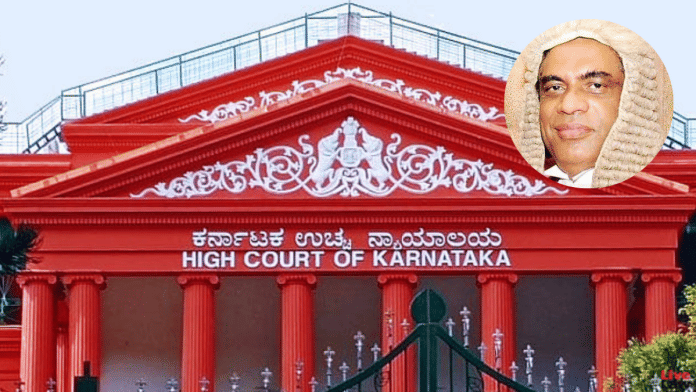



New Delhi: A sitting judge of the Sri Lankan Supreme Court has moved the Karnataka High Court, seeking the court’s intervention to remove certain defamatory publications against him and secure justice.
As Google’s headquarters are situated in Bengaluru, the Karnataka HC is the appropriate forum for addressing the legal ramifications of the defamatory content in question, Justice A.H.M.D.Nawaz of the Sri Lankan Supreme Court petitioned. It is important to note that Sri Lanka does not have any Google offices at the moment.
The said articles were from news articles published in newspapers in February 2015 and 2020. While one of these articles was from the Colombo Telegraph and was titled ‘Gota’s Account Controversy and The Division of Financial Responsibility’, the other article was from the same newspaper and titled ‘Gota’s Judges: Dirty Judge Nawaz As CA President, Kodagoda Rewarded For Dismissal Of Pre-Poll Citizenship Case’.
Apart from this, there were also two more articles by Lanka e-news, published between February and March 2020, which essentially accused the judge in a bribery case, while adding that he disappeared with 80 different case files, and another story which said that he deluded the Attorney General in the case of Choka Malli, a Sri Lankan MP who was named in a murder case.
Advocate R. Prabhakaran, who represented the Sri Lankan judge, shared the reasons for filing the plea. “One of the main reasons for approaching the Indian court is that the petitioner is a sitting judge of the Sri Lankan SC, and no man can be a judge in his own cause,” he told ThePrint.
The Google headquarters is based in Bengaluru, India and not in Sri Lanka, the Delhi-based lawyer told ThePrint. “In 2023, we issued Google a notice and they responded saying that they will remove the defamatory content only if the court asks them to remove it. Hence, we filed the present plea.”
A sitting judge cannot be tarnished on Google otherwise the reputation of the entire country and even its judiciary is at stake, the lawyer said, adding that in the NCERT textbooks case as well, the Indian judiciary banned the school text book which hinted at corruption in the judiciary.
On Thursday, a bench of Justice Sachin Shankar Magadum issued notice on the plea seeking responses from the Ministry of Electronics and Information Technology (MeitY) by 16 March.
Flagging the articles published in a now-quashed case as “dirty and corrupt”, Justice Nawaz said that the accusations were wholly unfounded and deeply damaging to his personal and professional standing, and could also harm the judiciary’s reputation and integrity.
‘Malicious, unjustified campaign’
In a 72-page plea, the Sri Lankan SC judge said that he was approaching the court owing to certain defamatory and “misleading” articles published against him on Google.
Despite the bribery case against him being dismissed by the courts, he said, these articles, which were termed by him as “flagrantly discriminatory”, “utterly arbitrary” and “manifestly unlawful”, were still in the public domain.
He said “despite judicial scrutiny and the case being dismissed by the Sri Lankan Supreme Court”, the petitioners were seeking the court’s intervention to remove these publications and to secure justice, as the continued presence of such harmful materials has irreparable consequences on both the professional and personal lives of those being targeted.
This undermines, he said, the very foundation of the judicial system.
It pointed out on the basis of his legal opinions, which he had delivered in concurrence with the then Attorney General, Justice Nawaz became a target of a “malicious and wholly unjustified campaign” to tarnish his professional integrity and “wholesome career”.
Eventually, these allegations led to a “frivolous and spurious criminal case” concocted on the basis of political vendettas and personal grievances, with a view to besmirch the careers of him and the then AG.
The plea added that although the case was pending before a magistrate court, it was dismissed. There was another case pending before the Sri Lankan SC, which was also quashed, it pointed out, adding that this affirmed their triumph of justice over unwarranted allegations.
Determining redressal venue
Significantly, the plea pointed out that the defamatory articles were perpetrated through online platforms like Google.
“As the court time and again aptly considered the place of the server or the headquarters of the entity responsible for hosting the defamatory material must be considered in determining the venue for redress,” it said.
Referring to the 2019 SC ruling in Escorts Limited vs. Tejpal Singh Sisodia, the plea said that if an artificial person or corporation was wronged by defamation, the place of the registered office of the company would be considered when it comes to the jurisdiction.
As the reputation of a judge is the cornerstone of judicial integrity, the plea contended that it cannot be undermined through baseless and malicious articles published in cyberspace.
Relying on Article 6 of the International Covenant on Civil and Political Rights, which entails the right to life and on Article 14 of the ICCPR, 1996, which deals with the opportunity of fair trials and presumption of innocence, the plea said that the articles were intentionally crafted to cause maximum harm to the judge’s reputation.
Significantly, the plea went on to cite the right to be forgotten, upheld by the Delhi HC in several orders like the ex-Roadies and Bigg Boss winner Ashutosh Kaushik, as a facet of the right to privacy enshrined under Article 21 (right to life). “The right to be forgotten is not merely a matter of legal principle, but of moral justice, ensuring that an individual’s reputation is not irrevocably tarnished by outdated or unfounded content,” it said.
(Edited by Tony Rai)
Also Read: India activates its first privacy law: What new DPDP Rules mean for protection of your digital data