





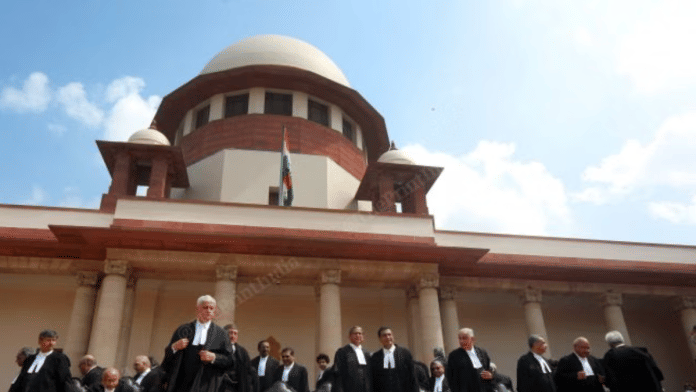



New Delhi: Fearless judges are the bedrock of an independent judiciary, the Supreme Court has observed as it reinstated a Madhya Pradesh judicial officer removed after 27 years of unblemished service over allegations of corruption linked to bail in liquor cases.
On Monday, Justices K.V. Vishwanathan and J.B Pardiwala reiterated that a “wrong” judicial order cannot amount to misconduct without proof of corrupt motive, recklessness, or extraneous influence. The court was hearing an appeal filed by Nirbhay Singh Suliya, who was accused of receiving bribes via his stenographer in liquor cases under the Madhya Pradesh Excise Act, 1915.
Allowing the appeal, the division bench set aside the removal of Suliya, ordering his immediate reinstatement with full back wages and noting that the removal could not be upheld based on the facts.
The decision went beyond the individual case to highlight a “lurking fear” among trial court judges that administrative action may follow if they grant bail.
In his concurring opinion, Justice Pardiwala observed that judges often shy away from granting bail even in deserving cases because they fear administrative action if the order is later deemed incorrect.
“This is one reason why the High Courts are flooded with bail applications,” Justice Paridwala wrote, warning that when fear takes precedence over judicial duty, the rule of law suffers.
The case before the SC involved an additional sessions judge with 27 years of unblemished service, who was removed from his post in 2014 over allegations of corruption linked to bail orders.
The dispute emerged from a complaint filed with the Chief Justice of the Madhya Pradesh High Court. The complaint alleged that Suliya was granting bail in liquor cases through corrupt means, supposedly routed via his stenographer.
However, the complaint was vague. It did not refer to any specific bail order and the complainant was never examined during the subsequent inquiry.
Despite the lack of direct evidence, departmental proceedings were initiated. The inquiry zeroed in on four specific bail orders passed by Suliya in cases under the 1915 Act involving large quantities of liquor.
The core allegation was that in these orders, Suliya did not expressly refer to Section 59-A of the Act, which prescribes twin conditions for bail in such cases. This was contrasted with 14 other bail orders where the judge referred to the provision while rejecting bail.
From this comparison, the inquiry concluded that the judge applied “double standards” and acted with an “oblique motive”. Suliya was removed from service, and the High Court later refused to interfere, terming the inquiry findings “reasonable”, and not requiring its interference.
The Supreme Court rejected the logic of the disciplinary inquiry, finding its conclusions “perverse” and unsupported by evidence.
The bench relied on previous cases like Ishwar Chand Jain (1988) to note that High Courts must protect honest officers from ill-conceived complaints made by unscrupulous litigants.
“It is therefore imperative that the High Court should also take steps to protect its honest officers by ignoring ill-conceived or motivated complaints made by the unscrupulous lawyers and litigants,” the court said.
It reiterated a series of other decisions where the court said that disciplinary proceedings cannot be initiated merely because another conclusion was possible in a case.
The court noted that the public prosecutor, who appeared in all the bail hearings, testified during the inquiry that Suliya’s orders were “absolutely proper” and based on the facts of each case. Furthermore, the state never challenged those bail orders in a higher court.
Inferring misconduct solely because a judge failed to mention a statutory section is unsustainable, it said. “It will be a dangerous proposition to hold that judgments and orders, which do not refer expressly to statutory provisions, are per se dishonest judgments.”
The court emphasised that disciplinary proceedings must examine the conduct of the officer, not the correctness of their legal verdict. This means that even if a judge passes an incorrect order, unless there is material to show the decision was driven by external considerations, disciplinary action cannot follow.
Justice Pardiwala echoed this concern, observing that initiation of departmental proceedings on “mere suspicion” has made trial court judges reluctant to exercise discretion in bail matters.
“It should not happen that because of the lurking fear in the mind of a trial court judge, of some administrative action being taken that even in a deserving case, well within the principles of law, bail is declined.”
Such reluctance at the trial court-level, he warned, has wider consequences for the justice system, democracy, and the rule of law.
He noted that authorities cannot ignore a lifetime of reputation based on a mere hunch. Doubt must be reasonably entertainable on the material before labelling an officer as one of “doubtful integrity,” Justice Pardiwala observed.
(Edited by Tony Rai)
Akshat Jain is a final-year student at the National Law University, Delhi and is a contributor with ThePrint
Also Read: Day-to-day hearings, periodic reports & more—SC’s directions to ensure speedy trial in UAPA cases