





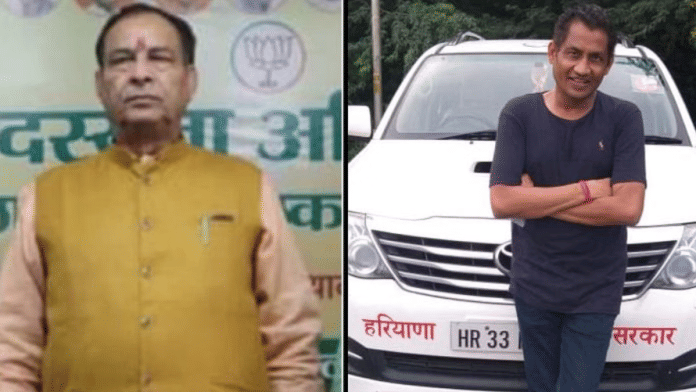



Gurugram: “The acquittal of guilty individuals, while regrettable, is a lesser evil compared to the horror of condemning the blameless.” This is what Ashok Kumar, Additional Chief Judicial Magistrate at a Kasauli court in Himachal Pradesh, said as he explained why he had accepted the closing of the gang rape case against Haryana BJP president Mohan Lal Badoli and singer Rocky Mittal alias Jai Bhagwan.
The 20-page order, which has been made available about two weeks after the court accepted the police’s cancellation report, cites a litany of inconsistencies, an unexplained 17-18 month delay in filing the complaint, questions on why the complainant accompanied an unknown person to a hotel room, the absence of a specific allegation of being forced to drink alcohol with the accused, and the outright denial of the incident by the complainant’s friend.
“When the foundational version itself suffers from serious doubts… directing further investigation would amount to permitting a fishing and roving enquiry,” Kumar ruled.
The court’s ruling effectively closed the FIR filed on 13 December 2024 against Haryana BJP President Mohan Lal Badoli and singer Rockey Mittal under Sections 376-D (gang rape) and 506 (criminal intimidation) of the Indian Penal Code.
The complainant (identity withheld) had alleged that on 3 July 2023, Badoli and Mittal introduced themselves as a politician and a singer, lured her and her friend to their room at the state-run HPTDC Hotel New Ros Common in Kasauli. After that, the complainant alleged, they made her consume alcohol and raped her.
The woman said that threats from the two and fear of stigma prevented her from filing the FIR for almost a year and a half. But, in their cancellation report filed February 2025, the Kasauli police stated that the victim refused to undergo a medical examination, and that her allegations could not be corroborated with witnesses, hotel staff and records.
The complaint’s friend whom she described in the FIR as the key witness, told the magistrate that no such incident had taken place.
In his order, the additional chief judicial magistrate noted all these discrepancies, adding the the complainant’s conduct raised serious doubts. He pointed out that it was improbable that the women accompanied strangers into their room under duress, especially with their boss staying in a nearby room.
The order also states: “There is no clear and specific allegation that intoxicating drinks were forcibly administered… The version put forth by the complainant does not appear to be probable.”
The court also referred to the FIR filed against the complainant and her associates by Mittal in September 2024, months before the women’s complaint in Kasauli. This, the judge observed, gave her allegations the “colour of being a counterblast”.
The magistrate leaned heavily on a Delhi High Court judgment in P (complainant) vs State of NCT of Delhi (2024), upheld by the Supreme Court, which emphasised that while a victim’s sole testimony can lead to conviction, it must be reliable and weighed against surrounding circumstances.
The complainant’s counsel, Mohit Girdhar and Sanyam Yadav, argued bias in the probe, citing political influence (Badoli is a prominent BJP leader), suppression of call detail records (CDRs), and pressure on her friend.
They invoked Supreme Court rulings like State of Punjab vs Gurmit Singh (1996) to argue that delay in sexual offence cases isn’t fatal to the case and a victim’s consistent statement suffices.
The complainant’s counsel contended that the complainant has consistently narrated the incident in the FIR, in her statements before the police as well as before the court, and there was no material contradiction in her version.
The counsel argued that the consistency of the complainant’s statement itself constitutes a strong prima facie material which could not have been overlooked by the police at the stage of investigation.
They further argued that the police didn’t seize the electronic devices of the accused for forensic analysis despite the complainant’s allegations of photography and videography of the incident.
But the court found no material evidence of bias or new compelling facts in the protest petition.
Assistant Public Prosecutor Vikas Sharma, representing the state, backed the closure, stressing that investigation was fair and there was no medical or witness support.
“When the best witness herself does not support the case, the complainant’s allegations do not inspire confidence,” he submitted.
(Edited by Viny Mishra)