








New Delhi: Two decades after the Indian Young Lawyers Association filed a Public Interest Litigation, legal and political reverberations continue to be felt from what has come to be known as the Sabarimala Temple case.
The Supreme Court on 7 April 2026 will begin its hearing to determine ‘questions of law’ in the case, two days before Kerala polls to elect its new government. The case remains a political hot potato in the state.
The original filer of the PIL–The Indian Young Lawyers Association–approached the Supreme Court in 2006 challenging the customary ban on entry of ‘menstruating women’ (age 10-50) to the Sabarimala temple. They argued that such a ban violated the right to equality as guaranteed under Article 14 and the right to practice or profess religion as detailed under Article 25.
The administrators of the temple–the Travancore Devaswom Board–contended the exclusion to be an essential religious practice and claimed themselves to a be a religious denomination. Article 26 allows religious denominations the right to manage internal religious affairs. Interestingly, the president of the IYLA had sought to withdraw the PIL citing threats to his life, but the court had denied it, stating that a PIL once filed belonged to the public.
Also Read: Sabarimala administration is stuck in the 1960s
‘Children of a lesser god’
In 2018, the court held the ban to be unconstitutional and violative of Article 15 and Article 25. “To treat women as children of a lesser god is to blink at the Constitution itself,” the then Chief Justice Dipak Misra-led bench of five judges stated. It was further held that Ayyappa devotees were not a separate religious denomination, and hence it was not an essential religious practice protected by law. Justice Indu Malhotra (now retired) wrote the sole dissenting opinion, arguing that “notions of rationality cannot be invoked in matters of religion”.
Reactions to the judgment were divided, hailed as progressive by some and criticised for judicial overreach by others. Over 50 review petitions were filed by individuals and organisations, including Kantaru Rajeevaru (Chief Priest of the temple), the National Ayyappa Devotees (Women’s) Association, the All Kerala Brahmin’s Association and the Nair Service Society among others. The review petitioners contended that the court erred in not recognising Ayyappa devotees as a religious denomination, and the ban was meant to isolate the deity, worshipped as a celibate, and not discriminate against women. It is also said that the original petitioners are not devotees themselves, hence the writ was not maintainable.
While hearing the review petitions in 2019, the top court, by 3:2 majority, decided to refer certain ‘questions of law’ to a larger bench. Taking note of pending cases, related to other religion, with overlapping issues – entry of Muslim women in dargah/mosque, entry of Parsi woman married to non-Parsi in the fire temple, and the practice of female genital mutilation in the Dawoodi Bohras – the majority observed that “the decision of a larger bench would put at rest recurring issues touching upon the rights flowing from Articles 25 and 26 of the Constitution”.
It was held that the review petitions will be decided post the decision on the overarching constitutional issues.
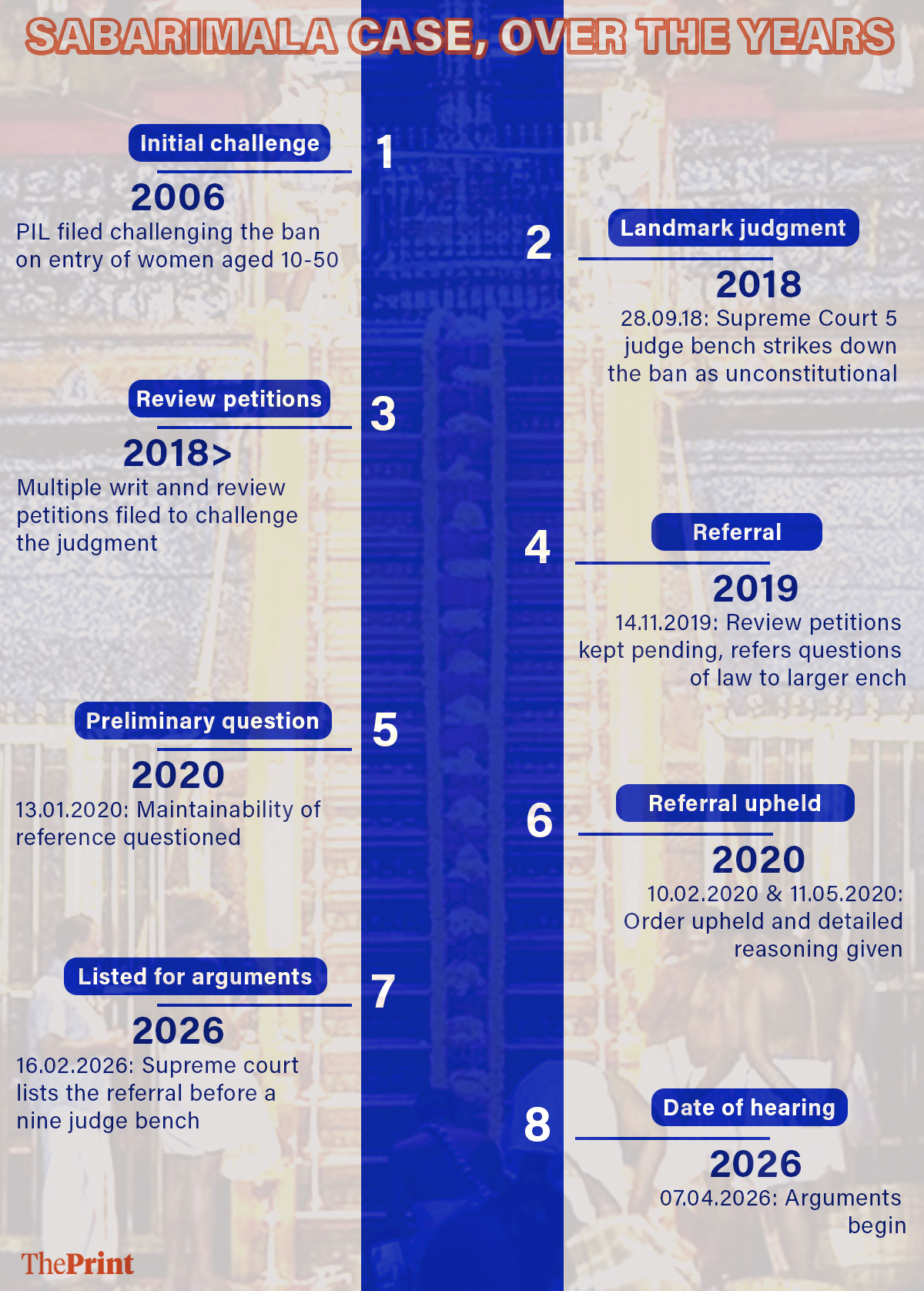
In 2020, a nine-judge bench under then CJI S.A. Bobde acknowledged the preliminary question raised by parties–whether the court, in a review petition, can refer questions of law to a larger bench. Subsequently, the court upheld the referral and issued a detailed order with its reasoning. Interestingly, current CJI Surya Kant was a part of this nine-judge bench. A nine judge bench carries exceptional significance for precedent-setting constitutional interpretations.
Referring extensively to the Supreme Court Rules 2013 as well as Articles 142 and 145 of the Constitution, the court clarified on its own power of review. It was held that, as a superior court of record, the Supreme Court is entitled to determining questions of its own jurisdiction with no matter beyond its jurisdiction, unless expressly excluded by the Constitution.
In February 2026, the court issued a detailed order for the reference hearing, setting out a timeline for both sides to complete their arguments. Senior Advocate K. Parameshwar and Advocate Shivam Singh were appointed as amicus curiae. Sixty-six connected matters were tagged to the reference, including the Muslim women, Dawoodi Bohras, and Parsi /Non-Parsi cases.
As directed by the court, parties, including intervenors, have filed their submissions before the fixed date of hearing. Broadly, the arguments advanced revolve around what constitutes essential religious practice and whether the judiciary is the appropriate forum to determine its elements.
A group of Jain organisations—an intervenor in the case—submitted that courts must not interfere with the “internal autonomy” of religion, and called upon the protection of Article 25 for freedom of religion. They question the essential religious practices doctrine, introduced by the court in the Shirur Mutt case.
The All India Muslim Law Board too finds issue with the doctrine, contending that “courts must not attempt to judicially determine the nature of religious practices”. The board also asserts gender and religion to not be opposing identities. The Akhil Bhartiya Sant Samiti, an umbrella Hindu group, seeks to intervene submitting that the court is not a religious expert.
The State of Kerala calls for consultations with religious scholars and social reformers before any judicial intervention. The Travancore Devaswom Board, which manages the Sabarimala temple, has asked the court to apply a subjective rather than objective test, and not to sit in judgment on the religious beliefs of a community.
As the nine-judge bench convenes on April 7, 2026, the Sabarimala saga will test the Supreme Court. Whether it upholds the 2018 judgment or defers to religious autonomy, this referral will recalibrate the delicate interplay of Articles 14, 15, 25, and 26. It may redefine not merely who ascends Sabarimala’s 18 steps, but how a secular democracy balances sacred customs with modern rights.
Saumya Sharma is an alum of ThePrint School of Journalism and an intern with ThePrint.
(Edited by Nardeep Singh Dahiya)
Also Read: Poll season on horizon, Sabarimala gold ‘theft’ stirs the pot in Kerala. UDF takes on ruling LDF