





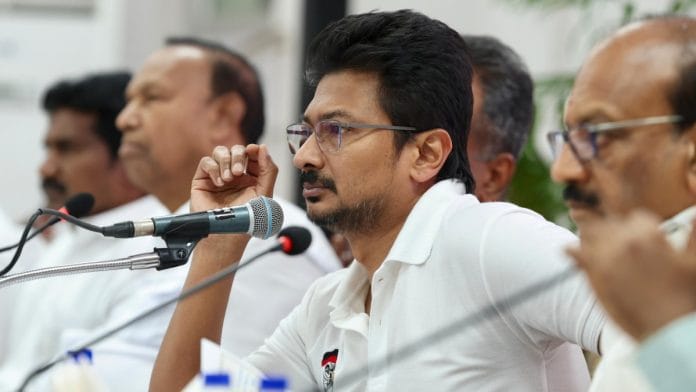


New Delhi: The Income Tax Department Monday informed the Madras High Court of “inconsistencies” in the income tax returns, and the 2021 and 2026 poll affidavits of Tamil Nadu Deputy Chief Minister and DMK leader Udhayanidhi Stalin.
However, it has said that many relevant financial records are “not readily available” yet, and no “conclusive inference” can be drawn regarding the variations mentioned in the affidavits without a thorough examination, which will take time.
The High Court Bench of Chief Justice Sushrut Arvind Dharmadhikari and Justice G. Arul Murugan granted the department four more weeks to carry out the investigation.
The election affidavits of CM M.K. Stalin’s son are being scrutinised after a resident of his constituency (Chepauk-Thiruvallikeni) filed a plea before the high court on 15 April, alleging discrepancies in his election affidavit. The court had sought the IT department’s response on 16 April, which was submitted to court Monday.
The I-T department’s response filed by Deputy Director of Income Tax, (Investigation), Tamil Nadu and Puducherry stated that ITRs filed for respective financial years “do not capture or reflect the investments or loans etc as on the exact dates of filing of the said affidavits”.
It added that given the “temporal incongruity between the affidavit dates and the financial reporting periods” under the ITRs, “a direct and conclusive comparison cannot be undertaken at this juncture without a detailed verification, reconciliation of records and enquiry with the parties concerned”. Consequently, the department requires additional time to conduct a comprehensive verification of the assets and investments declared by Udhayanidhi.
Udhayanidhi declared a personal investment of over Rs 7.36 crore in M/s Red Giant Movies in his 2021 affidavit, which is not mentioned in his 2026 affidavit. Instead, an investment of approximately Rs 2.63 crore is declared in the name of his spouse, Kiruthiga Udhayanidhi.
The I-T department told the court that because recent ITRs were filed in Form ITR-2—“which does not mandate a balance sheet”—it is currently impossible to ascertain or verify the existence or quantum of these investments without further enquiry.
The department further mentioned conflicting figures regarding loans advanced to a company, M/s Snow Housing Private Limited. While the 2026 affidavit declared a loan of Rs 10 crore, the department noted that audited financial statements from FY 2020-21 to FY 2022-23 reflect no investment by the deputy CM in the entity. Furthermore, the company has reportedly failed to file audited financial statements from FY 2021-22 onwards, making it impossible to reconcile the “Loans and Advances from Related Parties” at this stage.
Filing his nomination earlier this month, Udhayanidhi declared assets worth Rs 20.64 crore, including moveable assets of Rs 12.92 crore and immoveable ones worth Rs 7.72 crore. This is a dip from the Rs 27 crore that he had declared in 2021. Meanwhile, the declared assets of his wife saw a jump from Rs 1.15 crore to over Rs 13.25 crore.
Under the Representation of the People Act, 1951, a candidate is mandated to disclose the assets, liabilities, and income of their spouse and dependents.
The plea alleging discrepancies
The writ petition filed by resident R. Kumaravel, who insisted that voters must know about the assets of every candidate before the day of polling, has sought a probe into these “material discrepancies”.
The plea, filed by advocate V. R. Shanmuganathan, noted that the minister has not disclosed any transfer, sale, or restructuring to explain this change in his election affidavits.
The plea also notes “discrepancies” in his asset disclosure as a violation of the Representation of the People Act, 1951, and the right to information of voters, seeking an inquiry into it.
The IT department explained that a “direct and conclusive comparison” between election affidavits and Income Tax Returns (ITRs) is currently impossible as Udhayanidhi filed his election affidavit for the 2026 Assembly Elections on 1 April, 2026. However, the department noted that ITRs for the corresponding financial years do not yet reflect investments or loans as they stood on that specific date. This gap, it said, necessitates a detailed verification, reconciliation of records, and enquiry with the involved parties.
The department follows a Standard Operating Procedure (SOP) issued by the Central Board of Direct Taxes (CBDT) on 20 March, 2019, for verifying candidate affidavits. This process typically commences on its own motion after the Election Commission of India announces poll results. The Investigation Division of CBDT is generally accorded a 150-day window from the date of initiation to complete the process of verifying the financial statements and detecting undisclosed income.
Inconsistency in spouse’s asset records
The I-T department also pointed to challenges in verifying investments in a firm named Raj Promoter Private Limited. The 2026 election affidavit discloses that his wife Kiruthiga holds an investment of over Rs 5.76 crore in this company associated with real estate and construction.
The affidavit has described the transaction as a direct “investment”, while the company’s own financial statements reported a Rs 6.75 crore loan from her.
The department has stated that it cannot correlate these figures because the wife has not yet filed her ITR for the corresponding FY 2025-26, and a loan and investment are treated differently under legal and accounting rules.
(Edited by Viny Mishra)
Also read: ‘Udhayanidhi’s Sanatana remarks fall within hate speech’: Madras HC quashes FIR against Amit Malviya