





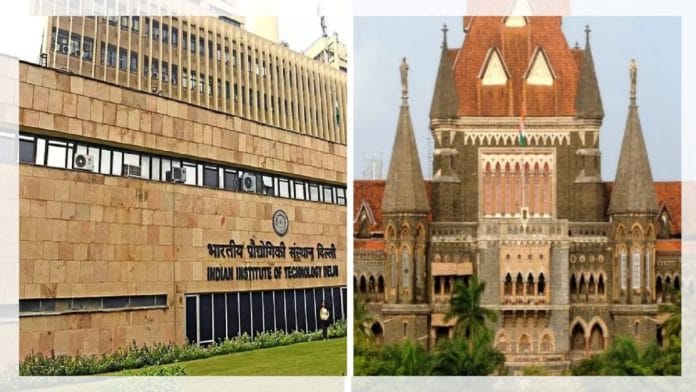



New Delhi: The Bombay High Court Tuesday said that misconduct under the prevention of workplace sexual harassment Act cannot be taken lightly, stressing it must be dealt with “utmost gravitas”.
With that, the high court set aside an IIT Bombay professor’s plea to quash an internal complaints committee’s order for his “compulsory retirement”, which followed a student’s sexual harassment charges against him.
Pronouncing the judgment, a two-judge High Court (HC) bench comprising of Justices Advait M. Sethna and R.I. Chagla clarified that special laws, such as the Prevention of Sexual Harassment of Women at Workplace (Prevention, Prohibition and Redressal) Act, 2013, will always prevail over general laws.
“In such matters involving allegations not merely of indiscipline but of serious misconduct, a myopic approach under the extant legal framework ought not to be adopted,” the bench ruled.
Considering that a specialised fact-finding body, the internal complaints committee (ICC), rendered its decision after “a full-fledged inquiry” in which the professor “fully participated”, the bench found no violation of natural justice principles—decisions should be impartial and all parties receive a fair hearing.
Speaking to ThePrint, Advocate Arsh Misra, who appeared from IIT Bombay’s side, said, “The professor was penalised with compulsory retirement from the institute after the ICC conducted a detailed inquiry. Natural justice principles were strictly followed in this case.” Misra said the court ultimately upheld the institute’s management’s decision to order his compulsory retirement.
Before the high court, the accused’s lawyer, Ramesh Ramamurthy, argued that imposing punishment on the professor based on the ICC’s report, without issuing a chargesheet, violated Section 13(3) (1) of the POSH Act. The provision states that when the ICC concludes that an allegation is proved, it shall recommend the employer to take action for the sexual harassment, considering it as misconduct under the service rules applicable or in any other manner prescribed.
The lawyer argued that since the Institutes of Technology Act, 1961, did not have a procedure in place for giving penalties, the Central Civil Services (Classification, Control & Appeal) Rules, 1965, should instead apply.
The CCS (CCA) Rules, which govern central government officers, mandates a formal chargesheet following an inquiry.
ThePrint reached Advocate Ramesh Ramamurthy for his comment via texts and calls. This report will be updated if and when he replies.
The case & arguments
The case dates back to March 2023, when a student filed a complaint with the college against the professor, accusing him of sexual harassment between March 2022 and September 2022. Nearly eight months later, the ICC issued a report based on the complaint and its fact-finding inquiry. During the process, the professor’s defence and the statements of witnesses were recorded. The professor was allowed to cross-examine the witnesses too.
Afterwards, the ICC’s report recommended removing the professor from service as a form of penalty. Objecting, he filed an appeal against the ICC order before the institute’s board of governors, which acted as the disciplinary authority for the university. In February 2024, the disciplinary authority also directed IIT Bombay to remove the professor from service by ordering him to take compulsory retirement. The ICC had also mentioned that if required, the board of governors could take further action against the professor.
In April that year, he was asked to show cause as to why penalties should not be imposed against him. Shortly after, in May, he filed his reply. The board, thereafter, issued an order on 18 June 2024, directing him to take compulsory retirement before his tenure officially ended. The professor then challenged the order in the Bombay HC.
Relying on the 2025 Supreme Court ruling in Dr Sohail Malik’s case, he submitted before the court that statutory rules should prevail over the institutes’ Act and Policy, as the latter did not provide a procedure for giving penalties. Even after a formal inquiry under the POSH Act, he argued that a formal chargesheet should be issued.
On the other hand, IIT Bombay argued that the action taken by the board aligned with Section 13(3)(1), and Rule 9 of the POSH Rules, clearly allowing the ICC to give recommendations to the employer for taking actions. These actions could include demanding a written apology, issuing a warning, reprimanding or censuring the employee, withholding promotion or raise, and “terminating” service, among other penal measures.
What the court ruled
Emphasising that it is settled law that wherever special laws exist, they always prevail over general laws, the high court ruled that the POSH Act and its accompanying rules would prevail over the CCS Rules—which require an additional chargesheet—in this particular case. “This is not a case of ‘unoccupied interstices’, where any gap in the Rules and/or instructions is to be filled,” it said, dismissing the professor’s appeal against the ICC order.
Allowing the professor’s plea would amount to the court permitting a “double inquiry”, the bench said, adding that such a manner of conducting inquiry would undermine the objectives of special statutes, such as the POSH Act. Stating that it found no merit in his case, the bench said that apart from his case being legally vulnerable, it neither appealed to conscience, nor would it meet the ends of justice in the court’s considered view.
The court noted that the very object, purpose, and purport of the POSH Act and Rules is specifically to address sexual harassment and that the Act is a “complete code”.
(Edited by Madhurita Goswami)
Also Read: 9 in 10 abortion petitions succeed in Bombay HC. A rare bright spot in Indian judiciary