





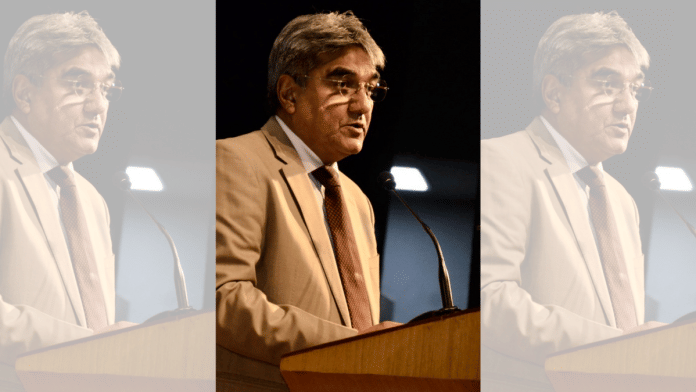



Balotra (Rajasthan): Not just external enemies, there are forces within the country working to weaken and ensure the objective of “social harmony” is not achieved, Supreme Court judge Justice Vijay Bishnoi said Friday.
The judge was speaking at the two-day 17th National Conference of the Akhil Bharatiya Adhivakta Parishad in Rajasthan. The theme of the conference was ‘75 years of the Indian Constitution—Social Harmony’. The event was also attended by another Supreme Court judge Justice J.K. Maheshwari, Justice Dr Pushpendra Singh Bhati of the Rajasthan High Court, Solicitor General Tushar Mehta, Akhil Bharatiya Adhivakta Parishad president and senior advocate K. Srinivas Murthy, and the general secretary advocate D. Bharat Kumar, among others.
In his address, Justice Bishnoi called for rumination on whether we had achieved the objective of “social harmony”. He quoted Dr B.R. Ambedkar, who had said, “We must make our political democracy a social democracy as well. Political democracy cannot last unless there lies at the base of it social democracy. What does social democracy mean? It means a way of life which recognises liberty, equality and fraternity as the principles of life. These principles of liberty, equality and fraternity are not to be treated as separate items in a trinity. They form a union of trinity in the sense that to divorce one from the other is to defeat the very purpose of democracy.”
The apex court judge further asserted that social harmony cannot be achieved merely by speeches, and that there would have to be active and constant effort for it. “The manner in which an attempt is being made to disturb the social harmony in the country and to weaken the country. It becomes the duty of the lawyers who have gathered here to figure out such designs to disturb social harmony and weaken the country.”
Referring to an earlier speech by senior advocate K. Srinivas Murthy, the judge said, “Like Srinivas ji said, forming nations on language or on caste is a very dangerous concept. If people say only Rajasthani people should stay in Rajasthan or only Marathas will stay in Rajasthan, or only Malayalis will stay in Kerala. This concept is fatal.”
He added, “It should be the role of all of us lawyers to ensure that whenever such an attempt is made, we must figure out how to contribute to end it immediately.”
Speaking on the topic ‘Unity and Integrity of the Nation—Constitutional Mandate’, Justice Maheshwari referred to several Constitutional provisions that mention the unity and integrity of the nation. Among other things, he also recalled that jurist and former Rajya Sabha Member L.M. Singhvi had advocated for defining Indian secularism as “panth nirpeksha” (non-discrimination towards individual faiths), rather than “dharm nirpeksha” (indifference to religion).
Also Read: Vishal Gogne, the judge who took ED to task & who Rabri Devi doesn’t want to face
‘Constitution not copied’
At the event, Justice Vivek Singh Thakur of the Himachal Pradesh High Court spoke on the topic ‘Bharatiya Chetna (Indian consciousness)—Constitution’. In his hour-long speech, he asserted that the Constitution is not copied, and that “the conscience of India has been protected in the Constitution”. He compared beliefs in the Western society with principles in ancient India.
For instance, he pointed out that in the west, society was for the king, and that the people were his subjects, while in India, it was said that the king was not paramount. He said that when a king was crowned in India, it was said that ‘Dharam’ (religion) was supreme. However, he asserted that ‘Dharam’ wasn’t a way of worship or going to a place of worship, it is a “righteous path, the right way to live human life”.
With several such examples, he examined whether the Constitution was inspired by ‘Bharatiya values’ or was inspired by western thoughts.
Alleging a distortion of history, he asked, “Even though we were older than Egyptian civilisation or Mesopotamian civilisation, we were told a timeline by British historians which taught us that our ancestors were goat grazers… You are all learned, do you think people who graze goats like shepherds, can you compose the Rig Veda, Atharva Veda, Sam Veda, Yajur Veda?”
Speaking of socialism and secularism, he said that the Constituent Assembly members acknowledged that “spirituality is the soul of India”. He asserted that when the Constitution was being framed, socialism meant ‘communist revolution’, and the meaning of the word ‘secular’ was ‘non-believers’, and negation of religion or a state without religion.
However, he said that Indian socialism is an “entirely different concept”, and the Directive Principles of State Policy reflected the socialist culture of India at the time.
“They didn’t add it to the Preamble at the time (of framing of the Constitution) because its meaning would have been a disaster at that time. It would have misrepresented our Constitution,” he said.
Speaking on Indian secularism, he said that there is a misconception that “we are tolerant”.
“We are neither tolerant, nor were we ever tolerant. We are the culture that accepts all. For a democratic nation, we don’t need tolerance, we need acceptance…which was always present in India,” the high court judge explained.
Justice Thakur said that when socialist and secular words were finally added to the Constitution in 1976, “there was no significant difference”, because by then the two words had been correctly interpreted according to Indian thoughts by the courts and the direction taken by the country post independence.
‘Scriptures tell our history’
Justice Thakur advocated for not considering our religious scriptures as scriptures. “They tell our history, our culture, our state system, and the state’s thinking.”
Talking about equality, he said that Hindus say, “Aham Brahma, Tva Brahma, Jagat Brahma” (I am Brahma, you are Brahma, the universe is Brahma), which he said means we are all equal.
“When our Muslim brothers say ‘La Ilaha Illallah’, it means there is nothing except god. Is there any difference between the two? This is why when Islam came to India, invaders tried to forcefully convert people, but Indian Islam gave birth to Sufism, which involves acceptability of others with Islam,” he said.
Justice Thakur also defended Manusmriti, saying that those who consider Manusmriti casteist should read the book as a “researcher”.
Recalling several stories from the scriptures, he asserted, “India’s consciousness has been expressed through the Constitution; India’s consciousness has not been created by the Constitution”, and the democratic principles were always present in Indian culture, and the Constituent Assembly had only manifested it in the form of the Indian Constitution.
(Edited by Shashank Kishan)
Also Read: Ignorant lefties waving the Constitution are basically saying there was no India before 1950