





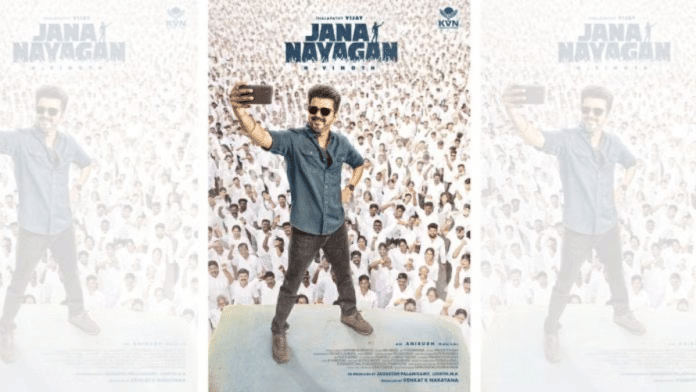



New Delhi: The fate of Tamil superstar Vijay’s film Jana Nayagan hangs in limbo after the Madras High Court Tuesday set aside a single-judge bench’s 9 January ruling directing the Central Board of Film Certification (CBFC) to grant the film a U/A certificate.
The film, touted as Thalapathy Vijay’s last film before he entered mainstream politics, was originally slated for a Pongal release on 9 January, but the release was delayed after the CBFC refused to give its clearance.
The movie, which also features Hindi movie actors Bobby Deol and Pooja Hegde, generated significant buzz after it was touted as Vijay’s last film before he entered mainstream politics.
A division bench of Chief Justice Manindra Mohan Shrivastava and Justice G. Arul Murugan sent the case back to the single-judge’s bench for a fresh decision, saying the principles of natural justice were not followed the first time since the censor board was not given enough time to decide and respond.
The Madras High Court’s single-judge bench will now decide the matter anew after considering the censor board’s response.
In the meantime, the court also allowed the film’s producers to challenge the CBFC chairperson’s order to send the movie for review.
Senior advocate Pradeep Rai, who represented the production house in this case, told ThePrint, “The release of the film ought not to have been blocked by the censor board. It is evident that the chairman had already exercised his statutory powers and granted permission for the release by issuing a U/A certificate on 22 December, subject to certain cuts. Though the order had specifically said that if the producers have any grievance, they can file a revision, the producers had gone ahead and fully complied with the cuts imposed by the Board.”
Also Read: Friday blockbuster: Nail-biter that played out in Madras HC over Vijay’s movie ‘Jana Nayagan’
The controversy surrounding the movie’s release
The movie’s producers, KVN Productions, sent the film to the CBFC for a clearance certificate in December 2025, after which the censor board granted it a U/A 16+ certificate subject to certain cuts and edits.
The producers made the changes and resubmitted the film, but said they received no response even though they informed the board by email.
The film’s audio launch was held on 27 December, where Vijay was also present.
However, on 5 January, the CBFC chairman referred the film back to the revising committee, based on a complaint made by the board’s examining committee, saying the film could hurt religious sentiments and show the defence forces in a negative light.
Finally, the matter reached the Madras High Court at the behest of the film’s producers, which, after hearing the case, reserved its judgment.
However, on 9 January, a single judge, Justice Asha, had directed the CBFC to set aside the chairperson’s referral sending the movie for review, and granted the U/A certificate.
The court noted that the chairperson had sent the movie even after it had already been certified, and that this action lacked jurisdiction. The court had also frowned upon the CBFC entertaining complaints from the examining committee members despite them already having given these recommendations earlier.
In the 9 January ruling, Justice Asha had also set aside a 5 January communication by the regional officer, informing the film’s producer that, based on a complaint, the censor board’s chairperson had referred the matter to the revising committee.
Despite this, shortly after the 9 January order, the CBFC filed an appeal before a two-judge bench this time, and managed to halt the operation of the order through a court-imposed stay, leading the producers to approach the top court this time.
On 12 January, the Supreme Court declined to interfere with the plea. The Madras High Court reserved its ruling in the case on 20 January.
However, seven days after reserving its order, the Madras High Court on Tuesday set aside the single-judge order, which had earlier allowed the release of the movie.
Simply put, this means that the movie will have to overcome more hurdles and a web of legal obstacles before it finally sees the light of day.
How the case unfolded in court
The film’s producers argued that the censor board didn’t issue a clearance certificate even after making changes to the movie.
But the CBFC said it had to send the film for review because one of the examining committee members filed a complaint about its objectionable portrayal of the defence forces and its tendency to hurt religious sentiments.
Another argument by the production house before the Madras HC was that the CBFC had delayed the movie’s release by taking too much time to give it a clearance certificate.
They also pointed out that the CBFC had decided to send the movie to a revising committee despite the film being given a U/A certificate initially.
The CBFC also argued that it was not given enough time to file a counter-affidavit, and this violated the principles of natural justice.
(Edited by Sugita Katyal)
Also Read: ‘Release Jana Nayagan & ban Parasakthi’—Congress can’t decide if cinema should be censored