





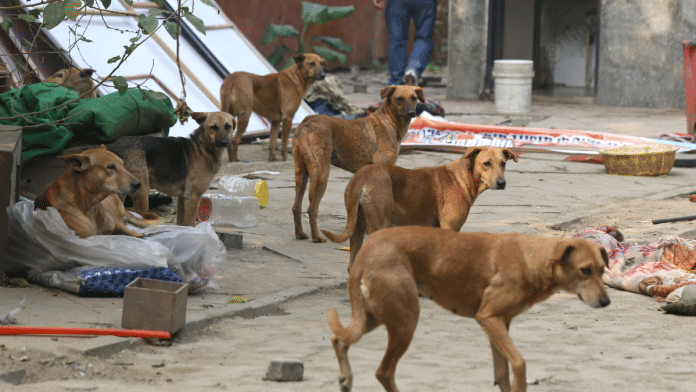



New Delhi: While hearing the stray dogs case Thursday, the Supreme Court asked the National Highways Authority of India (NHAI) to come up with a mobile-based application through which individuals can upload pictures of stray animals found traversing on the highways.
“Why not come up with an app so that any individual who spots a stray animal can click a picture and upload it there?”, remarked a three-judge bench of Justices Vikram Nath, Sandeep Mehta and NV Anjaria, while reserving their verdict on the plea.
When a verdict is reserved by a court, it means that the court is deferring its judgment to a later date, as opposed to announcing it in open court, right after the proceedings come to an end. At the end of the hearing the judge will usually state that judgment is being reserved and will subsequently circulate a draft written judgment to the parties.
During Thursday’s hearing, the court was also informed by the counsel of the Animal Welfare Board of India that there were only 76 recognised sterilisation centres in the country, while the data revealed by the states pointed to a much greater figure, that is, 883 stray dog sterilisation centres, which made the court question this discrepancy.
The case stemmed from a suo motu proceedings initiated by the top court, and broadly dealt with the management of stray dogs in the country. In November, last year, the issue picked up steam after the SC had asked the government to immediately remove all stray dogs from railway stations, schools, hospitals, bus stops and other public areas, and relocate them “to a designated shelter”.
Although the court had then modified its earlier ruling to say that stray dogs are to be sterilised, vaccinated and released in their original territories, while “only rabid dogs” and those exhibiting aggressive behaviour, couldn’t be released, the hearings in this case continued as different states and UT’s like Madhya Pradesh, Uttar Pradesh, Tamil Nadu, Karnataka and Punjab, were yet to file their compliance affidavits detailing the steps they had taken to manage the population of stray dogs in their territories.
During today’s hearing, the amicus curiae Gaurav Aggarwal also told the court that some states like Punjab were sterilising up to a hundred dogs in a day, which made the court say that this figure was still inadequate and akin to a “needle in a haystack”.
The amicus also told the court that Rajasthan had carried out 27,858 sterilisations of stray dogs in the last one year, and secured a total of 5,516 institutions with boundary walls and fencing in order to prevent stray dog attacks.
Between yesterday and today’s hearing, the court was taken through the different affidavits presented by states in this case, detailing steps taken by them to create Animal Birth Control centres, pounds, shelters, and towards vaccination of stray animals.
Situation of ABC centres
A uniform finding seen in almost all states was the lack of ABC centres. While the affidavits presented by states like Delhi said there was only one ABC Centre in the NDMC area, which had sterilised 433 stray dogs, Uttar Pradesh, said that there were at least 17 such centres in the state, although their exact capacity was not given.
Significantly, the data provided by the state of Andhra Pradesh showed that 37 Urban Local Bodies (ULBs) in the state have 39 functional ABC centres, with each one having a capacity of 1,619 dogs per day.
On the other hand, Himachal Pradesh said that it has 6 ABC centres while 3 are still being established. Gujarat fared slightly better as in December, last year, it increased the number of ABC centres from 13 to 21.
Shockingly, the amicus noted in his report that Jharkhand did not comply with the top court’s directions at all, as there was no mention of any vulnerable stretches in the state that stray cattle, dogs or other animals frequented, or of any ABC centres or their capacity.
How many dogs were sterilised
In the latest round of hearings, the court asked the states how many stray dogs were sterilised since the court’s November 2025 order, which had directed them to take this step.
On one hand, Tamil Nadu told the court that it had sterilised 35,000 dogs till now, while on the other it had no facilities for dog pounds, despite an amount of Rs 22 crore being sanctioned for setting up a total of 72 centres in the state.
Although the amicus said that there had been some improvement in dog sterilisation figures in Andhra Pradesh, where 1,03,684 dogs were sterilised in 2025, it also noted that in other states like Assam, only 13,373 dogs had been sterilised since 2020. Goa fared a little better since it had sterilised 73,151 dogs from the year 2020 onwards. As for the sterilisation figures of the year 2025 only, Goa sterilised roughly 50 dogs a day, which came to a total of 14,324 dogs.
Bihar said that it had sterilised 20,658 dogs, while Chhattisgarh said it had sterilised 16,463 dogs up till 31st December, last year.
Gujarat also increased the number of dog sterilisations from 96,787 to 4,79,665. It also identified 1805 dogs infected with rabies, or deemed aggressive. This also caused the amicus to say that there had been “a marked improvement” in the steps taken towards sterilising dogs in the state.
(Edited by Niyati Kothiyal)
Also read: New UGC rules on hold: Why Supreme Court believes they are ‘regressive’, can deepen caste divisions