





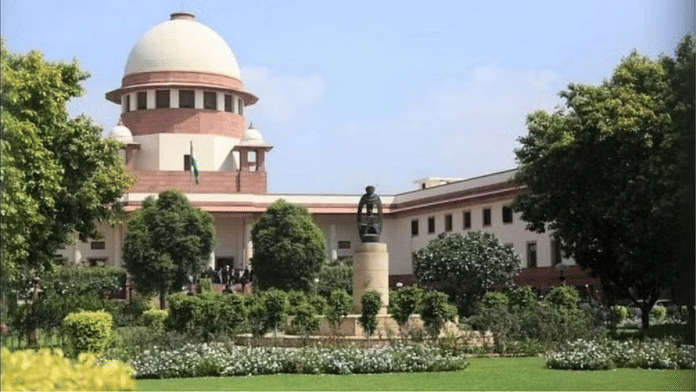



New Delhi: The Supreme Court Tuesday recalled its May judgment that quashed a 2017 notification and a 2021 office memorandum (OM) of the central environment ministry, permitting ex post-facto environmental clearances to projects, holding it as per incuriam (oversight of precedent) and not in public interest.
A three-judge bench led by Chief Justice B.R. Gavai, by 2:1 majority, decided to reconsider the earlier verdict after concluding that it was in conflict with the top court’s earlier decisions on the issue and could lead to the demolition of government’s ongoing welfare and infrastructure projects worth over Rs 20,000 crore.
CJI Gavai authored the majority opinion on behalf of Justice Vinod Chandran and himself. Justice Ujjal Bhuyan dissented and disagreed with the CJI’s view, noting the review was unwarranted.
Justice Bhuyan was part of the two-judge bench that in May quashed the 2017 notification and 2021 OM and banned post-facto environment approvals in development and infrastructural projects. The bench was headed by Justice Abhay S. Oka, who retired days after delivering the judgment.
According to the majority opinion, the May judgment is per incuriam because it was rendered without taking note of SC’s earlier judgment of the two-judge benches that said post-facto green clearances can be granted in exceptional cases. Two of the judgments amongst them had also upheld the two notifications, which the May judgment quashed.
Judicial propriety required the two-judge bench that authored the May judgment to refer the issue to a larger bench if it disagreed with the earlier two-bench decisions on the legality of the 2017 and 2021 notifications, SC said Wednesday in its recall order.
Given that the May decision had stalled both state and central government projects worth over Rs 20,000 crore, the top court Tuesday warned the judgment’s operation will have serious consequences.
It would result in the demolition of projects that are either complete or are about to be complete in the near future, which are of vital public importance and constructed with public funds, the bench said.
Also read: SC bars govt from giving post-facto environmental clearance citing citizens’ rights, conservation
‘Cannot be oblivious to economy’
Recalling past precedents, SC said Tuesday that courts cannot be “oblivious to the economy or the need to protect the livelihood of hundreds of employees and others employed in the project and others dependent on the project, if such projects comply with environmental norms”.
The top court said, establishments contributing to the economy of the country and providing livelihood to hundreds of people cannot be closed down on grounds of technical irregularity that can be conveniently checked.
Further, the May decision would create even more pollution, instead of protecting it.
“I say so because if such large number of buildings/projects which have been completed or are near completion are demolished and they could be reconstructed shortly thereafter after obtaining EC as they were otherwise permissible; it would result in nothing but creating more pollution which could not have been the intention of the judgment under review,” wrote CJI Gavai.
As the May judgment was delivered by a bench of two judges, CJI Gavai followed judicial discipline and referred the matter to the Chief Justice of India to place it before a larger bench of, possibly of five judges, for a fresh consideration and final resolution.
In the May 2025 judgment, SC had issued three crucial directions to the Centre. It held the 2017 and 2021 notifications as illegal and struck them down. Besides, it restrained the Centre from issuing circulars, orders or office memorandums to grant post-facto clearances to regularise acts done in contravention of the Environment Impact Assessment (EIA) notifications that mandated prior environmental approvals.
The judgment did not disturb the clearances that were granted under the 2017 and 2021 notifications.
The judgment was delivered on a batch of four petitions that were filed in SC at different times either to quash the 2017 notification or the 2021 office memorandum.
The central government, some states and a consortium of real-estate companies approached SC with a request to modify the May decision. They all argued that the judgment was inconsistent with earlier judgments of the SC. If the bench differed with the view taken by the top court in the past, then it should have referred the matter to a larger bench, they contended.
‘Projects impacted’
Appearing for the Centre, solicitor general Tushar Mehta gave examples to depict the implication and effect of the May judgment. He said a project started by SAIL on the basis of the 2021 office memorandum was stopped following the verdict. Similarly, construction of an AIIMS hospital building in Odisha comprising 962 beds is complete, but cannot start without the green clearances, which is at the final stage.
Those who opposed the review argued it was not maintainable as it was almost in the nature of an appeal. Further, the notification as well as the office memorandum, which provided for grant of ex-post facto EC, was totally illegal and contrary to environmental jurisprudence.
The majority opinion considered the judgments on which the May decision relied and opined the latter had “completely lost sight of” them.
A perusal of those judgments revealed that the court had adopted a balanced approach by holding the industries accountable for operating without green clearances in the past, but without ordering a closure of operations.
All the judgments clearly held that ex-post facto clearances or removal of technical irregularities in terms of notifications under the Environment Protection Act cannot be declined with pedantic rigidity. They followed the principle of proportionality that was ignored in the May judgment, SC said.
Relaxations and even grant of ex-post facto environmental clearances in accordance with law, in strict compliance with rules, regulations, notifications in appropriate cases, where the projects are in compliance with, or can be made to comply with environment norms, is not impermissible, it said.
Since the May decision was by a two-judge bench, it was bound by the earlier views as they were given by benches of equal strength. Judicial discipline required this bench to refer the matter to a larger bench if it was opposed to the earlier decisions, the court said.
The bench also examined section 15 of the Environment Protection Act and found the May judgment interpreted it erroneously. While the provision deals with the aspect of penalty only, the judgment said the section requires the authorities to either stop the project or demolish it, even after collecting penalty from the violator who does not seek environmental approval.
The judgment had led to an anomalous situation as well. While it protected those projects that had already got approval before the judgment was pronounced, it failed to protect those whose applications were pending, but were not granted clearance due to the SC’s interim order of January 2024.
(Edited by Viny Mishra)
Also read: Curtailing ED powers to quashing post-facto environmental clearances, Justice Oka’s indelible legacy