





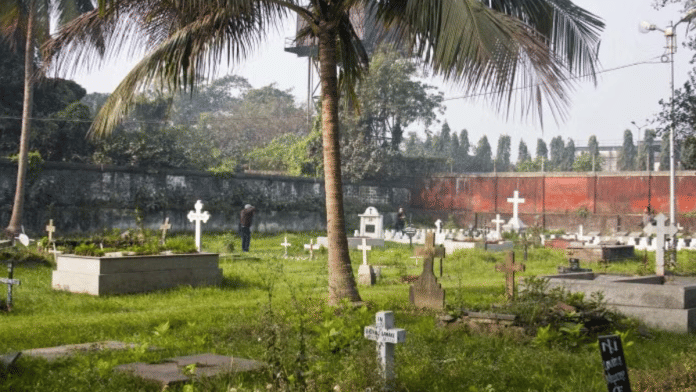



New Delhi: The Supreme Court’s unresolved year-old split verdict on whether tribal Christians of Chhattisgarh can bury their dead within the boundaries of their villages has led to a serious problem for the community.
According to a petition filed before the top court, which heard it Wednesday, the January 2025 decision is being used by the local police to prevent the burial of tribal Christians in their own villages, even in places where there is no dispute.
The petition also alleges that police have supported locals in exhuming bodies and forcing families to rebury them 50 km away from their native villages.
As an interim order, the SC restrained the forcible exhumation and relocation of bodies away from their village grounds.
In January 2025, justices B.V. Nagarathna and S.C. Sharma differed with each other on the burial of a pastor, a converted tribal Christian, in Chhattisgarh’s Chhindawada village against the local community’s objections. The issue before the court was whether the burial could occur in the native village.
While Justice Nagarathna permitted burial in the pastor’s private land in the native village, criticising state inaction against discriminatory practice, Justice Sharma favored last rites of a converted tribal Christian in a designated area.
Despite divergent views, the judges issued a unanimous direction to the state to bury the pastor’s body at a designated place that was 20 km away from Chhindawada village. This was done taking into account that the body had been lying in the morgue for close to a fortnight.
Filed by a civil society, Chhattisgarh Association for Justice and Equality, the petition before the top court has given details of 143 families who were allegedly not permitted to bury their dead relatives in the native village, following the SC judgement.
According to the petition, the hostility towards tribal Christians has become so extreme that bodies are being exhumed to be re-buried in other sites located outside the villages.
Emphasising that even dead have to be treated with dignity, the petition accused the state police of misusing the top court’s January 2025 order, which, it said, arose out of a situation where a group of people objected to the burial.
The police, the petition added, are citing the order even in cases where there are no objections. Police would intervene and foment “trouble” insisting that the order has made it illegal to bury the body within the same village graveyards.
“While in many cases there was the possibility of peaceful burial in the village itself as per the tradition, the body was forcibly taken out of the villages to so-called designated place by the police and administrations,” the petition has submitted.
On Wednesday, when a bench of three judges led by Justice Vikram Nath, took up the case, it issued a notice to the state.
Placing details of the situation that has emerged following the January 2025 judgement, the petitioner claimed that at least 50 pastors have been arrested and sent to jail for performing last rites at the time of burial ceremony.
Arguing that the arbitrary denial of burial in the common village graveyard violates the rights of tribal Christians under Article 25 (that allows freedom to practice one’s own faith and religion), the petition termed the state’s “discriminatory” approach abetment of unlawful communal acts.
The state police’s actions have caused communal disharmony, forcing tribal families to transport bodies to faraway spots that has caused them immense financial, emotional and cultural hardships.
The petition also accused the state government of misleading the top court in the case that led to the January 2025 decision. There, the state had claimed that the pastor’s body can be buried in a designated spot meant for Christians.
“There is no such thing as a designated site,” maintained the petition, adding it filed three RTI applications for each of the 26 districts in the state. Against these queries, the petitioner received 36 replies and all accepted that there is no designated spot for burial based on caste and religion.
(Edited by Ajeet Tiwari)
Also Read: A Dalit Christian’s body lay in Chhattisgarh mortuary for 3 weeks—courts feared ‘public unrest’