





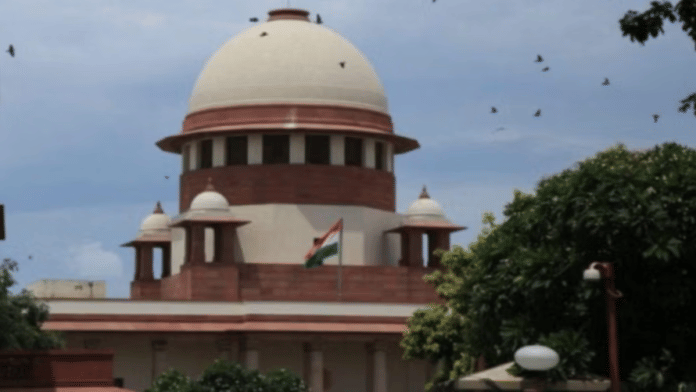



New Delhi: The Supreme Court Tuesday granted bail to former Amtek group promoter Arvind Dham in a multi-crore bank fraud case, saying pretrial detention cannot be turned into a form of punishment, and upholding speedy trial as a fundamental right that emanates from Article 21.
The court added 210 witnesses are yet to be examined in this case, and there is “no likelihood of trial commencing in the near future”.
Continued incarceration in such circumstances, especially where evidence is of documentary nature mostly, violates the accused’s right to a speedy trial under Article 21, the court said.
The case against Dham was initiated by the Enforcement Directorate, which accused him of establishing a network of around 500 shell companies operating as a layered structure, with up to 15 levels of indirect ownership, in order to divert funds running into thousands of crores from many public sector banks.
Dham, a former promoter and the non-executive chairman of Amtek Auto Limited, was accused of allegedly siphoning off nearly Rs 26,000 crore from the banks, in the form of loans, for his personal gains and for buying real estate.
In December 2022, the IDBI Bank and Bank of Maharashtra filed complaints against him for offences like criminal conspiracy, cheating, criminal breach of trust and forgery, along with misconduct.
As part of these FIRs, Dham was named as an accused alongside 27 other individuals.
These FIRs served as a basis for the ED’s ECIR’s in the case. The ECIR or the Enforcement Case Information Report is similar to an FIR, but it differs from an FIR because it is not made publicly available. Simply put, the ECIR serves as a basis for initiating proceedings and conducting investigations.
In its January 6 ruling, a division bench of justices Sanjay Kumar and Alok Aradhe said that after taking into account the objective of the Prevention of Money Laundering Act (PMLA), the gravity of the offence and other related circumstances, it could be concluded that it is wrong to categorise all offences into one group and deny bail on that basis.
Underlining that Article 21—which includes the right to life and liberty, and which has been interpreted to include right to speedy trial—will apply irrespective of the nature of the crime in this case, the court added that neither the government nor any prosecuting agency can oppose the bail plea on grounds that the crime committed is “serious”.
Recalling the Supreme Court’s 2025 ruling in Manish Sisodia’s case, the court said that a long period of incarceration without the trial commencing would amount to depriving the appellant of his right to a speedy trial under Article 21.
In that case, the court had made this observation after finding out that Sisodia, the former deputy chief minister of Delhi, had been incarcerated for 17 months.
In the Dham case, the court noted that he has been in custody for 16 months and 20 days.
The court also cited its 2024 ruling in V. Senthil Balaji’s case where a two-judge bench had ruled that statutes like the PMLA, where the maximum sentence is seven years, prolonged incarceration without a trial, “may warrant grant of bail” if there is no likelihood of the trial finishing within a reasonable time.
Also Read: A Rs 33,000 cr ‘banking fraud’: ED’s case against Arvind Dham, Amtek’s web of ‘500 shell companies’
ED’s case against Dham
In 2022, a plea was filed by a person named Jaskaran Singh Chawla before the top court alleging that the CBI and the Serious Fraud Investigation Office (SFIO), failed to investigate the fraud committed by the Amtek group, involving diversion and siphoning of bank loans to the tune of Rs 33,400 crore.
In February, 2024, a two-judge bench of the top court directed the CBI and the SFIO to conduct an “exhaustive investigation” and cooperate with the ED in the collection of evidence.
In a nutshell, the investigation lead to allegations against Dham implying that he was the “ultimate beneficiary of the fraud”, which was a well-orchestrated scheme, executed by him, involving diversion and siphoning of public funds through layered entities, resulting in a substantial wrongful loss to public sector banks.
After search and seizure operations conducted at his residence, Dham was arrested on 9 July, 2024.
Although the prosecution’s complaint from August last year named 40 accused entities, including 22 individuals and 18 companies, the court noted that only Dham had been arrested and kept in custody.
In August last year, the Delhi HC had denied him regular bail, while noting the allegations pertain to an economic offence of “exceptional magnitude, involving complex, deliberate, and sustained criminal conduct causing grave loss to public sector banks”.
“Such offences erode the fabric of economic governance and public trust and cannot be taken lightly,” the court had ruled in its August 19 order.
Right to a fair trial
The right to a speedy trial, under Article 21, is not eclipsed by the nature of offence, the SC bench said, while adding that the prolonged incarceration of an undertrial, without the trial progressing reasonably or even beginning in the first place, could not be allowed.
Doing so, would have the effect of converting pretrial detention into a form of punishment, it added.
“Economic offences, by their very nature, may differ in degree and fact, and therefore cannot be treated as a homogenous class,” the court said, while adding that such offences cannot be grouped together to deny bail.
The court pointed out that Dham had also joined the investigation before his arrest in June and July, 2024, implying that he had cooperated with the authorities.
Pointing to a slew of SC cases like P. Chidambaram’s where bail was granted in three months, or Senthil Balaji’s where it was granted in 15 months, the court said this period of incarceration must be taken into account.
The SC also said the delay in the trial was attributable to the ED, and not to Dham, as records show the agency had sought a stay before the HC on the proceedings, which was granted. The stay was lifted only after eight months.
The court also said there were no material links to show that Dham had signed any sale documents, or dissipated the proceeds of crime.
Finally, the court set aside the August 2025 order of the Delhi High Court order denying him bail, while concluding that he should share his mobile numbers with the ED officers so that they are in the know about his whereabouts.
He should also surrender his passport and not leave the country unless the trial court permits him to do so, it added.
(Edited by Ajeet Tiwari)
Also Read: Fugitive businesswoman accused in 2002 import-export fraud case extradited from US after 2 decades