





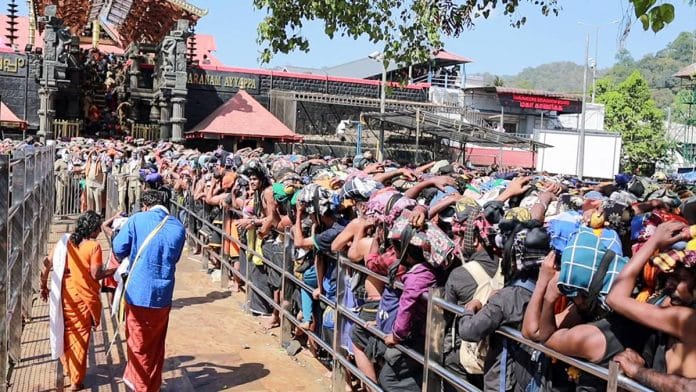



New Delhi: The religious freedoms enshrined in Articles 25 and 26 of the Constitution of India are not merely legal or theological, rather they highlight the delicate balance of a pluralistic nation. The ongoing Sabarimala constitutional hearings bring into sharp focus the original compromises the Constituent Assembly made in balancing individual rights, social reform and denominational autonomy.
On 7 March 2026, Solicitor General Tushar Mehta in his arguments for the Union of India requested the Court to interpret religion, religious practices and the right to manage religious affairs as per Articles 25 and 26. Interestingly, the Constitution does not define religion. Mehta also highlighted the internal plurality within religions, while stressing upon the enormity and width of religion in this country.
The question of what defines an ‘essential religious practice’ was raised once more, underscoring it as a focal point of the reference.
In this backdrop ThePrint takes a look at the legislative history of these two Articles.
From Draft Article 19 to Article 25
Article 25: Freedom of conscience and free profession, practice and propagation of religion
(1) Subject to public order, morality and health and to the other provisions of this Part, all persons are equally entitled to freedom of conscience and the right freely to profess, practice and propagate religion.
(2) Nothing in this article shall affect the operation of any existing law or prevent the State from making any law—
(a) regulating or restricting any economic, financial, political or other secular activity which may be associated with religious practice;
(b) providing for social welfare and reform or the throwing open of Hindu religious institutions of a public character to all classes and sections of Hindus.
Explanation I—The wearing and carrying of kirpans shall be deemed to be included in the profession of the Sikh religion.
Explanation II—In sub-clause (b) of clause (2), the reference to Hindus shall be construed as including a reference to persons professing the Sikh, Jain or Buddhist religion, and the reference to Hindu religious institutions shall be construed accordingly.
The Constituent Assembly debated Draft Article 19 (Article 25) over two days in December 1948, eventually adopting the article with minor amendments. Two key questions were raised by members – whether the right to propagate religion would facilitate forced conversions, and whether the social welfare clause should extend to Buddhists, Jains and Christians.
Members such as Tajamul Hussain saw religion as a private affair between the individual and the divine. He vehemently opposed any involvement of a secular state in religion, and viewed the right to propagate as a segue to proselytization and forced conversion. Concerns about the autonomy and rights of minority communities were also raised.
Other members, including Lakshmi Kanta Maitra and K. Santhanam, asserted that propagation allowed for religious awareness and would eventually lead to communal harmony. Accordingly, the proposed amendment to omit the word ‘propagate’ was defeated. Propagate was understood as a general right to share beliefs, not licence for coercion. In the course of the debate, it was also accepted that freedom of speech and expression includes religious propagation.
Durgabai’s amendment to include ‘all classes and sections of Hindus’ in the social welfare clause was not merely technical, but a recognition of the caste-based exclusion that plagues Hindu places of worship. Notably, it was the sole amendment accepted by Dr. B.R. Ambedkar, Chairman of the Drafting Committee, without comment. Similarly, K.T. Shah’s proposed amendment to extend the social welfare clause to Sikhs, Jains and Buddhists was incorporated by the Drafting Committee after initial Assembly rejection. It is indicative of the broad social reform intention, not confined to Hinduism alone.
From Draft Article 20 to Article 26
Article 26: Freedom to manage religious affairs
Subject to public order, morality and health, every religious denomination or any section thereof shall have the right—
(a) to establish and maintain institutions for religious and charitable purposes;
(b) to manage its own affairs in matters of religion;
(c) to own and acquire movable and immovable property; and
(d) to administer such property in accordance with law.
Draft Article 20 (Article 26) was debated and adopted by the Constituent Assembly on 7 December 1948. Dr Ambedkar’s amendment to make the right subject to ‘public order, morality, and health’, in the same vein as restrictions on other fundamental rights, was accepted without debate. The Assembly’s cognisance of the Constitutional responsibility of balancing protections and accountability is evident. Syed Abdur Rouf argued that religious education was as vital as religion itself, but the Assembly rejected his claim, seeing no need for it in the constitutional scheme. Similarly, Jaspat Roy Kapoor’s fear that religious charitable institutions would become exclusionary was dismissed, underscoring the Assembly’s confidence that religious charity could coexist with, rather than undermine, social inclusion.
Article 26 recognised internal plurality within religions, and provided a constitutional shield for various denominations and sects from majoritarianism. Importantly, this autonomy was qualified from the outset, as evidenced by the restriction of public order, morality, and health, and the wording in the last sub-clause – “administer such property in accordance with law”.
The interplay of Articles 25 and 26
While both Articles operate in the area of religion, 25 deals with the personal whereas 26 deals with the collective. It seems the Constituent Assembly meant for the two to be read together, and not in isolation.
Judicial interpretations by the Supreme Court clarified the interplay between Article 25 and Article 26. Using harmonious construction, the Court clarified that the social reform objective of Article 25(2) cannot be diluted by a strong reading of Article 26.
In the 2018 Indian Young Lawyers Association case (Sabarimala case), the top court applied the 1958 Venkataramana Devaru principle of interpretation. Along with the 1954 Shirur Mutt case and the 1961 Durgah Committee case, it was understood that Article 25 based claims of equality can override Article 26 customs, where those customs are not essential religious practice. The precedents of Shirur Mutt, Devaru, and Durgah Committee are all centrestage in the ongoing reference.
Sabarimala and the legacy of 1948
Dr. B.R. Ambedkar famously said “The Constitution is not a mere lawyers’ document, it is a vehicle of life, and its spirit is always the spirit of the age.”
The 1948 debates suggest that the Constituent Assembly anticipated the persistent tension between religion and reform. And while it did not resolve the question conclusively, the debates amongst the framers are of great evidentiary value in determining their intent. The Sabarimala reference will ultimately decide whether the 1948 constitutional compromise between religious freedom and social reform still holds in an India where religion is both intensely personal and fiercely political.
Saumya Sharma is an alum of ThePrint School of Journalism and an intern with ThePrint.
(Edited by Nardeep Singh Dahiya)
If sabrimala judgement is reversed, it will open a pandoras box from accepting polygamy to triple talaq as non discriminatory religious practices by few denominations. Religious plurality argument is highly subjective