





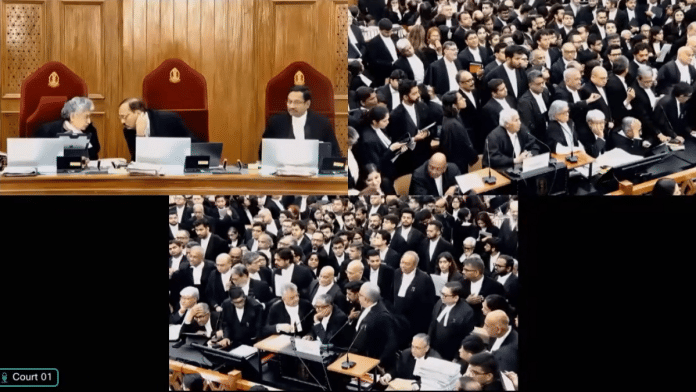



New Delhi: Justice B. V. Nagarathna—a member of the nine-judge bench, hearing a reference on what constitutes essential religious practice—Tuesday raised doubts over whether the Supreme Court could have equated Sabarimala temple administration’s entry ban on menstruating women to untouchability.
She said that reference to Article 17 of the Constitution (which abolished untouchability) and discussion on untouchability in the context of the Sabarimala case was not required.
In its 2018 verdict striking down the ban on menstruating women from entering the temple precincts, SC had identified the it as a form of “untouchability”.
“Speaking as a woman, I can say, there can’t be three days of untouchability (for a menstruating woman) every month and then on the fourth day (when a period ends), there is no untouchability. Let us go by the hard realities. Speaking as a woman, Article 17 cannot apply for three days and on the fourth day, there is no untouchability,” she remarked on the first day of the hearing.
The comments by the sole sitting woman judge of SC came when Solicitor General Tushar Mehta opened the arguments in the case before the Chief Justice of India Surya Kant-led bench that is hearing the reference.
In detailed written submissions filed Monday, the Centre advised against judicial review of what is construed as essential religious practice. It has criticised past judgments of the SC that developed this doctrine. The precedents did not subscribe to the core belief of the Constitution given in its preamble, which promises liberty of thought, expression, belief, faith and worship, the Centre has stressed.
Mehta was addressing the concept of intra-religious diversity and how the SC had ignored this in the Sabarimala case, when Justice Nagarathna shared her views.
Mehta responded to the judge’s observations by pointing out that the issues argued in Sabarimala had less to do with an individual’s dignity and, instead, revolved more around respecting the beliefs of religious denominations.
“I have no dispute with that. Sabarimala (prohibition) doesn’t mean four days (women can’t enter). (In) Sabarimala it’s a particular age group (of women who can’t enter)… Lord Ayappan temples are open throughout the world for all sections of ladies, except one temple which is a sui generis (unique) case,” Mehta said, while taking liberty to argue the specific points related to Sabarimala at length later in SC.
But he highlighted that due to diverse religious practices, not just within the religion, but within the varied sub-sects of a religion, “denominational practices have to be respected”.
“Everything is not related to human dignity or individual body freedom. If I have to go to Gurudwara, if I have to cover my head, I cannot say, ‘where is my dignity, you are taking my dignity, or my right of choice’. This is where Sabarimala (judgment) has gone wrong because it said (the ban) my right to choice has been taken away,” Mehta argued.
He further added: “It’s not taking away autonomy; it is respecting the tenets, the faith and belief of that religion. When we go to Ajmer Sharif (Dargah), we do cover our heads; when we go to a Gurudwara, we do cover our heads and nobody says that this is bodily integrity.”
He took the stand that the Sabarimala decision was based on wrong law and wrongly decided.
During his four-and-half hours of arguments in SC, the solicitor focused extensively on religious plurality in India, existence of several denominations and diversity of practices within each religion, the interplay of Articles 25 and 26 and their collective interpretation.
While Article 25 is about an individual’s freedom of conscience and freedom to profess, practice and propagation religion, Article 26 is about freedom to manage religious affairs, giving a religious denomination or a section the freedom to manage religious institutions for charitable purposes.
Mehta argued the earlier SC judgments that became the basis of discussing essential religious practices never took into view the plurality within each religion prevalent in India. He took the court through various sub-sects of different religions to describe their scope.
Specifically, about Hinduism, he said, there were several denominations and, therefore, there was no precise definition of this religion.
The Sabarimala judgment had declined to recognise followers of Lord Ayappan as a sub-sect of Hindu religion. This, Mehta submitted, restricted the definition of denomination that is at odds with the inherent plurality of religions as well as intra-religious diversity.
Through a fresh understanding of the term “denomination” or a “section thereof”, the Centre sought to “protect the intra-religious diversity and ensure that every belief, faith or custom would be capable of a constitutional protection”.
After re-examining the definition of denomination, the court will then have to answer whether it has the expertise to define essential religious practice, the solicitor submitted.
Mehta said the court cannot take Hinduism as a broad denomination to interpret an essential religious practice as it would require a detailed study of religious texts and understand the faith and belief of the specific sect that follows it.
Mehta then referred the court to various judgments through which the essential religious practice principle emerged.
He said none of them examined the scope of Articles 25 and 26 and neither construed them in line with the constitutional aspirations reflected in the Preamble that allows “Liberty of thought, expression, belief, faith and worship”.
He recalled at length the legislative history of Article 25 and its modifications from time to time. This Article, along with Article 26 were designed to suit Indian conditions, though derived from the Irish Constitution.
“Both Articles should be interpreted keeping in mind belief and faith,” he added.
Mehta went into the reasons for the inclusion of the phrase “equally entitled” in Article 25 which reads: “Subject to public order, morality and health and to the other provisions of this part, all persons are equally entitled to freedom of conscience and the right to freely profess, practise and propagate religion.”
Referring to the Constituent assembly discussions, Mehta said “equally entitled” in Article 25 cannot be construed as gender equality. He countered the Sabarimala judgment on this point by saying that while framing this Article the framers of the Constitution were aware that they were dealing with a pluralistic society.
The intention behind the two words was to ensure religious equality. In view of the prevailing conditions then, the solicitor said, the framers did not want one religion to claim higher rights on the basis of numerical strength where one religion might try to acquire more than the others.
“The phrase ‘equally entitled’ demonstrates the framers did not conceive religious liberty as a protection confined to a few recognised faiths. It reflects a constitutional commitment that freedom of conscience and the right to freely profess, practise and propagate religion would extend across the full spectrum of religions in India,” he argued, asserting that the two words were a manifestation of secularism.
However, in the last decade, jurisprudence has developed in such a way where everything is being viewed from the gender lens, he added.
Mehta sought to discourage judicial intervention in cases of religious practices and said they may not fall within judicial review unless they directly hit public order, health or morality. Judicial review can be limited to cases where a social evil is branded an essential religious practice, he explained.
Towards the end of his argument on the first day, the solicitor asserted that Articles 25 and 26 cannot be treated as standalone islands, but have to be read with each other and other parts of the Constitution.
While Article 25 deals with an individual right, Article 26 relates to denominational right. And in the Indian context there is no indication that individual rights take precedence over collective rights, Mehta said.
(Edited by Viny Mishra)
Also read: Sabarimala administration is stuck in the 1960s