





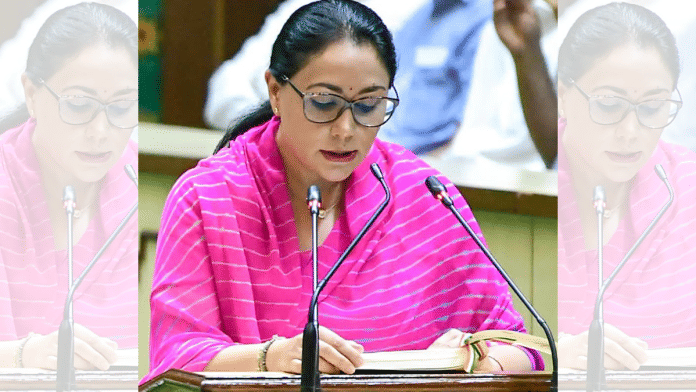



New Delhi: The Supreme Court has restored the Jaipur Development Authority’s (JDA’s) case in the Rajasthan High Court against Deputy Chief Minister Diya Kumari’s family which has asserted ownership over properties worth Rs 400 crore in the main Jaipur city.
The JDA’s appeal against a 2011 trial court order that declared the erstwhile royal family as the owner of what used to be “Hathroi village” in official records, now part of the sprawling urban Jaipur, was dismissed by the HC in September last year, after the JDA had failed to deposit Rs 5,000 with the Rajasthan State Legal Services Authority within a stipulated time frame.
The HC had directed the JDA to deposit the amount if the authority wanted restoration of its appeal that was dismissed for the first time in November 2023 due to non-appearance. This condition was imposed in November 2024 upon the JDA’s application to restore the appeal.
However, since the JDA did not comply with the order, the HC in December 2024 did not proceed in the case.
But a month later, the JDA deposited the amount and once again urged the restoration of the appeal before the single-judge bench, which refused to entertain it. Against this, the JDA approached the division bench that not just declined to interfere but characterised the lapse as “persistent non-compliance”.
Aggrieved, the JDA moved the Supreme Court, belatedly though. The authority had filed its petition in December 2025, which was heard Friday.
Appearing before a court of Justices J.B. Pardiwala and K. Vishwanathan, JDA counsels, additional solicitor general KM Natrajan and additional advocate general Shiv Mangal Sharma, described the HC orders as rigid and punitive. According to them, the deposit amount was minor and the authority had provided an explanation on the delay.
Yet, its statutory appeal was declined on a hyper-technical ground, without considering the implications on the status of the public land that is of considerable value and now part of residential colonies established in Jaipur, they argued.
The court has asked the HC to decide the JDA’s pending first appeal on merits within four weeks and to submit a compliance report to the apex court, ensuring expeditious resolution of the dispute.
The core dispute in the case concerns government properties that were once under the ownership of Jaipur’s erstwhile royal family, headed by Maharaja Sawai Mansingh.
According to the JDA, once this land came under government control, they were developed to establish residential colonies, hospitals and other public structures.
The JDA has argued that the covenant signed between the royal family and the state post-accession did not include the said land. Since this covenant is a sovereign instrument and not an ordinary conveyance, the claim by the royal family should be strictly confined to the properties enumerated in it.
This was followed by a physical inspection and the land was classified as government property without rent.
Thereafter, private instruments within the family also did not alter the statutory arrangement and this is reflected in the registered gift deed executed by Sawai Mansingh in favour of his son Brigadier Bhawani Singh, who too prepared a similar instrument in favour of his daughter and current Deputy CM Diya Kumar.
In 2005, Brigadier Bhawani Singh filed a civil suit, asserting right over the disputed land as their private property. This, the JDA states, was done without offering explanation about the delay in challenging the mutation that existed for almost six decades in favour of the government.
The suit sought correction of entries in the official documents regarding the land in question.
Despite the JDA’s strong opposition, the civil court, by its judgement of November 2011, decreed in favour of the royal family and declared it the owner.
The JDA appealed in 2012, but it remained pending for several years until November 2023 when it was taken up and then dismissed due to non-appearance of the authority’s counsel.
On the JDA’s restoration application, the HC in November 2024 agreed to condone the delay, subject to its depositing Rs 5,000 with the State Legal Services Authority.
The JDA was to revert on 6 December 2024, after complying with the condition.
According to JDA’s appeal in the SC, due to an internal communication lapse between the authority and its counsel the money could not be deposited within the fixed timeframe. The JDA even failed to appear before the court on 6 December, prompting the judge not to proceed in the case.
A month later, the JDA appeared and urged the court to condone the lapse on its part. The delay, it said, was neither deliberate nor contumacious, and that serious questions of public title over large tracts of land were at stake.
But the HC dismissed the recall application and treated the delay as fatal, an order upheld by the division bench.
In the SC, the JDA argued that the HC decision was without “examining that the delay did not cause any prejudice to the other side, and without considering that public land of considerable value was in issue”.
Resultantly, the November 2011 trial court order has attained finality.
On merits, the JDA contended, some parts of the land, recognised as government property were in occupation of different persons from whom the land was acquired formally through a legal procedure, after being paid adequate compensation. Now, residential colonies stand on these acquired lands.
The royal family, it said, never challenged the said entries for around five decades, which itself creates bar towards any such challenge after such delay and latches.
Also, Article 363 of the Constitution imposes a specific bar on all courts to entertain or adjudicate any dispute arising out of covenants.
(Edited by Ajeet Tiwari)
Also Read: Royal, Rajput, and not Raje— why BJP is placing its bets on Diya Kumari in Rajasthan