





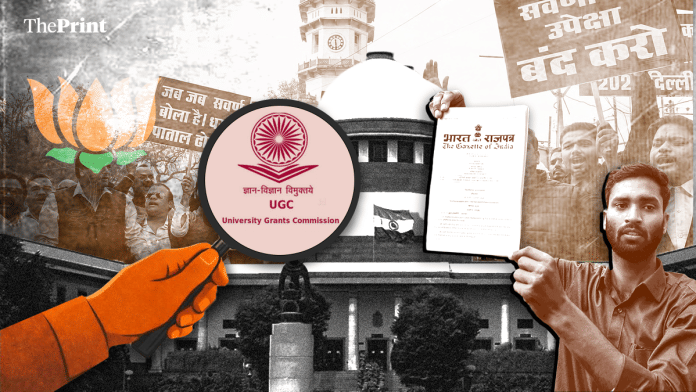



New Delhi: The Supreme Court Thursday kept in abeyance the University Grants Commission’s 2026 anti-discrimination norms – UGC (Promotion of Equity in Higher Education Institutions) Regulations, 2026 – terming them prima facie “regressive” with a potentially “dangerous impact” on educational institutions and society.
A bench of Chief Justice Surya Kant and Justice Joymala Bagchi was hearing a batch of petitions challenging the framework aimed at curbing caste-based discrimination in higher education.
The court issued a notice to the Centre and advised Solicitor General Tushar Mehta to constitute a committee of experts to study the regulations and suggest changes to make them “inclusive and holistic”, so that no student faces harassment on campus.
The Bench expressed surprise that the regulations excluded ragging from their ambit and found their language vague, warning that it could be “misused by miscreants”.
The judges observed that the regulations did not comply with the top court’s September 2025 ruling in the Rohith Vemula case, which had ordered the Centre to frame rules to end caste discrimination.
The hold on 2026 rules will remain in effect till at least 19 March, when the court will hear the petitions next. Until further orders, the preceding 2012 regulations will remain in effect, the Bench said.
The top court’s direction comes amid a barrage of criticism against the rules by General Category students and protests by upper caste leaders, including those within the ruling BJP.
Also Read: ‘Underestimating upper caste unity’: Resentment & resignations within BJP over new UGC rules
Main contention: Regulation 3(c)
The petitioners’ key challenge centred on Regulation 3(c), which–they argued–is sweeping and presumes that Scheduled Castes, Scheduled Tribes and Other Backward Classes can only be oppressed, while forward category students are inherently oppressors.
Regulation 3(c) defines ‘caste discrimination’ as “discrimination only on the basis of caste or tribe against the members of the scheduled castes, scheduled tribes, and other backward classes”.
Advocate Vishnu Jain, appearing for one of the petitioners, sought a stay on this provision, saying: “A statute cannot presume that discrimination will only be by a certain section of society.”
He added that Regulation 3(c) was “completely averse” to Article 14 of the Constitution, which guarantees every citizen equality before law.
Senior Advocate Indira Jaising, appearing for Vemula’s mother, urged the court not to stay the rules and grant them a proper hearing. Jaising, in turn, argued that Regulation 3(c) employed the language of Article 15(4) of the Constitution, which empowers the State to make special laws for SC and ST communities as part of affirmative action. The Vemula case was tagged with these petitions as the 2025 order to tighten anti-caste discrimination norms stemmed from it.
On this, Justice Bagchi questioned: “Why should there be regression in a protective and ameliorative law?”
The judge added that “the principle of non-aggression also perpetrates in law for protection”, suggesting that the framework of the new rules should not go to the extent of separation “like in the US”. She emphasised that “unity of India must be reflected in the educational institutions”.
Ragging not included
Advocate Satyem Pandey, appearing for petitioner Mrityunjay Tiwari, told the court that students face discrimination through ragging, but the new rules were completely silent on this. “This doesn’t address actual issues faced in colleges. It assumes that only general category students can be harassers. It believes that India lives in a caste-divided society,” Pandey said.
Another petitioner drew a parallel between ragging and caste discrimination by giving an example: “I am a General Category fresher and my senior comes to rag me. If I oppose (ragging), then I can face anti-discrimination charges.”
The term ‘ragging’, not mentioned in the 2026 rules, was referred to in the 2012 norms, which said it can be defined under UGC’s Regulations on Curbing the Menace of Ragging in Higher Education Institutions, 2009.
The Bench, too, expressed surprise that ragging was excluded from the 2026 rules.
Justice Bagchi remarked: “We could have understood the vision (of the new rules) if it served the purpose”.
The Chief Justice also said that “this kind of situation can be exploited by miscreants” and suggested involving those who “understand our social ethos and values”. He noted that schools and colleges cannot exist “in isolation”.
Acknowledging that courts may not be experts in such matters, the CJI said that “those who are social engineers should be involved”. He observed that 75 years after India’s Independence, while aiming to “create a casteless society”, an effective redressal mechanism must remain in place.
The Chief Justice noted that in some states, “the policy maker’s wisdom that one group is better among the reserved category” prevails.
Citing Haryana’s categorisation of groups A and B within reserved categories, he said that even among reserved groups, “there are haves and have nots”.
He questioned whether the new rules provided grievance mechanisms for weaker sections within Scheduled Caste communities.
The court observed that separate hostels, as mentioned in the new rules, cannot be the way forward. This observation was related to a reading of Regulation 7(d), which says that higher education institutions “shall ensure that any segregation, or allocation for the purpose of hostels, classrooms, mentorship groups, or any other academic purposes is transparent, fair, and non-discriminatory”.
Background & the case
UGC notified the new regulations on 13 January following the Supreme Court’s September 2025 directive to tighten anti-discrimination rules, including policies on ragging and caste bias, within eight weeks.
The directive came after the mothers of Rohith Vemula and Payal Tadvi petitioned the Supreme Court over the matter. Rohith and Payal were students who died by suicide after alleged caste-based discrimination.
The current challenge initiates from a clutch of pleas, including a writ petition by Advocate Vineet Jindal.
The advocate’s plea sought to read down and amend Regulation 3(c) “so as to define ‘caste-based discrimination’ in a caste-neutral, inclusive, and constitutionally compliant manner, extending protection and grievance redressal mechanisms to all persons subjected to discrimination on the basis of caste, irrespective of caste identity”.
The petition alleges that the 2026 rules adopt an “exclusionary, asymmetric, and caste-specific definition of ‘caste-based discrimination’, thereby denying equal protection of law to a substantial section of citizens solely on the basis of caste”.
Other petitioners also argue this excludes General Category individuals and violates fundamental rights under Article 14 (right to equality), Article 15(1) (prohibition of discrimination by the State on grounds of religion, race, caste, sex or place of birth), and Article 21 (right to life and personal liberty).
The petitions go on to say that the rules violate Article 21’s encompassment of “the right to live with dignity, including psychological integrity and equal access to institutional safeguards, all of which are systematically denied to non-reserved students under the impugned regime”.
While hearing the pleas, Chief Justice Surya Kant urged advocates not to “make this a political issue”, and said the Supreme Court only wanted to examine constitutionality of the rules. He asked them not to file multiple petitions in the same matter, saying: “If you have any other issue, just file an IA (interlocutory application) – we can’t stop you, but don’t file multiple petitions.”
The Bench said it is tagging the latest petitions with the Rohith Vemula case, and will hold comprehensive hearings starting 19 March.
(Edited by Prerna Madan)
Also Read: Why row over new UGC equity rules has put Congress in a quandary