





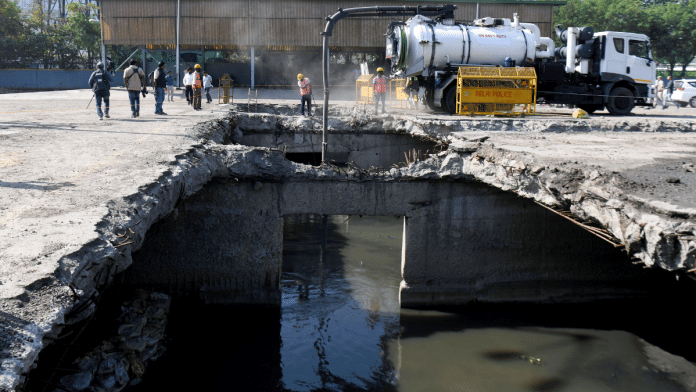


New Delhi: Ten-year-old Mohd Nazim died after falling into an uncovered and unguarded sewerage pit in Delhi. Twelve years on, the Delhi High Court has ordered the city government and the Delhi Jal Board (DJB) to pay Rs 16.9 lakh in compensation to his parents alongwith 9 percent interest.
He was “brought dead” to GTB Hospital in September 2014. And since then, his parents—the father a contractual painter earning Rs 15,000 a month and the mother a homemaker—navigated a labyrinthine legal battle against state entities that sought to deflect responsibility.
Systemically denying liability, the Delhi Jal Board (DJB), Engineers India Limited (EIL), and the private contractor, M/s DSCL-Fengshun-Wabag Consortium, spent years engaged in a “tripartite” blame game – the Delhi High Court noted while disposing of Nazim’s parent’s petition filed in 2019.
Before the HC, the three respondents argued that Nazim was “mischievous”, the site was “private”, and, even, that safety covers had been stolen by locals. However, the court rejected these defenses entirely, invoking the principle of ‘res ipsa loquitur’—the thing speaks for itself.
Justice Mini Pushkarna noted that the presence of an open, unguarded pit in a residential area created an “irrebuttable presumption of negligence”.
Even after years of jurisprudence, the court further highlighted that the authorities failed to comply with Supreme Court’s 2010 guidelines issuing mandatory safety protocols, including written notice to authorities, mandatory registration of drilling agencies, and the construction of concrete platforms with steel plate capping for all hazardous wells and shafts.
It also highlighted the Gopalpur Victim Association case of 2011, where the court held that it was the obligatory duty of the DJB to ensure nobody enters the area.
The HC also referred to the Kishan Lal (2007) and Sattar Sheikh (2012), establishing that children cannot be imputed with contributory negligence, and rejected the defense that a victim “trespassed” into a site with an open manhole.
Vicarious liability
Justice Mini Pushkarna of the Delhi High Court delivered a stinging indictment of the authorities involved, characterising the case as a “classic case where the state authorities have displayed apathy towards the death of a child”.
The court noted how all the respondents have played “an active role in the Project which was being carried out in the area where the site of incident is located”.
Furthermore, on account of the active involvement of DJB and the other respondents as its instrumentalities for operation and execution of work, the HC said that “there is a clear aspect of vicarious liability involved in the matter, and none of the respondents can seek to absolve themselves if negligence is found to be present in the matter”.
In its final ruling, the High Court ordered the Delhi government and the DJB to pay Rs 16,92,511.60 in compensation alongwith 9 percent interest to Nazim’s parents.
The court held that when fundamental rights under article 21 (Right to Life) are violated by State negligence, the remedy must be “readily available, especially for the have-nots of society”
The court observed that the attempt by various agencies to shift the burden to one another was a “pointer to the fundamental breakdown of the civic governance”.
While the financial award provides some relief, the judgment serves as a broader call to action. It warns that the “enrichment of a welfare State… at the cost of poor farmers (or laborers) is not permissible”.
The judgment emphasised that the “pain, trauma, and financial distress cannot be measured in mere legal timelines”, dismissing the state’s technical objections regarding the 12-year delay in the case.
Sewer deaths
Nazim’s death is not an isolated example of the dangers posed by poorly secured sewerage infrastructure. While he was not a sanitation worker who died during hazardous sewer or septic-tank cleaning, his death reflects the same broader failure to ensure basic safety around dangerous sewerage infrastructure.
Data presented in Lok Sabha recently paints a grim picture of hazardous cleaning practices across India.
The Ministry of Social Justice and Empowerment told Lok Sabha in February 2026 that 859 sanitation workers have lost their lives due to hazardous cleaning of sewers and septic tanks between 2014 and 2025. The peak of this crisis was seen in 2019, which recorded 131 deaths.
Furthermore, in an answer given on 28 July 2026, the ministry said that 166 deaths occurred in just the last three years (as of the reporting period).
Maharashtra led this list with 29 fatalities, followed by Tamil Nadu and Uttar Pradesh with 21 each, and Rajasthan with 20. Delhi itself recorded 12 such deaths in this short window. Perhaps most concerning is the gap in accountability: while 166 deaths were reported, FIRs were lodged in only 110 of those cases, leaving dozens of families without even the start of a criminal inquiry.
These deaths occurred due to the “non-observance of prescribed safety precautions”, the ministry said.
Also Read: 332 sanitation worker deaths since 2021; no plan for mechanised sewer cleaning, govt tells Lok Sabha