





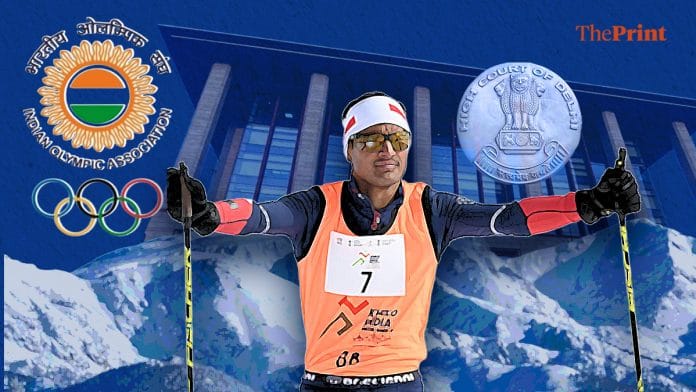



New Delhi: In a scathing rebuke of sporting bureaucracy, the Delhi High Court has ruled that administrative “whims and fancies” cannot be allowed to extinguish the career of elite athletes, ordering the Indian government to make every possible effort to send the nation’s top-ranked cross-country skier to the 2026 Winter Olympics.
Justice Jasmeet Singh delivered the judgment Friday, observing that the Indian Olympic Association (IOA) and its ad-hoc committee had systematically and illegally excluded Manjeet, the country’s premier skier, from the Milano Cortina 2026 to be held in Italy this month.
Manjeet had challenged the IOA-appointed ad hoc committee’s decision to forward Stanzin Lundup’s name for the event in the cross-country skiing category, submitting that he had been overlooked despite holding a superior place in the International Ski and Snowboard Federation (FIS) rankings.
The court characterised the IOA’s conduct as “casual, callous, arbitrary, (and) malafide… (that) shows disrespect to fair competition”.
“Athletes competing at international fora do not represent themselves alone; they represent our nation,” the court said, noting that the manner in which the association and its ad-hoc committee had conducted themselves “conveys an impression of institutional indifference to merit and excellence, as though mediocrity in international competition were an acceptable outcome”.
“Talent, no matter how exceptional, can only flourish when supported by transparent, fair, and accountable institutions. In global sporting events, it is not merely the athlete but the country itself that is under observation. The approach adopted in the present case, if allowed to stand, risks eroding public confidence in sports governance and tarnishing the credibility of India’s sporting institutions on the international stage. Such a consequence cannot be accepted,” it added.
Athlete’s plea
Manjeet, who has consistently won medals at the National Winter Games and Khelo India since 2021, approached the court as the top-ranked Indian athlete on the FIS list for 2025-2026.
His petition sought a writ of mandamus to compel the IOA and the ad-hoc committee to include him in this year’s Olympic contingent on the argument that his exclusion was a violation of his fundamental rights under Articles 14 and 21 of the Constitution.
Beyond mere inclusion, Manjeet’s counsels requested the court to quash the functioning of the ad-hoc committee, alleging it was “ex facie illegal (and) conflicted” as its constitution in 2023 was “not ratified by the Executive Committee of the IOA”.
Specifically, the petitioner revealed that two of the committee’s three members were actually active athletes who exercised control over the selection process. In effect “selecting themselves for international events” while leaving out more meritorious competitors like Manjeet, he told the court.
The core of the dispute involved the IOA’s insistence that Manjeet was ineligible as he did not participate in the March 2025 World Championships.
The IOA told the court that this specific race was a mandatory qualifying event and that because Manjeet was absent, he was left off the “long list” of potential candidates submitted to the Olympics organisers in September 2025.
However, the court found this to be a “fundamental misreading” of the FIS Qualification System.
Justice Singh noted that while Section D of the FIS rules governs how a country earns a quota, Section C, which governs individual athlete eligibility, is strictly points-based and contains no mandatory requirement of competing in the World Championships.
By ignoring Manjeet’s superior FIS points achieved during the full 18-month assessment window, the court said the IOA had wrongly acted as a “super selector”, creating arbitrary criteria that did not exist in the binding international framework.
Also, inclusion in the long list of potential candidates is a mandatory precondition for anti-doping oversight and integrity monitoring. The IOA told the court that by remaining outside of this long list, the petitioner did not go through “mandatory pre-competition safeguards, rendering any post facto inclusion incompatible with the Olympic Charter and the NOC Accreditation and Sport Entries Manual”.
Sports ministry stance
One of the most significant aspects of the judgment was the court’s expression of “displeasure” at the stance of the Ministry of Youth Affairs and Sports in the matter.
During the proceedings, the ministry tried to distance itself from the controversy, stating it had “no role in the selection criteria” and no direct communication with the Olympics federation.
This approach was rejected by the court, which asserted that the ministry, as a “repository of public trust”, cannot act as a “mute spectator” while an athlete’s “once-in-a-lifetime opportunity” is jeopardised.
Justice Singh reminded the ministry that it is “duty-bound to ensure that the selection process is fair, transparent, and merit-based”, and that it cannot ignore the hardships faced by athletes due to institutional failure.
While the technical deadline for athlete entries passed on 26 January, the court refused to let procedural timelines override substantive justice.
The court held that the selection process was “manifestly arbitrary and unfair” and thereby directed the sports ministry to “try and make all reasonable efforts” to ensure Manjeet is permitted to participate in the Winter Olympics, with the IOA ordered to provide full support.
The court has scheduled a follow-up hearing for 13 April to further adjudicate the legality and alleged conflicts of interest within the ad-hoc committee. For now, the ruling serves as a stern reminder that “talent… can only flourish when supported by transparent, fair, and accountable institutions”.
(Edited by Nida Fatima Siddiqui)
Also Read: How bringing OCI players back in the game could help Indian football find the net