





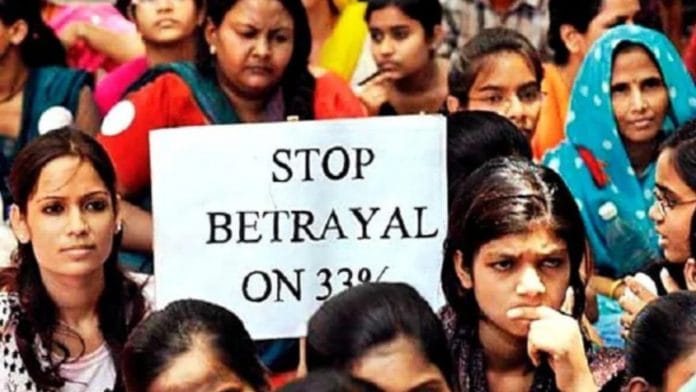



New Delhi: The Supreme Court issued notice to the Centre Monday, asking it to respond to a plea that sought the implementation of a law reserving one-third seats for women in the Lok Sabha, state assemblies and the Delhi Legislative Assembly.
A bench of Justices B.V. Nagarathna and Ujjal Bhuyan gave the government four weeks to respond to the petition first filed by Congress leader Jaya Thakur. It listed the matter for hearing on 13 April.
The case had been pending for a year. On Monday, Additional Solicitor General K.M. Nataraj asked for some more time for the Centre to respond. The court gave it four weeks.
The case dates back to 28 September 2023, when the Nari Shakti Vandan Adhiniyam received the President’s assent after a special session of Parliament. The bill sought to reserve 33 percent of all seats in the Lok Sabha, state legislatures, and the Legislative Assembly of the National Capital Territory of Delhi.
The bill also earmarked a quota for Scheduled Castes and Scheduled Tribes in the seats designated for women. However, the reservation was scheduled to come into force after the next Census and a delimitation exercise based on the Census results.
Although the law is in place, women’s representation is still contingent on the Census, which jeopardises the cause of women’s representation in politics, the lawyers argued.
Broadly, the plea sought to strike down a provision that makes the conduct of the Census and subsequent delimitation a prerequisite for implementing the reservation, arguing that the law should be rolled out immediately.
Jaya Thakur, who is the general secretary of Madhya Pradesh women’s wing of the Congress, initially filed the plea in 2023, urging the implementation of women’s reservations in Parliament ahead of the 2024 general elections. However, the top court refused to entertain the petition.
“Today, we argued in front of the court that more than 10 Vidhan Sabha elections are already over since the bill was passed in 2023. Moreover, the elections across states like West Bengal, Tamil Nadu, Assam and Pondicherry are also coming soon,” Advocate Varun Thakur, who appeared for the petitioners, told ThePrint.
Women in the judiciary
The women’s representation issue has also been raised in the judiciary.
On Sunday, while speaking at the first National Conference of Indian Women in Law themed ‘Half the Nation-Half the Bench’, organised in the Supreme Court, former Jammu & Kashmir High Court Chief Justice Gita Mittal said that of late, the Collegium responsible for recommending judges’ names for appointment has not been picking women judges.
Recalling a time when the Delhi HC Collegium appointed seven judges, yet not one was a woman, Justice Mittal said, “One of the collegium members said to me, ‘Don’t you think there are enough women?’ to which I answered back saying, ‘Don’t you think there are enough men?’”
Sitting Supreme Court judge Justice Ujjal Bhuyan, speaking at the Indian Women in Law conference at the Supreme Court, said, “During the tenure of CJI (Chandrachud) when I came to this court, 14 appointments were made to the SC, but none of these were women.”
According to the latest data from the Ministry of Law and Justice, India has 116 women judges working across high courts, out of the total working strength of 814 judges.
The data shared by the Law Ministry in the Lok Sabha last month also showed that 1,122 posts are sanctioned for high court judges in the country.
The Punjab and Haryana High Court fared best with 18 women judges, while states like Manipur, Tripura and Uttarakhand had no female judges at all.
According to the data, 170 women judges have been appointed to high courts since 2014, including 96 in the last five years, and 11 in the Supreme Court.
Currently, the Supreme Court has only one woman judge: Justice B.V. Nagarathna, who heard the present plea, and is next in line to become the CJI in 2027, after Justice Vikram Nath.
(Edited by Sugita Katyal)
Also Read: SC reconsiders 3-yr legal practice mandate for judicial office. What this will mean for women