





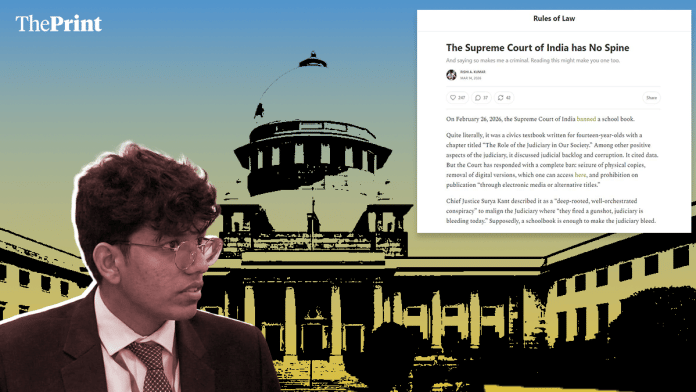



New Delhi: The Tamil Nadu National Law University has allegedly asked a final-year law student to remove a Substack post criticising the Supreme Court, citing the institution’s “reputation” and the “best interest” of the university and the student.
The move came in response to the 14 March post by the student, Rishi Kumar, in which he questioned the legality of the top court’s decision to ban an NCERT school textbook with a chapter referring to “corruption in the judiciary” and the blacklisting of three academics involved in drafting the chapter. The student has put up the university’s purported email on his Substack.
“The data on judicial corruption in India is not hard to find. It is literally everywhere. I made a four page list of such news reports in 10 minutes,” he wrote in his post, adding that the “apotheosis of judiciary has to stop”.
Kumar said he made it “unequivocally clear” that he would not comply with the email directing the “immediate takedown” of his personal Substack titled ‘The Supreme Court of India Has No Spine’, saying he was ready to face “disciplinary” action.
“Not now, not ever,” he said in an email to the university on Friday.
Kumar told ThePrint he was determined. “The University first approached me via email, to which I have responded. I am not inclined to approach them directly, go up to them and talk to them about this, particularly. But if they initiate disciplinary proceedings, I’m ready.”
Kumar, who got back to campus late Sunday night, said he wasn’t sure how the university would proceed.
“I’m not really sure if the university is willing to go forward with this, but you never know,” he said, adding that now people can approach him in person.
Issuing a show-cause notice to the secretary in the department of school education and the NCERT director on 26 February, CJI Surya Kant had said, “It seems to us that there is a calculated move to undermine the institutional authority and demean the dignity of the judiciary. This, if allowed to go unchecked, will erode the sanctity of judicial office in (the) estimation of the public at large and within impressionable minds of youth.”
In its response to ThePrint’s queries, Tamil Nadu National Law University said it “did not issue any directive or mandate requiring the student to take down the article”.
“The communication referred to by the student was in the nature of a request and advisory, made in good faith,” it added.
The university’s statement read: “This was necessitated in light of representations received from certain members of the legal fraternity who had expressed strong objections to the language employed in the article and had called upon the University to initiate action against the student. The university, however, categorically declined to take any punitive measures.”
It added that the university takes “pride in nurturing our students to be torchbearers of law, justice, and constitutional values”, and “does not, and will not, kowtow to the external pressures that seek to undermine these foundational principles”.
Also Read: NCERT textbook row: Priyanka Chaturvedi flags ‘judicial dictatorship’ in RS after SC bar on authors
‘Pressure from above’
In a fresh Substack post on 22 March, Kumar wrote: “Yesterday, my university administration wrote to me an email (read the email and my response here). They informed me that they have been receiving a ‘spate of phone calls from advocates of the Supreme Court and various High Courts as well as a few judges’ who were complaining about and criticising my article. He told me that the ‘reputation of the institution is at stake’.”
Set to graduate in May, the 22-year-old said he was surprised by judges in the country issuing what he called de facto “takedown” orders to students through their universities, simply because he criticised them.
Speaking to ThePrint, he said when the news of the top court banning the book first broke, he was talking to his friends during dinner and they wanted to write something on it.
“But of course, the pressure is always there. Because writing something, especially about the judiciary, is a very tough subject,” he said. “And we, especially as law students, know what can happen. Like, technically, we are taught about contempt laws. We know how thin the line is.”
Since the controversy erupted, Kumar has received both praise and criticism for his post. “Because there have been multiple instances earlier where the university has been pressured… on other issues where students have taken some chances,” he said.
He said the pushback was expected, but what was unexpected was judges calling about the post. “I understand that the pressure (on his university) is coming from very credible people. It’s not something that they can take on easily.”
The Substack posts
Kumar’s post was shared widely on X (formerly Twitter) and Substack.
Detailing the reasonable restrictions in the Constitution to the freedom of speech, he argued that “the Court is not ‘the State’ in this context, and ‘law’ under Article 19(2) cannot be equated with judicial orders or judgments. Therefore, such restrictions cannot be justified under 19(2)”.
Article 19(2) of the Indian Constitution empowers the State to impose “reasonable restrictions” on the freedom of speech and expression guaranteed under Article 19(1)(a).
“These past few days have told us more about the Supreme Court as an institution than the textbook ever could,” he wrote in the post. “It tells us that a chapter which mostly praises the judiciary, profiles a great judge, celebrates landmark judgements, and calls the court ‘the watchdog of democracy’ is nothing but a ‘deep-rooted conspiracy’. It tells us that quoting a former Chief Justice’s words on corruption is ‘deliberate misrepresentation’.”
He added: “It tells us that fundamental rights of three academics can be extinguished without any statutory or constitutional basis and without a full hearing. It tells us that critics can be listed and witch-hunted even from abroad. It tells us that the Court’s own free speech rulings apply to everyone except the Court.”
“How long will we wait before this Court remembers what it is? It is not a god. It is not a monarch. It is not beyond reproach or truth. And if we do not speak now, we must forever hold our peace.”
In a follow-up post updating readers on the email he received from the university, Kumar said his criticism of the judiciary wasn’t written lightly. “I have had the good fortune of working under some very remarkable judges. I do not write any of this lightly or with any pleasure. But an institution is not only its best people. It is also its worst impulses that is (are) left unchecked.”
“I want to be fair to my university. They are supposed to be a line of defence for their students. They did not do that job,” he added.
At the same time, he acknowledged the extent of the pressure on the university.
“But these are not anonymous internet trolls. These are judges and advocates of the Supreme Court and High Courts exerting real and credible institutional pressure. One cannot just ignore it,” he added.
Kumar also wrote about what he described as “the structural problem” in the system. He said most NLUs, including his, had a sitting High Court or Supreme Court judge as a nominal Chancellor.
“The very people who are being criticized and pressuring us are already embedded into our own institutional structure. I am not at all saying these are the people who did this. But the structure itself has a problem. How can the university be expected to push back effectively? They are quite literally the same groups of people acting in two different capacities,” he wrote.
Kumar also urged those who had stayed quiet to think about the reasons for their silence.
“I know the fear of this kind of pressure is real. But consider who that silence is serving. It is not serving you. It is serving exactly the people who need you to stay quiet,” he wrote.
At the end, Kumar reiterated that he would not remove his post. “I will not take my article down. I stand by every single word of that,” he wrote.
This report has been updated to incorporate a response from Tamil Nadu National Law University.
(Edited by Sugita Katyal)
Also Read: Supreme Court’s NCERT textbook order punishes the messenger, doesn’t answer the message