





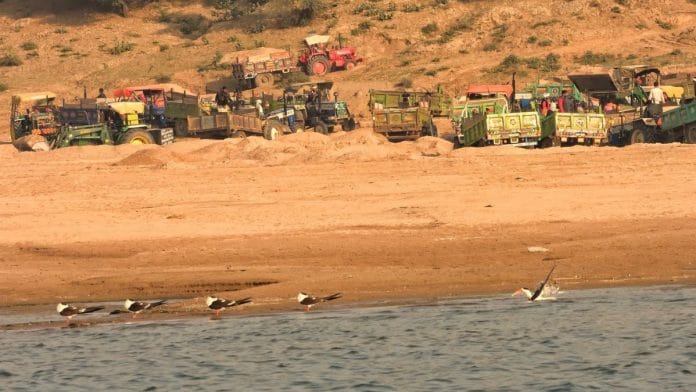



New Delhi: In the Chambal riverbed spanning Madhya Pradesh, Rajasthan, and Uttar Pradesh, the lack of effective inter-departmental and inter-state coordination, along with the states’ denotification of forest areas without the top court’s permission, has resulted in rampant illegal sand mining.
Highlighting these reasons as leading to the severe degradation of Chambal’s fragile riverine ecosystem, the Supreme Court-appointed Central Empowered Committee has suggested that the court immediately prohibit all forms of mining, extraction, transportation, and storage of sand in the National Chambal Wildlife Sanctuary and its eco-sensitive zone. The panel assists the court in environmental cases.
On Thursday, the panel placed its report before the SC bench led by Vikram Nath, which has been hearing a matter related to unauthorised mining in the region’s protected forest area.
Hearing the matter, the judge, in suo motu proceedings, stayed the Rajasthan government’s December 2025 notification, which sought to de-notify 732 hectares of sanctuary land for boundary rationalisation. The court issued the order after being informed that the state notification was in breach of its November 2000 order that sought a blanket ban on the de-reservation of forests, sanctuaries, and national parks.
Senior advocate Nikhil Goel, who is assisting the court as an amicus curiae, called for the SC to seek states’ inputs on the economic impact of a complete ban on mining in the region, if such a ban is established.
On Thursday, the bench directed that Madhya Pradesh, Rajasthan, Uttar Pradesh, and the central ministry of environment and forests respond to Goel’s report, which suggested the preparation and implementation of a time-bound Chambal Fringe Community Rehabilitation and Sustainable Livelihood Plan. Under the plan, locals are to be trained in eco-tourism and fisheries enhancement outside the riverbed, as well as handicrafts linked to sanctuary branding.
The 4 aspects of illegal mining
The CEC report broadly observed four principal aspects related to illegal mining.
It pointed out that despite a 14-year-old central coordination committee tasked with developing a mechanism between the three states—MP, Rajasthan and UP—to protect Chambal, there has been no effective management of the sanctuary.
The committee’s constitution recognised the importance of a coordinated management of the sanctuary. Yet—the report submitted—the continued incidence of illegal mining implied that the intended coordination to enforce mechanisms had not been effectively implemented on the ground.
Despite Chambal being a protected sanctuary, illegal mining had continued due to the failure of regulatory authorities’ inter-state efforts. This, in turn, enabled the illegal operators to exploit jurisdictional gaps, particularly along the boundaries.
The CEC highlighted that Madhya Pradesh and Rajasthan had issued de-reservation orders in violation of the SC’s November 2000 order. While MP withdrew its notification in 2023, Rajasthan confirmed it in December last year, without seeking the court’s approval. This prompted the CEC to request the top court to put the state notifications on hold.
During discussions with state officials, when CEC members enquired about the basis of the notifications, they were informed that the 2000 order was no longer in force, as it had been superseded by a subsequent top court order. However, the CEC said that it could not trace any such order.
The CEC’s report highlighted an important aspect of the Chambal wildlife area: the lack of clarity regarding the total area falling within this zone. While a 1978 notification by the Madhya Pradesh government mentioned the area to be nearly 3,582 square kilometres, the eco-sensitive zone (ESZ) notification furnished by state authorities to CEC stated that it was 435 sq km. A similar discrepancy, requiring clarity, was noted in the records of the Rajasthan government, the CEC told the top court.
Regarding the ESZ notification, the CEC expressed concerns that such an area had not been identified in Rajasthan. Meanwhile, in both MP and UP, it was the central government that had issued the notification.
In the absence of ESZ, the protected area was directly exposed to unregulated development and extractive activities that may adversely affect wildlife habitats, ecological processes, and the overall integrity of the sanctuary, the CEC pointed out.
(Edited by Madhurita Goswami)
Also Read: What makes Malkhan Singh, ex-dacoit & Congress star campaigner in MP’s Chambal-Gwalior