





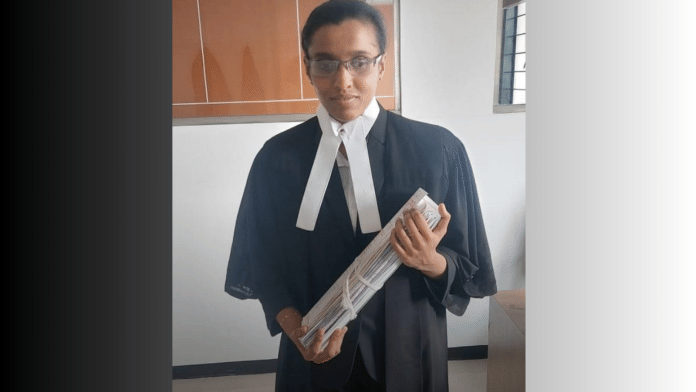



Thiruvananthapuram: Thanya Nathan wanted to pursue law for two reasons. She felt it was a unique path, as visually impaired persons are usually seen to prefer art studies, and she wasn’t interested in it. The second reason was to study law and serve the community.
“Knowing law is an advantage for an oppressed and marginalised community to establish rights,” Thanya told ThePrint Tuesday.
Now, within two years of graduating in law, the 24-year-old is set to become Kerala’s first visually impaired judge, after securing first rank in the Kerala Judicial Service Examination for civil judge (junior division) in the category of persons with disabilities.
“I feel great. Being first is irreplaceable. It’s really nice. I want to do the best I can. Especially, I want to bring some changes for persons with disabilities,” she said, adding that she is ready for the challenges ahead and is hoping for systemic support on her journey.
“I know it will not be easy because our system is not used to it. So, it doesn’t know. But I am hoping that the government will provide the necessary facilities. The advantage is that there are paperless courts and judges are using voice typing. There itself, there is a level playing field. So, we do the same as visually-abled judges. It was all introduced around the same time. I feel like it’s a miracle,” she told ThePrint.
Hailing from a middle-class family in Kannur, with her father working in Oman, the 24-year-old studied at a special school until Class VII before moving to regular schools in the district.
Later, Thanya joined Kannur University for LLB studies, topping her class and graduating with first rank in 2024. Besides studies, she enjoys music and movies.
After graduating, she enrolled as an advocate and practised civil and criminal law in Taliparamba, Kannur, as a junior under senior lawyer K. G. Sunilkumar.
She said she started dreaming of becoming a judge soon after she enrolled as a lawyer, but it felt like a distant certainty.
“As visually challenged people weren’t allowed to write judicial service exams till 2025, it was like a dream beyond reach as the system itself did not allow us,” she said, adding that she prepared her notes in Braille to present in court as digital devices are not allowed inside courtrooms.
In March 2025, the Supreme Court delivered a landmark judgment which held that visual impairment cannot be grounds to deny a person the opportunity to participate in judicial service exams, allowing Thanya to pursue her dream.
Alongside her work, she started preparing for the judge exam and wrote it with the help of a scribe, a person who read the questions while Thanya dictated her answers.
She said even choosing to become a lawyer was nerve-racking in a system not used to lawyers with visual impairment. But, she added, she received strong support from her colleagues, and judicial officers provided her with a comfortable environment.
However, the system should not merely adjust to accommodate persons with disabilities, but should be equipped to utilise their talents, she told ThePrint.
“There is usually a concept that visual ability is important to decide a case. People have said that to me as well. But the Supreme Court and high court felt that this is exactly why they are giving us this post,” Thanya asserted.
(Edited by Nida Fatima Siddiqui)