





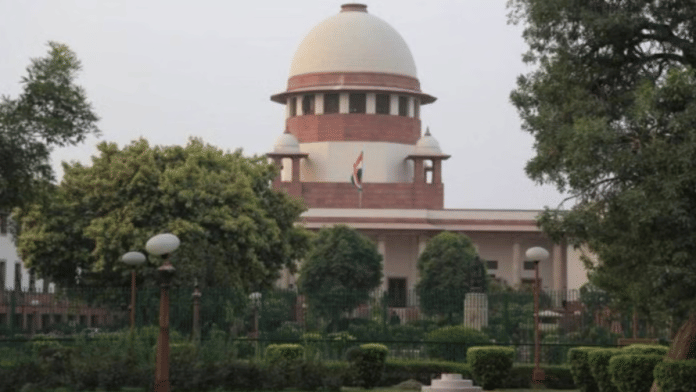



New Delhi: A month after he took over as the Chief Justice of India (CJI), Justice Surya Kant has ushered in administrative reforms in the Supreme Court to bring more transparency and procedural certainty in listing and hearing of cases, issues that have always kept the top court under scrutiny.
On Monday, the Supreme Court released two circulars, one of which prioritises listing of cases related to persons with disabilities (PwDs), senior citizens above 80, persons below poverty line, and acid attack victims, separately, in order to prioritise their hearings.
The other important circular fixes timelines for oral arguments, while mandating that these timelines should be intimated to the court at least a day prior to the commencement of the hearing of the case.
Pragya Baghel, Secretary, Supreme Court Bar Association (SCBA), told ThePrint, “This is a welcome move aimed at better court management and timely disposal of cases. I sincerely hope it is followed uniformly across all matters, so that the intended objective is achieved in a fair and effective manner.”
Advocate Rahul Bajaj, who co-founded the disability rights nonprofit organisation Mission Accessibility welcomed the Supreme Court’s administrative order on listing of cases.
“We had written to the Chief Justice of India about this in December, on two different occasions and are happy to see this being reflected in today’s circular. After important matters like bail and new cases are taken up on Mondays and Fridays, the disability rights cases will be taken up right after them,” he told ThePrint.
Bajaj also said that this is the first time in 75 years that such a thing has happened, and it will help ensure that these cases are given more time and attention than before.
Arguing counsel Nipun Saxena also told ThePrint that the oral arguments circular is a welcome one as other countries like the United States have a federal court, where specific time is allotted for oral submissions.
“In India, however, you have a very polyvocal court, where there are 16-17 different benches. Suppose in each case, multiple intervention applications are filed. When 20-30 intervening applications are filed in a case, how much time will each intervenor get?” he asked.
Underlining that a fixed timeline for oral arguments means they will not become repetitive, and majority of the time is not taken up by one speaker, Saxena said, “If it can be implemented uniformly, it can be a step further in cases which take an inordinate amount of time like constitutional matters, or cases where benches have differing views. For instance, the presidential reference case hearings went on for 10-15 days. The question is, was it necessary?”
“Prolonged arguments result in lengthy and verbose judgments but if you look at SC judgments from the 1950s or 60s, you will notice they would never exceed 5-7 pages,” Saxena told ThePrint, adding that the more time is spent on arguments, the more the number of pages in the judgment.
“Hopefully, the principle will apply to all AoRs and non-senior advocates too,” Saxena said, adding that often, judges are prone to indulging the senior counsel. “Not applying these circulars in a uniform way would be more detrimental than beneficial,” he said.
How cases will be heard in SC now
On 29 December, the SC released a notification which said that in order to maintain uniformity in listing of cases, CJI Surya Kant has directed that the causelist on miscellaneous days, that is, Mondays and Fridays, will be published to prioritise matters in the given order.
On top of the list will be early hearing applications in admitted matters, followed by fresh matters. Interestingly, at the third spot, in order of priority, will come bail hearings, which means that the CJI has prioritised personal liberty. This will be followed by post-notice ad-interim stay matters, freshly adjourned matters, and settlement cases—in that order.
Ranked seventh in order of priority are cases relating to PwDs and acid attack victims, followed by those of senior citizens aged 80 and above. Subsequently, cases concerning citizens below the poverty line will be taken up, after which legal aid matters, transfer pleas, orders, Public Interest Litigation or PILs will be taken up—in that order. Finally, the circular mentions part-heard, post-notice matters, and matters listed for direction—in that order.
“Accordingly, members of the Bar, parties-in-person and all stakeholders are required to invariably mention the relevant head, among these four newly introduced” ones, under which the matter actually falls, in all fresh petitions being filed with the Registry.
What are the timelines for oral arguments
The other circular issued by the SC said that in order “to facilitate effective court management” and equitable distribution of the top court’s working hours, along with the proper administration of justice, a standard operating procedure or SOP will be devised for sticking to the timelines for submission of oral arguments.
The circular, which comes into effect immediately, specifies that senior advocates, arguing counsel, and AoRs will submit timelines for making oral arguments “in all post-notice and regular hearing matters”, at least a day prior to beginning the hearing of a case. Such timelines need to be submitted to the SC through an online portal, where advocates submit appearance slips, it adds.
In case any written submissions need to be filed, the arguing counsel and senior advocates are to file their brief notes, through the concerned AoRs or nodal counsel. Such notes must be limited to five pages or less, the circular said, while adding that the other side must also be given a copy of the note, at least three days before the hearing.
“All counsel shall strictly adhere to the timelines fixed and conclude their oral arguments,” the circular said.
Advocate Kartik Seth also hailed these circulars as a “clear move towards discipline, fairness, and merit-based advocacy”.
“Fixing timelines for oral arguments, supported by brief written submissions, is a long-overdue reform. It ensures that preparation and clarity—not seniority or face value—determine how court time is utilised. This will organically place the younger Bar on a more equal footing and encourage serious preparation, without undermining the role of seniors,” Seth told ThePrint.
(Edited by Viny Mishra)
Also read: A Supreme Court order opens up district judge posts to young talent. What are the implications