





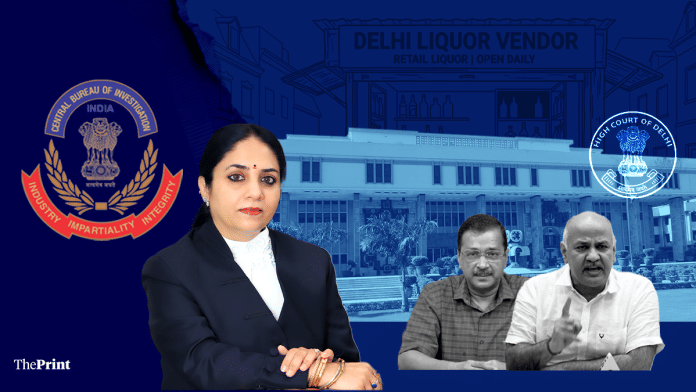



New Delhi: The Delhi High Court listing of 9 March for the CBI’s appeal against the discharge of Aam Aadmi Party leaders Arvind Kejriwal, Manish Sisodia and others in the Delhi excise policy case brings the court of Justice Swarana Kanta Sharma back in the spotlight. Justice Sharma has delivered significant verdicts relating to AAP leaders and others in the same case.
The central agency’s appeal challenges a 598-page discharge order delivered last Friday by Special CBI Judge Jitendra Singh at the Rouse Avenue Courts. Holding that the case has “no material whatsoever”, the special judge discharged Kejriwal and 22 others. The trial court pulled the case from going to trial, criticising the “manner in which the investigating agency has proceeded, by repeatedly recording the statements of the approver without justification and over a prolonged duration”.
“If left unchecked, such conduct risks converting the exceptional mechanism of pardon into an instrument for narrative construction rather than truth discovery, thereby causing serious prejudice to the accused and eroding confidence in the criminal justice process,” Judge Singh said in his order.
Within minutes, the CBI announced it would file an appeal. In its revision petition before the high court, the agency has argued that the order was passed “on a selective reading of the prosecution case, disregarding the material showing the culpability of the accused”.
It says the discharge order is “patently illegal, perverse and suffers from apparent errors. Not only does it fail to appreciate the facts of the case in its correct perspective, such failure on the part of the Ld. Special Judge has further led to passing of adverse remarks against the investigating agency, as well as the investigating officer, all of which are unwarranted and incomprehensible, to say the least.”
Being the only judge on the latest roster handling criminal cases relating to sitting/former MPs/MLAs, as per Delhi High Court’s website, Justice Sharma’s prior rulings in the same case when Kejriwal and Sisodia approached the court have drawn attention for their detailed engagement with investigative powers under the Prevention of Money Laundering Act (PMLA) and the threshold for bail.
Also Read: Kavitha, Vijay Nair & others: CBI couldn’t establish ‘money trail’ in Delhi excise policy case
April 2024: Kejriwal’s arrest upheld
In April 2024, the Delhi High Court rejected Kejriwal’s plea challenging his arrest by the ED, and held that his arrest was valid.
It noted that Kejriwal’s “conduct… of not joining investigation left little option with the Directorate of Enforcement other than his arrest for the purpose of investigation of a pending case, in which other co-accused are in judicial custody, and the investigating agency is also running against time in view of the order of the Hon’ble Supreme Court vide which it was ordered that the trial in this case should proceed expeditiously.”
Kejriwal had challenged his arrest on the ground that it violated Section 19 of the Prevention of Money Laundering Act (PMLA)—which lays down procedural safeguards for executing an arrest—and sought a declaration that the arrest order and subsequent proceedings were illegal, arbitrary and unconstitutional.
In a 106-page order, Justice Sharma observed that “this court would not lay down two different categories of laws, one for common citizens, and the other granting special privilege to be extended by investigating agency to a chief minister or any other person in power only on the basis of being in that public office since that public office is enjoyed by that public figure due to the mandate of the public”.
She noted that despite service of nine summons over six months, Kejriwal had failed to appear for recording of his statement or to be confronted with the material collected during investigation. Therefore, the investigating agency had no option but to seek his custody through remand to make him join the investigation and answer questions.
On Kejriwal’s argument that replying to summons amounted to cooperation, the court had said: “Replying to summons is not equivalent to joining investigation under PMLA as there is no procedure prescribed that replying to a summon will suffice joining an investigation or any other proceeding as contemplated under PMLA.”
Further, the replies “were counter-questioning the investigating agency about its intent and authority to summon him to join investigation of a pending case, which could not have been done by way of a reply but only through the order of a court of law”.
The court said that Kejriwal’s contention was “bound to be rejected since the investigating agencies, under the Indian Criminal Jurisprudence, cannot be directed to conduct investigation in accordance with convenience or dictates of a person”.
It added: “The investigation has to take its own course, and if the investigating agency would be directed to visit the house of every such person for the purpose of investigation, in that case the very purpose of investigation would be lost and would end in chaos.”
On the timing of the arrest ahead of the 2024 elections, the court held: “In case this argument is accepted, it would amount to accepting that in case a person delays presenting himself before the investigating agency, he can take advantage of the same and later take a plea of mala fides since the time when the investigating agency arrests him does not suit him either personally or professionally.”
The court also said that Kejriwal neither challenged the summons issued to him nor did he join the investigation since October 2023.
May 2024: Sisodia fails to clear bail threshold
In May 2024, the Delhi High Court declined to grant bail to Manish Sisodia in the same case. This was the second time Sisodia had approached the high court for bail in the CBI and ED case. Justice Dinesh Sharma in 2023 rejected his bail pleas in both the cases.
Sisodia had moved two bail applications—one in the CBI case and another in the ED case. Prior to this, the Supreme Court, in its common judgment of October 2023 in Manish Sisodia vs CBI, had dismissed his Special Leave Petitions. His review and curative petitions were also dismissed, with liberty to apply afresh if circumstances changed or trial was delayed.
Justice Sharma held that he “also fails to cross the bar and rigours of Section 45 of PMLA as this court cannot arrive at a conclusion that Manish Sisodia is prima facie not guilty of offence alleged against him on the basis of the material placed before this court”.
The court recorded that, as alleged by the prosecution, Sisodia had prima facie indulged in destruction of crucial evidence, including electronic evidence. It noted that he had failed to produce two mobile phones used prior to initiation of investigation, claiming they were damaged and their whereabouts unknown.
“In this court’s opinion, this deceptive act was a calculated move to create an illusion that the excise policy was formed after careful consideration of feedback received from the public. But in reality, the feedback was manufactured to justify the applicant’s predetermined decision to formulate the excise policy, in defiance of the Expert Committee Report, to enrich a few individuals in exchange for kickbacks.”
The court further observed: “Non-recovery of any amount of money in cash cannot be prima facie proof that no corruption has taken place since the offender’s mind uses the new technology to commit offences without leaving traces of commission of offences.”
Referring to the Supreme Court’s earlier denial of bail, the high court noted that the ED had assured the apex court on appropriate steps to conclude trial within six to eight months. “…Corruption is a menace which when committed while holding a public office eats the very crop that it has to guard,” Justice Sharma had said.
Others in the same case
The Delhi High Court in February 2024 denied bail to AAP leader Sanjay Singh accused in the same case. This was after the trial court denied him bail, saying the case against him was “genuine”. Again, a bench of Justice Swarna Kanta Sharma denied bail, noting that the allegations were serious and no case of bail was made out at that time. She also urged the trial to be expedited again in this case.
In July 2024, Justice Sharma denied bail to BRS leader K. Kavitha, another accused and the lone woman in the same case.
The Delhi High Court bench of Justice Sharma denied bail to businessman Amandeep Singh Dhall in June 2024 noting that the allegations against him in this case were serious and their impact on society at large need to be in consideration.
(Edited by Nardeep Dahiya)
Also Read: How CBI case against Kejriwal, Sisodia unravelled. ‘Failed to establish even policy manipulation’
An interesting article. But it would surely be more complete if you had her judgements regarding BJP members. As in the case of Bela Trivedi, who showed a pronounced bias for the Government.